
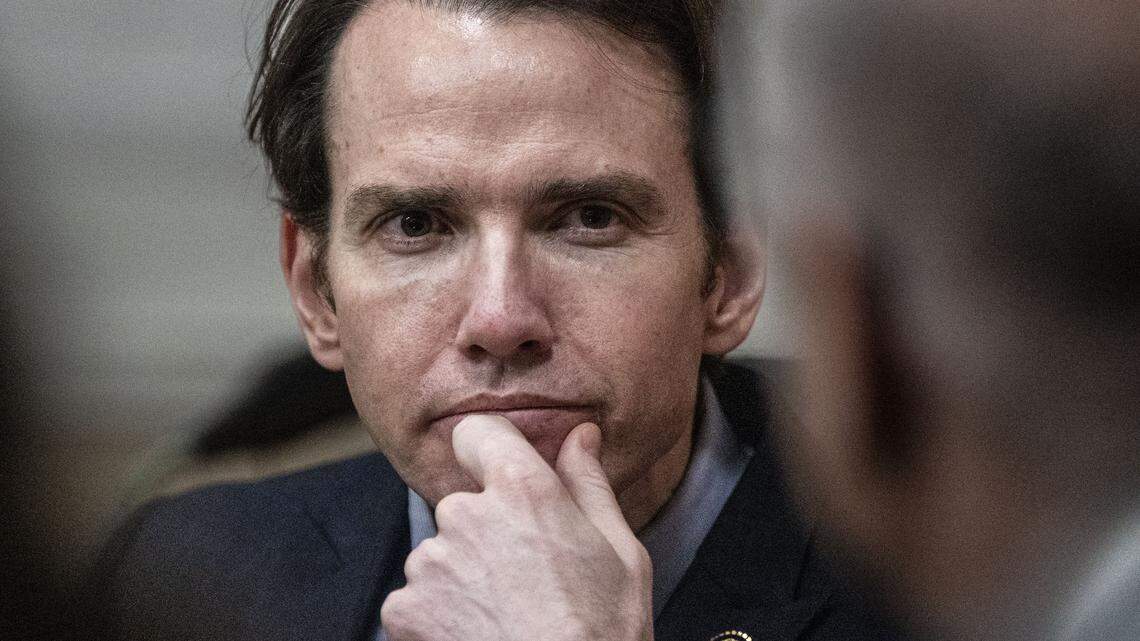
Rep. Kevin Kiley, R-Rocklin, speaks during a Sacramento Bee town hall meeting at the historic Loomis Train Depot in Placer County on Tuesday, Feb. 17, 2026.
HECTOR AMEZCUA
hamezcua@sacbee.com
Rep. Kevin Kiley is betting that a change of party registration from Republican to No Party Preference will win him favor with Democrats and independents, a population he’ll need to get elected in a redrawn congressional district that now leans left.
Kiley’s challenge will be that his conservative voting record (and a resume that includes the vigorous endorsement of President Donald Trump) will no longer be a strength — and very likely could be a liability.
When California voters passed Proposition 50 last year, state congressional districts were altered to benefit Democrats and Kiley’s “safe” 3rd District was carved up, making him a political orphan.
Now running in the newly drawn 6th Congressional District, Kiley has gone from favorite to underdog; from facing longshot challengers, to big name Democrats; and from voters who appreciate his record to those who will be skeptical at best — and hostile at worst.
Starting in January, the 6th District will cover Rocklin, Roseville, Citrus Heights, the city of West Sacramento and a large part of northern and eastern Sacramento. The race is crowded with successful Democrats, including Sacramento District Attorney Thien Ho; former Sen. Richard Pan; West Sacramento Mayor Martha Guerrero; and reproductive rights advocate Lauren Babb Tomlinson, among others.
How Kiley will do remains to be seen. What is certain is that Democrats in the new 6th District will remember Kiley’s previous votes on these three top-of-mind issues — and they may have a hard time forgiving and forgetting:
Kiley on abortion
Kiley has long been a vocal opponent of abortion rights, and a staunch pro-life supporter, but 84% of Democrats and Democratic leaners in California say abortion should be legal in all or most cases, according to the Pew Research Center.
Last year, Kiley voted “yea” for the “Born-Alive Abortion Survivors Protection Act” which required hospital transportation and medical care for aborted fetuses, and criminalized medical professionals’ failure to comply.
In 2024, Kiley voted against Proposition 1, which enshrined reproductive freedom in the California Constitution. He has been rated the highest possible score by the California Pro-Life Council, and the lowest possible scores by Planned Parenthood and NARAL Pro-Choice California.
Also in 2024, Kiley voted in favor of the Van Duyne Amendment, which blocked veterans and service members from accessing abortion services, and voted for an amendment prohibiting the Department of Defense from covering abortion-related travel or services for service members.
Kiley on Medicare
Kiley drew heat from some of his constituents in the 3rd District last year, when he voted in favor of President Donald Trump’s “Big Beautiful Bill.” The legislation created significant reductions to Medicaid funding while increasing funding for immigration enforcement and border security, and hundreds of Kiley’s constituents held massive protests outside his Rocklin office expressing their concerns but were generally ignored by the congressman and his staff.
Medicaid — called Medi-Cal in California — is a public health insurance program for low-income communities. In early 2024, California expanded the state’s Medi-Cal benefits to all undocumented immigrants, increasing services for about 750,000 adults overall, funding that has since been cut. In response, Kiley introduced the “No Medicaid for Illegal Immigrants Act” the following year, which prohibits state Medicaid programs from covering immigrants without legal residence in the U.S.
According to the Public Policy Institute of California, seven in 10 California voters oppose the federal cuts to Medicaid.
Kiley on climate
Kiley has criticized aggressive climate policies, including California mandates to transition to zero-emission vehicles and tighter emissions regulations, and California’s goal for 100% clean electricity by 2045, which may be essential for combating climate change.
In 2025, Kiley voted for the “Protecting American Energy Production Act,” which blocked a presidential ban on fracking, and recently initiated efforts to limit the California Coastal Commission’s authority, arguing that the state’s environmental review process could delay projects related to national security.
A new poll by the Sacramento-based group, California Environmental Voters finds that 68% of voters support increasing California’s investment in clean energy sources, and 70% of voters want California to lead on environmental protection, even without the federal government’s support.
Kiley’s move away from the Republican Party in this election cycle has been met with no shortage of experts who are down on his chances.
“Some people have said ‘How would (Kiley) win otherwise?’” said California political data consultant, Paul Mitchell. “But if he does this, (Kiley) also doesn’t have a future in the Republican Party. He’s trying to do this magic trick and I don’t think voters are going to go for it.”
So: Can Kiley win?
“People don’t approach it from the perspective of, ‘What party are you?’ They approach it from the perspective of, ‘OK, how do we come together to solve problems?’” Kiley told NPR’s Morning Edition last week.
Stranger things have happened, but in California, lacking an R or a D next to your name on a ballot has usually meant a tough election night for the candidate. In the end, Kiley voted the way he voted before Prop. 50 upended his political fortunes.
This story was originally published March 18, 2026 at 5:00 AM.
Related Stories from Sacramento Bee
Robin Epley is an opinion writer for The Sacramento Bee, with a focus on Sacramento County politics. She was born and raised in Sacramento, was a member of the Chico Enterprise-Record’s Pulitzer Prize-finalist team for coverage of the Camp Fire, and is a graduate of Chico State.