
Clovis Unified School District did not see a significant increase in absences last month due to a student walkout, data shows.
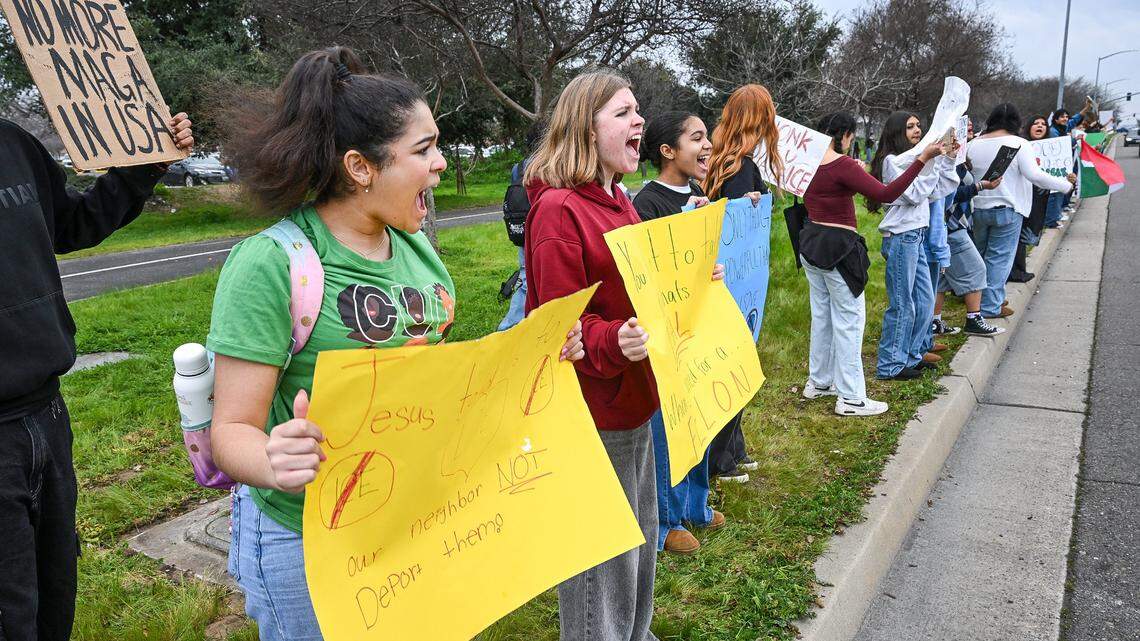
In response to the Jan. 30 national strike protesting the killings of Renee Nicole Good and Alex Pretti by federal agents in Minneapolis, some Clovis Unified students organized a protest on Feb. 10 at the intersection of Clovis and Shaw avenues. The march included students from Clovis High, Clovis East High and Clark Intermediate School.
The walkout marked the first large-scale student protest in Clovis Unified in recent years. A school district known for its rigorous standards, Clovis Unified has rarely seen student activism compared to neighboring districts.
Absenteeism data acquired by The Fresno Bee, per California’s Public Records Act, shows that on Feb. 10, Clovis Unified recorded 642 unexcused absences, including 211 high school students and 87 intermediate students.
By comparison, the school district had 707 unexcused absences on Feb. 17, a regular school day after the President’s Day long weekend, including 127 high school students and 93 intermediate students.
The figures represent the total number of students who missed classes on the school day, such as vacation, family matters, missing the bus or simply not notifying the school. Clovis Unified does not have data confirming whether students skipped school to participate in the protest.
There were also 25 students across the district marked as excused absence on Feb. 10, according to Clovis Unified, meaning a parent or guardian submitted a note stating a valid reason for the student to be excused from school per the district’s policy.
A state law, Senate Bill 955, allows middle and high school students to be excused from school for one day per school year for civic or political events if they submit notices in advance.
Clovis Unified declined The Bee’s request for how many students submitted civic or political event notes in advance, saying the data is exempt from disclosure for privacy reasons per federal and state laws.
Very few students followed the district’s required process to check out of school on Feb. 10, according to a joint news release issued a day after the walkout from the Clovis Police Department and Clovis Unified.
In the same news release, the police department announced it would pursue misdemeanor charges against adults who attended the student walkout, saying officers observed adults “actively encouraging, organizing, and facilitating students leaving school without authorization.”
The police department used a network of 500 city surveillance cameras and its Camera-On-Wheels vehicle to record the protest. The department had identified two adults at the protest and was reviewing footage to identify other adults involved to recommend charges against them for allegedly contributing to the delinquency of a minor, the police said in early February.
As of mid-March, police have not recommended charges against the parents and community members who attended the student walkout.
“I spoke to the officer who has this case and was told that he is almost done with his investigation,” said Ty Wood, spokesperson for the police department.
In California, the state funding for local school districts is calculated based on the average daily attendance (ADA), meaning the actual number of students showing up in the classrooms. At Clovis Unified, it costs the district $83 per unexcused absence per day. For high school students, the figure rises to $99.
The consequence for students who leave school without permission or the district’s proper check-out procedures is a Saturday detention, said Kelly Avants, spokesperson for Clovis Unified.
“I don’t believe we have existing records that pool the number of students who got Saturday school specifically related to not properly checking out of school on the 10th,” Avants said.
Related Stories from Fresno Bee
The Fresno Bee
Leqi Zhong is the Clovis accountability/enterprise reporter for The Bee. She is a graduate of UC Berkeley with a Master’s degree in journalism. She joined The Bee in 2023 as an education reporter. Leqi grew up in China and is native in Cantonese and Mandarin.