

ANAHEIM, Calif. — Jamie Drysdale had two options when facing a developing — and slightly terrifying — situation during a Philadelphia Flyers game in Minnesota earlier this month.
He could give ultra-dangerous Wild forward Kirill Kaprizov, the league’s highest-paid player next season, room to drive the puck down low, which is where Kaprizov’s momentum seemed to be taking him. Drysdale could shadow Kaprizov, but he would do it from a safe distance, giving Kaprizov the respect he deserves as one of the NHL’s best play-making wingers.
Or, he could be aggressive.
Drysdale chose the second option.
The Flyers defenseman closed the gap. He harassed Kaprizov with a stick check. Kaprizov, realizing that he couldn’t advance to his preferred position in the corner with Drysdale in his way, slammed on the brakes and pivoted toward open ice at the point. Drysdale, arm extended towards Kaprizov’s numbers, stayed on top of him — and gave Kaprizov an authoritative forearm thrust from behind, sending Kaprizov, and the puck, out of the Flyers’ defensive zone.
It was a risky maneuver. Kaprizov could have potentially spun off of Drysdale before unleashing a shot on net or finding an open teammate for a prime scoring chance. Drysdale could have ended up on the unfortunate side of the NHL highlights that evening.
BEAT OUR EXPERTS
Predict how you think the tournament will
play out. Can you beat one of our experts?
Instead, the sequence served as a vivid representation of where Drysdale’s game is now. Known primarily as an offensive defenseman when he was drafted by the Anaheim Ducks sixth overall in 2020, Drysdale has become arguably the Flyers’ top two-way blueliner, with an enhanced ability to defend combined with an improving offensive game.
Drysdale spoke about having the temerity to make that sort of play on Kaprizov.
“I think it’s just having the comfortability to play that aggressive, and be confident that you’re not going to get beat,” Drysdale said. “I think (it was) just being aggressive, just trusting my feet, trusting my position.”
Said coach Rick Tocchet: “Being able to go against those type of players — he’s got the good feet where he can do that sort of stuff.”
Staying healthy has been vital for Drysdale, who missed just three games this season. The 23-year-old had missed significant chunks of time previously, including a month early last season with an upper body injury, and more than a month late in the 2023-24 season with a sports hernia that required offseason surgery.
But Drysdale has spoken in the past about how the mental part of the game is something that he’s had persistent trouble with, too. Sitting in the visitors dressing room at Honda Center (the building in which he began his NHL career) after practice the day before Wednesday night’s 3-2 overtime win over the Ducks, Drysdale opened up about how some of the early, less prosperous parts of his game from back then stayed with him in an unfortunate way.
He wasn’t in much of a mood to reminisce when asked whether he thinks about the steps he’s taken since breaking into the league.
“To be honest, I obsessed with those X-amount of years as not ideal for me, just how I go about it in my head,” he said. “There’s things that I’ve gone through, drew on and whatnot. … I think this year predominantly for me is, this is who I am, we’re going to grow from here, learn what we can from the last handful of years, but just try to look forward and not think too much about it.”
That sort of introspection lends credence to what Flyers general manager Daniel Briere and former coach John Tortorella had previously indicated about Drysdale: that he was rushed into the league, which likely stunted his development.
Drysdale termed his first season-and-a-half with the Flyers as “rough,” which may be overstating it, but does reflect some of his consistency and injury issues. He added that there were too many times after his arrival in Philadelphia as part of the Cutter Gauthier trade on Jan. 8, 2024, when he was lost in his thoughts.
That had to change. So, he altered his approach over the summer.
“Coming into this year, I had a mindset,” Drysdale said. “The big thing was just changing my attitude towards the game, just from training camp and throughout the summer. I feel like last year I was almost playing timid, and not confident at all.”
How does one change his attitude ahead of his sixth NHL season? Drysdale acknowledged that he worked with both team-issued and independent mental coaches.
“It’s working on it both on and off the ice,” Drysdale continued. “Discussing things with people. Becoming more mentally strong. That side of the game I think has been probably the biggest difference for me, from what I’ve noticed. Getting your mind right, your thoughts right.”
When Tocchet and the Flyers coaching staff — including Todd Reirden, who oversees the defense — got their hands on Drysdale, they didn’t want him to focus too much on the scoresheet. Instead, they pushed him to first become a solid five-on-five defender.
Whether Tocchet and Reirden knew about Drysdale’s ongoing confidence issues isn’t certain, but Drysdale has appreciated the way the two coaches with whom he interacts the most have handled him from the outset of their relationship.
“They’ve been awesome,” Drysdale said. “Literally since Day 1, it was kind of, for lack of a better word, a blind confidence, and encouragement, also — two things that I’ve kind of leaned on.”
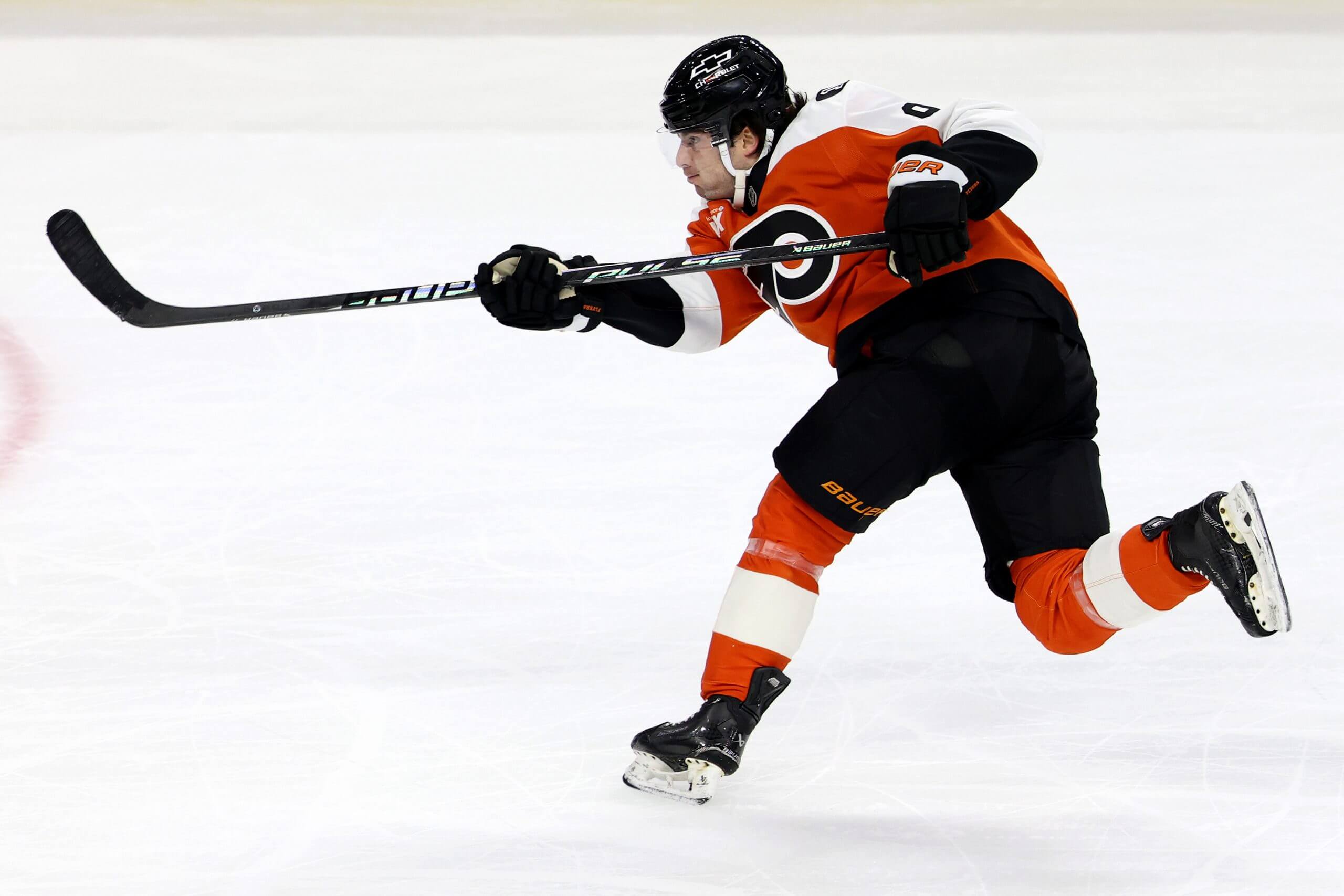
Since the beginning of February, Drysdale has two goals and four assists in 13 games for the light-scoring Flyers. (Emilee Chinn / Getty Images)
On the ice, the message was clear what the coaches wanted from Drysdale: button up defensively and squash plays as much as possible, relying primarily on his elite skating ability. It’s the way Tocchet has always preferred his teams defend.
“We didn’t want to push the envelope offensively,” Tocchet said. “I think we wanted to get a foundational thing. That’s a big thing for me. And now he’s starting to get some points, but I think the foundation was set with his five-on-five play.”
Nick Seeler, a frequent partner of Drysdale’s, said: “I think he’s really rounded out his game. I think he’s always had that offensive spark, but I think he’s using his legs more and more this year and his defensive side has grown a ton.”
With that part of his game in a good place, Drysdale can focus on having more of an impact offensively, which comes naturally.
Since the beginning of February, Drysdale has two goals and four assists in 13 games for the light-scoring Flyers, five points shy of his career high of 32 points in 2021-22.
But it’s his shot and his willingness to use it that is more notable than his point totals and has become much more of a weapon. Drysdale’s 26 shots on goal over the last 13 games is second on the team behind only Owen Tippett (36 shots).
Drysdale and Tocchet believe can he can take that to another level with more summer homework. Tocchet recently mentioned that Quinn Hughes, who he had in Vancouver, increased the velocity of his slap shot by 12 miles per hour during one offseason, and that maybe Drysdale can do something similar.
Can Drysdale make that sort of a leap? Part of that will be improving his strength, but “there is some technique to it, as well,” Drysdale said. “I’ve been slowly looking, learning, but it’s tough when you’ve shot the puck a certain way your whole life and then navigate new habits. But, got to get a harder shot.”
For now, Drysdale is focusing on simply using his shot more regularly and no longer hesitating when he finds himself in opportunistic areas of the ice.
“I’ve found myself a lot in certain spots frequently where I can be more dangerous and more of a threat,” he said. “So, I think (I’m) just staying comfortable being in those spots, having a shooting mentality.”
Where will it all go from here? That’s something Drysdale is leaving open-ended.
“My goal for this year was to try to be the player that I know in my head I can be,” he said. “Still a ways away, in my opinion.”