
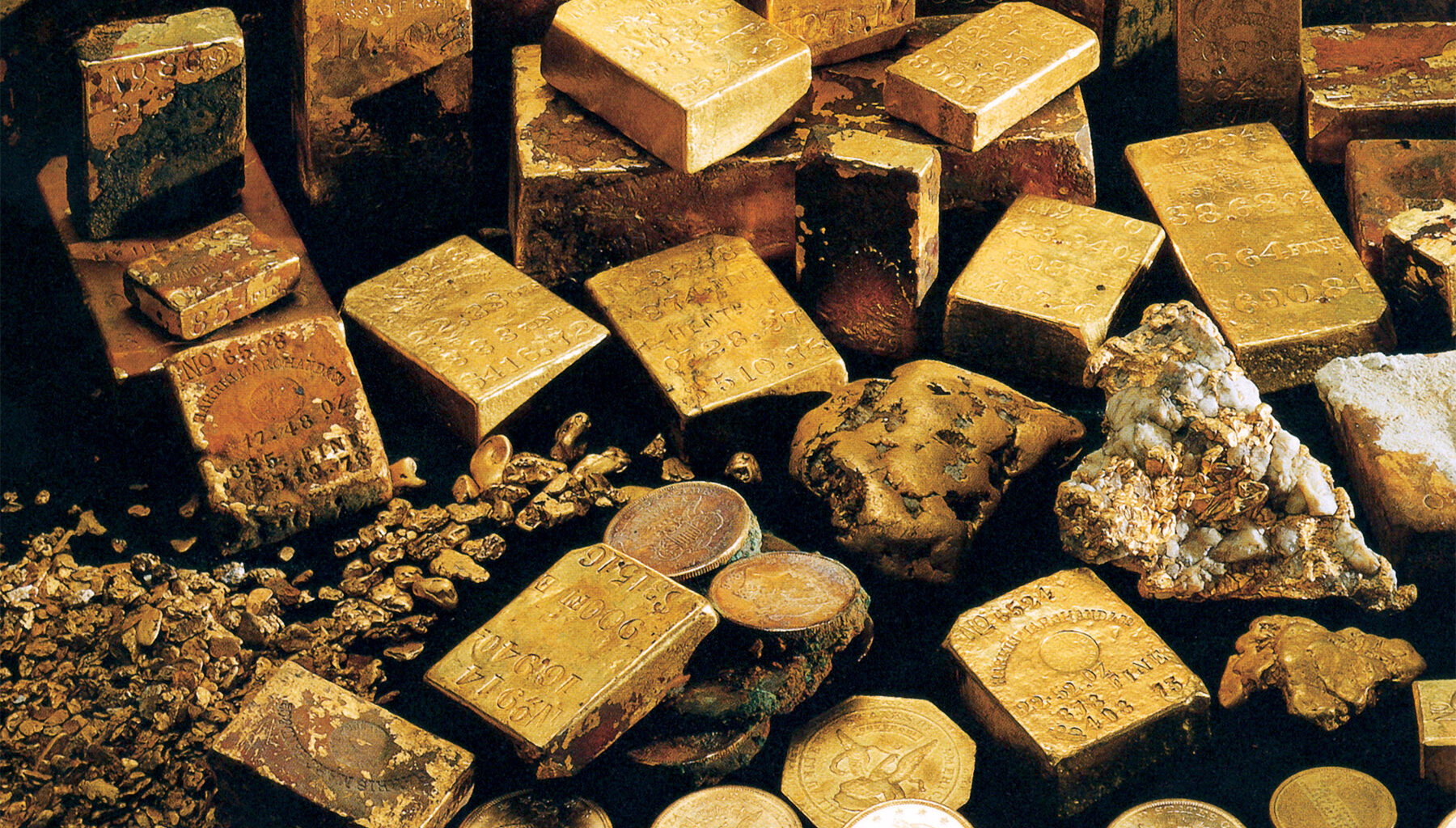
A “Eureka Bar” that dates back to the California Gold Rush was found among other riches at the bottom of the Atlantic. Now, a piece of it could be yours.
(Courtesy of Don Kagin)
At 64 pounds, the “Eureka Bar” is believed to be the biggest surviving ingot from the California Gold Rush. But what may be more alluring about it is the gold’s backstory.
It is a tale that includes a sunken ship and a treasure hunter who rescued the Eureka Bar from the floor of the Atlantic four decades ago, then went to prison in part for refusing to give up the treasure’s location.
The gold bar has sold before, but is now live on the market again — and this time “anybody who has $4,400 can own a piece of the most valuable gold bar in the world,” Don Kagin, a Tiburon-based coin dealer, said.
Article continues below this ad
“This is the most iconic and the biggest bar from the California Gold Rush,” said Kagin, who is using blockchain technology to fractionally sell the relic for the first time. Last sold to a private collector in 2002, the “Eureka Bar” is currently insured for $10 million.
The new sale price of the bar is $6.5 million in total, Kagin said. But now, buyers have a chance to own a piece of the sunken treasure — or at least 0.06% of it — for $4,400. A discount is available for those who buy 10 shares at once.
San Francisco Chronicle Logo
Make us a Preferred Source to get more of our news when you search.
Add Preferred Source
Melted down, the gold would be worth about $2 million less than that. But Kagin stressed that buyers were paying to be part of the Eureka Bar’s long legacy, which he said was “actually a better story than ‘Titanic.’”
The bar was forged in San Francisco in 1857, and stamped with its value at the time: $17,433.57. Later that year, it was loaded onto a New York City-bound steamship, the SS Central America. The ship went down in a hurricane off the South Carolina coast, along with more than 400 of its 578 passengers and 30,000 pounds of gold.
Article continues below this ad
At 64 pounds, the “Eureka Bar” pictured above is believes to be the biggest surviving ingot from the California Gold Rush.
(Courtesy of Don Kagin)
The Eureka Bar sat on the ocean floor for more than 130 years before Tommy Thompson, a research scientist-turned-treasure hunter, discovered it in 1988. The total haul of coins, nuggets and bars salvaged from the so-called “Ship of Gold” was valued at more than $100 million.
Thompson was then sued by his investors, who claimed they had not seen any returns from his sale of some of the treasure. He absconded to Florida and spent more than two years living under aliases. After authorities tracked him down, Thompson claimed not to know the whereabouts of 500 gold coins that were missing from the rest of the treasure.
Thompson was held in contempt of court after he skipped a 2012 court hearing regarding the location of those coins. For not giving up his secret, he spent 10 years in prison. He walked out a free man last week. Kagin said the timing of the sale was a coincidence — but he left open the possibility of Thompson, now 73, could now buy shares of the Eureka Bar.
Buyers will be able to pick from a grid of 1,500 boxes to select which fragment of the bar they’d like to own. Kagin said they might soon get a chance to see it in person: it’s currently held in a “financial institution” somewhere in California, but could be displayed at a convention in Chicago next month.
Article continues below this ad
The shares are mainly collector’s items, but they could also return value if the bar is resold for more money (Kagin said the $6.5 million sale price was “cheap” given the bar’s historical significance). There’s no upper limit on the number of shares someone can buy in the fractional sale, so someone could purchase the entire bar if they have the funds.
Kagin also framed the bar as an entry-point for anyone wary about dabbling in cryptocurrency.
His company, Kagin’s Inc., is the oldest family-owned coin dealer in the country, but took a modern tack when it launched Kagin’s Digital, a subsidiary specializing in “digital fractional offerings.” So far, it’s sold shares of a 1652 New England shilling and a 1934 $100,000 US Gold Certificate.
“For people who’ve been afraid of the digital world, they’re buying a tangible item that they own a piece of, but using the blockchain privacy and the blockchain flexibility of ownership,” Kagin said. “It’s something new. It epitomizes that whole new area of assets that are getting fractionalized.”
Article continues below this ad
The Eureka Bar was last sold in 2002 to a private collector, identified only as a “Forbes 400 business executive.” Its sale for $8 million set a new record for a transaction involving a piece of rare currency.
“Over the course of my career, I have handled and sold more than $100 million in SS Central America treasure, including the majority of all the ingots recovered,” said Adam Crum of online coin dealer Finest Known. “The Eureka Bar stands alone as the largest California Gold Rush artifact and, in my view, the most important surviving gold bar in the world.”