
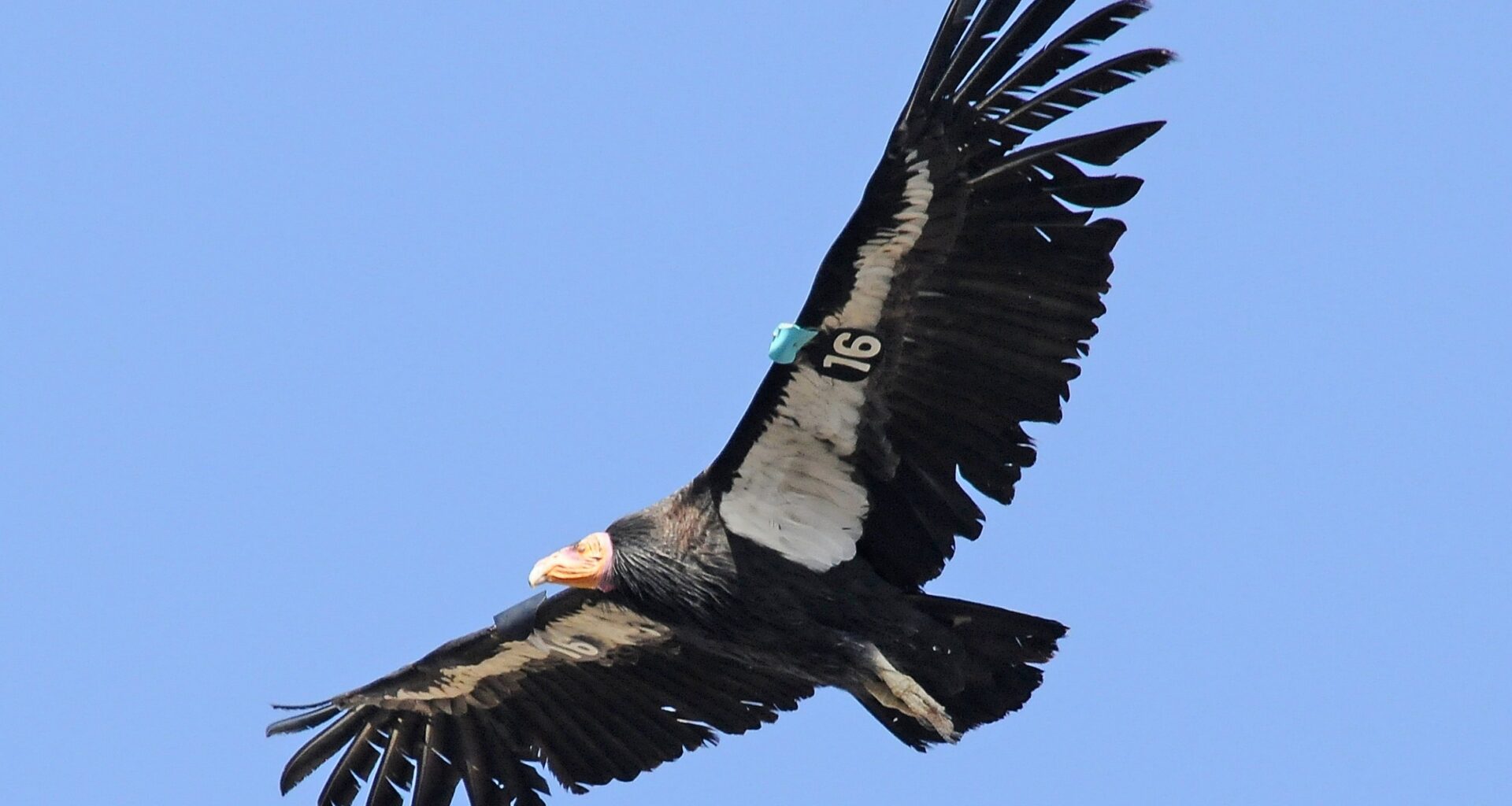
California condors were supposed to be one of conservation’s great comeback stories. For a while, they were.
These huge birds, once pushed to the edge of extinction, climbed back from a population that had fallen into the 20s in the mid-1980s.

By the end of December 2025, about 600 California condors were alive, with about 65% in the wild and the remainder in captivity. So, the latest numbers are hard to ignore.
Lead exposure is rising, and so are deaths. And that seems to clash with years of work meant to protect the birds, including bans on lead ammunition and public campaigns warning hunters and ranchers about the damage lead can do to scavengers.
The rise in condor poisoning
The picture gets clearer once you look at how condors actually live on the landscape. A new study suggests that the rise in poisoning does not mean the policies failed.
It means the birds and the world around them have changed in ways that make the problem harder to control.
Study senior author Myra Finkelstein is an adjunct professor of microbiology and environmental toxicology at UC Santa Cruz.
“We feel this is critically important research that reveals the lead bans and outreach in California have been effective at reducing condor lead poisoning risk,” said Finkelstein.
“Together, our results show that multiple factors have influenced condor blood-lead levels, including changes in wild behavior by condors and shooting behavior by humans.”
How condors are exposed to lead
The California condor is the largest land bird in North America. An adult has a wingspan of about 9.5 feet. It has mostly black feathers, a bald red-orange head, and a life span that can stretch to at least 60 years.
It also reproduces very slowly, usually laying just one egg every two years. That makes every adult bird matter.
Condors do not kill prey. They feed on carcasses. That habit is exactly what puts them in danger.
When hunters use lead-based ammunition, tiny bullet fragments can remain in the bodies of dead animals or gut piles left behind.
Condors, eagles, and other scavengers eat those remains and take in the lead. Even small amounts can damage the nervous system, weaken the birds, and kill them.
What the long record shows
This study drew on a rare kind of wildlife record. All free-flying condors are wing-tagged, many carry GPS telemetry tags, and field teams have tracked behavior on a near-daily basis from 1996 to 2023.
That gave scientists an unusually detailed view of where the birds go, what they eat, and how their blood-lead levels change over time.
The numbers are grim. Lead poisoning was the biggest cause of death among condors in the central and southern flocks, at 62% and 44%, respectively.
The number of birds with potentially lethal levels of lead in their blood almost doubled in the past five years.
The birds are acting more wild
At first glance, those trends make the conservation effort look weaker than expected. But the data show something else happening.
Condors are relying less on the safe food that conservation workers provide at feeding stations. Over the 27-year study period, feeding at those lead-free sites declined by 52% for birds in the central flock and 85% for birds in the southern flock.
The birds also spent less time near release sites, where education efforts and enforcement of lead-ammunition bans are likely strongest. Time near those areas fell by 42% and 70%.
“Thanks to the heroic efforts to bring condors back from near-extinction and track their recovery, we have a uniquely complete data set for this species,” noted study lead author Victoria Bakker, a quantitative conservation biologist at Montana State University.
“It was this decades-long record of behavior and health for every individual condor that allowed us to account for the multiple drivers of lead exposure and measure the true effectiveness of outreach and lead-ammunition bans.”
That matters because condors that range farther out are more likely to find contaminated carcasses. A few bad meals can be enough.
The study says fewer than 10 feedings on carcasses containing lead over the course of a year are enough to tip the scales from condors being self-sustaining to conservation reliant, based on analyses of blood lead levels.
The wild pig connection
The researchers also point to wild pigs as a likely piece of the puzzle. They did not have the data to prove a direct link between condor lead risk and pig shooting for population control. Still, the pattern fits.
Wild pigs have spread widely in California, more pigs are being shot, and the study found increased lead risk associated with pig hunting along with a strong correlation between pig hunting and pig control.
That creates a problem even when lead bans are working better than the raw trend lines suggest. Finkelstein’s earlier research helped establish the link between lead bullets and condor poisoning, and that work helped support California’s 2019 statewide ban on lead ammunition for hunting.
A partial ban in condor range had started 12 years earlier. The new study argues that these rules still reduce risk, but new pressures are masking their effect.
“The good news is non-lead ammunition for pig hunting is reasonably available and through effective outreach and free giveaways, we can solve this problem while supporting the heritage of hunting and ranching,” said Kelly Sorenson, a recovery partner at the Ventana Wildlife Society.
Why saving condors isn’t getting easier
The authors frame the situation with the “Red Queen dynamic,” a term for systems that demand constant effort just to hold the same ground.
“Our findings are a reminder to watch for Red Queen dynamics when evaluating conservation measures in today’s complex settings that can mask effectiveness. Otherwise, successful policies and actions could be abandoned,” said Bakker.
California remains the only U.S. state to ban lead bullets for shooting wildlife. That makes the condor story bigger than one species.
It shows that conservation wins can be real and still fragile, especially when animal behavior, hunting patterns, and land use keep shifting underfoot.
The full study was published in the journal Nature Communications.
—–
Like what you read? Subscribe to our newsletter for engaging articles, exclusive content, and the latest updates.
Check us out on EarthSnap, a free app brought to you by Eric Ralls and Earth.com.
—–