
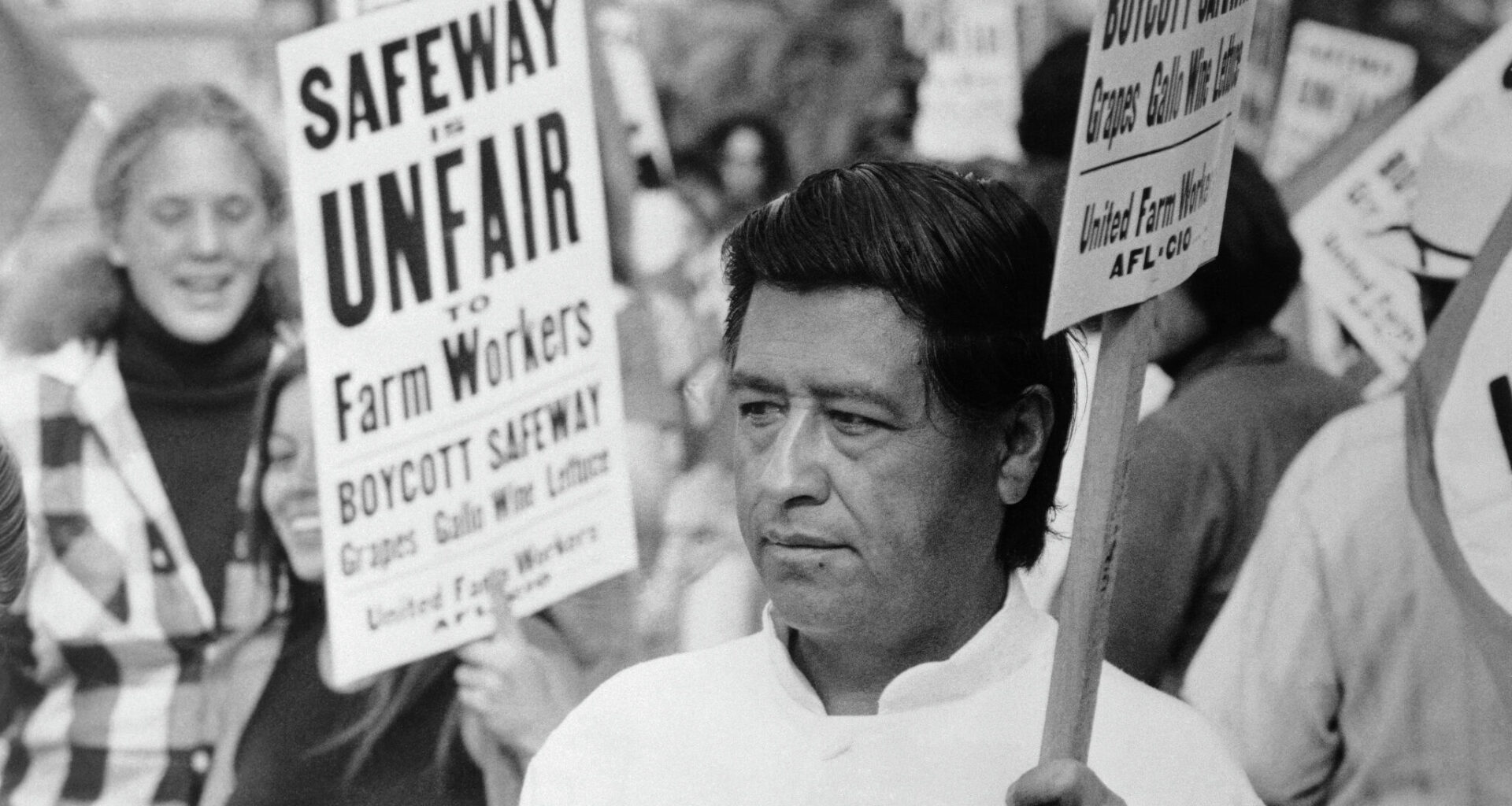
Farm labor leader Cesar Chavez pickets outside the San Diego-area headquarters of Safeway markets in 1973, protesting the arrest of 29 people at a Delano (Kern County) Safeway. A New York Times investigation published Wednesday includes accusations from two women who said Chavez sexually abused them as children in the 1970s.
Bettmann/Getty Images
As explosive allegations of sexual abuse against Cesar Chavez surfaced this week, celebrations honoring the labor leader began unraveling across the Bay Area and beyond.
The claims, detailed in a New York Times investigation published Wednesday, include accusations from two women — Ana Murguia and Debra Rojas — who said Chavez sexually abused them as children in the 1970s, while he led the United Farm Workers. The women said they were 13 and 15 at the time of the alleged abuse, according to the report.
Article continues below this ad
The women, both now in their 60s, said the abuse occurred between roughly 1972 and 1977, when Chavez was in his 40s and at the height of his influence. The Times reported it found evidence supporting their accounts and those of several other women.
Separately, Dolores Huerta, Chavez’s closest collaborator in the farm labor movement, broke decades of silence about her own experiences Wednesday, saying she was also sexually abused by Chavez.
San Francisco Chronicle Logo
Make us a Preferred Source to get more of our news when you search.
Add Preferred Source
Murguia said Chavez used the privacy of his California office to repeatedly molest her after gaining her family’s trust. She was 13 at the time, according to the report. She said the trauma led her to attempt suicide multiple times as a teenager.
Article continues below this ad
Cesar Chavez is seen with Ana Murgia during the United Farm Workers’ 1,000 Mile March in the summer of 1975. Murgia is one of two women who told the Times that Chavez sexually abused them as children in the 1970s, while he led the UFW.
Cathy Murphy/Getty Images
Allegations spark rapid cancellations across California
The United Farm Workers announced Tuesday it would not participate in any Cesar Chavez Day events on March 31, citing what it called “deeply troubling allegations” involving “abuse of young women or minors.”
The union said it had not received firsthand reports but called the allegations serious enough to require “urgent steps” to learn more and support anyone who may have been harmed.
Article continues below this ad
In a statement released hours before the publication of the Times’ article, the Cesar Chavez Foundation said it had learned of “disturbing allegations” that Chavez “engaged in inappropriate sexual behavior with women and minors.”
“We are deeply shocked and saddened by what we are hearing,” the foundation said.
In San Jose — where Chavez once lived and organized — institutions began pulling back. San Jose State University’s Cesar E. Chavez Community Action Center said it was reevaluating planned events. A long-running Chavez legacy dinner in the city was canceled.
At least four events across California and the Southwest have been canceled or modified, including a march in Tucson, Ariz., and multiple commemorations tied to Chavez Day, according to organizers.
In San Francisco, organizers said the annual Cesar Chavez Day parade will go forward on April 11 under a new name — the Dolores Huerta Parade and Festival.
Article continues below this ad
“We’re doing it for the farmworkers. The farmworkers need our support more than ever,” said organizer Eva Royale.
Families grapple with allegations at S.F. school
The San Francisco Unified School District, which has schools named after Chavez, said it was monitoring the situation.
“SFUSD shares in the community’s concerns regarding the recent allegations involving Cesar Chavez,” spokesperson Laura Dudnick said. “As these allegations have only just come to light, the district is closely monitoring the situation.”
Outside Cesar Chavez Elementary School on Wednesday, parents and grandparents waiting for dismissal were still absorbing the news, trying to reconcile the allegations with the legacy of a man long celebrated in their community.
Article continues below this ad
George Elias, 37, who was picking up his 7-year-old, said the reports immediately made him wonder whether the school’s name might change.
“It’s a gut punch,” he said. “He was a leader of the Latin American community.”
Marta Martinez, 55, who was waiting for her granddaughter, said the allegations were difficult to process.
“It was very ugly,” she said. “I had a good image of him.”
Martinez said the claims could force a broader reckoning.
“I don’t know if it’s true or a lie, but if he didn’t act well, they are going have to make a decision about whether they want to change the name of the school,” she said.
Antonia Zavala, 40, who has two children at the school, said she grew up viewing Chavez as an icon.
“According to what I heard, he is a hero, he’s marvelous,” she said.
She said she hopes there will be a full investigation into the allegations.
“They ought to get to the bottom of it,” she said.
A mural of Cesar Chavez is seen at the Cesar Chavez Student Center in San Francisco State University. The labor leader died in his sleep in 1993 at age 66.
Stephen Lam/S.F. Chronicle
San Francisco leaders react as Newsom weighs renaming holiday
San Francisco Mayor Daniel Lurie called the allegations “deeply disturbing and unacceptable” and said the city was working with community leaders to support those affected.
“It takes immense bravery to come forward, and my heart goes out to all of the survivors,” Lurie said in a statement.
San Francisco Supervisor Jackie Fielder, who represents the Mission District, called the allegations “horrifying” and said she stands with the survivors.
“It is devastating to think of the decades of pain they endured while the world and our movements unwittingly celebrated their abuser,” she said in a statement Wednesday.
Fielder, whose district includes Cesar Chavez Street and Cesar Chavez Elementary School, said she would support community efforts to rename “any District 9 institutions.”
Supervisor Myrna Melgar urged residents to prioritize those who may have been harmed.
“My heart is aching and crying,” Melgar wrote on social media Wednesday. “For all the folks calling for renaming things and cancelling things: let’s center those who are harmed first.”
San Francisco Supervisor Connie Chan echoed that sentiment.
“Too often, these women are not only ignored; they are forced to suffer harassment and abuse in silence,” she said.
Labor leaders also grappled with the moment.
“These allegations are serious. If harm was done, then we owe the truth to those who were harmed. No exceptions. No excuses,” said Rudy Gonzalez, executive director of the San Francisco Labor Council.
“Our movement has never been about one man,” he added.
U.S. Sen. Alex Padilla, D-Calif., called the allegations “heartbreaking” and “horrific” and said survivors “deserve to be heard” and supported.
“There must be zero tolerance for abuse, exploitation, and the silencing of victims, no matter who is involved,” Padilla said in a statement.
Gov. Gavin Newsom said the allegations had been difficult for Californians to process and signaled the state may need time to consider broader implications, including whether to rename Cesar Chavez Day.
“None of us knew,” Newsom said at a Bay Area news conference. “We’re all absorbing.”
He said Chavez’s legacy is deeply embedded in California, with dozens of schools bearing his name, and called the moment “sensitive” as communities grapple with what the allegations may mean.
“We want to have the backs of our victims,” he said.
Huerta breaks decades of silence
Huerta, Chavez’s longtime organizing partner, said Wednesday that she, too, had experienced sexual abuse by Chavez and had kept it secret for decades.
“I have never identified myself as a victim, but I now understand that I am a survivor,” said Dolores Huerta, seen here in San Francisco earlier this year.
Yalonda M. James/S.F. Chronicle
“I can no longer stay silent and must share my own experiences,” Huerta said in a lengthy statement published online.
She described two encounters in the 1960s, one coercive and one forced.
“The second time I was forced, against my will, and in an environment where I felt trapped,” she said.
Huerta said both encounters resulted in pregnancies, which she kept secret.
“I have never identified myself as a victim, but I now understand that I am a survivor,” she said.
Dolores Huerta, UFW leader, is seen in 1989. She said she also was sexually abused by her colleague Cesar Chavez.
Michael Maloney/The Chronicle
Alyce McFadden contributed to this report.