
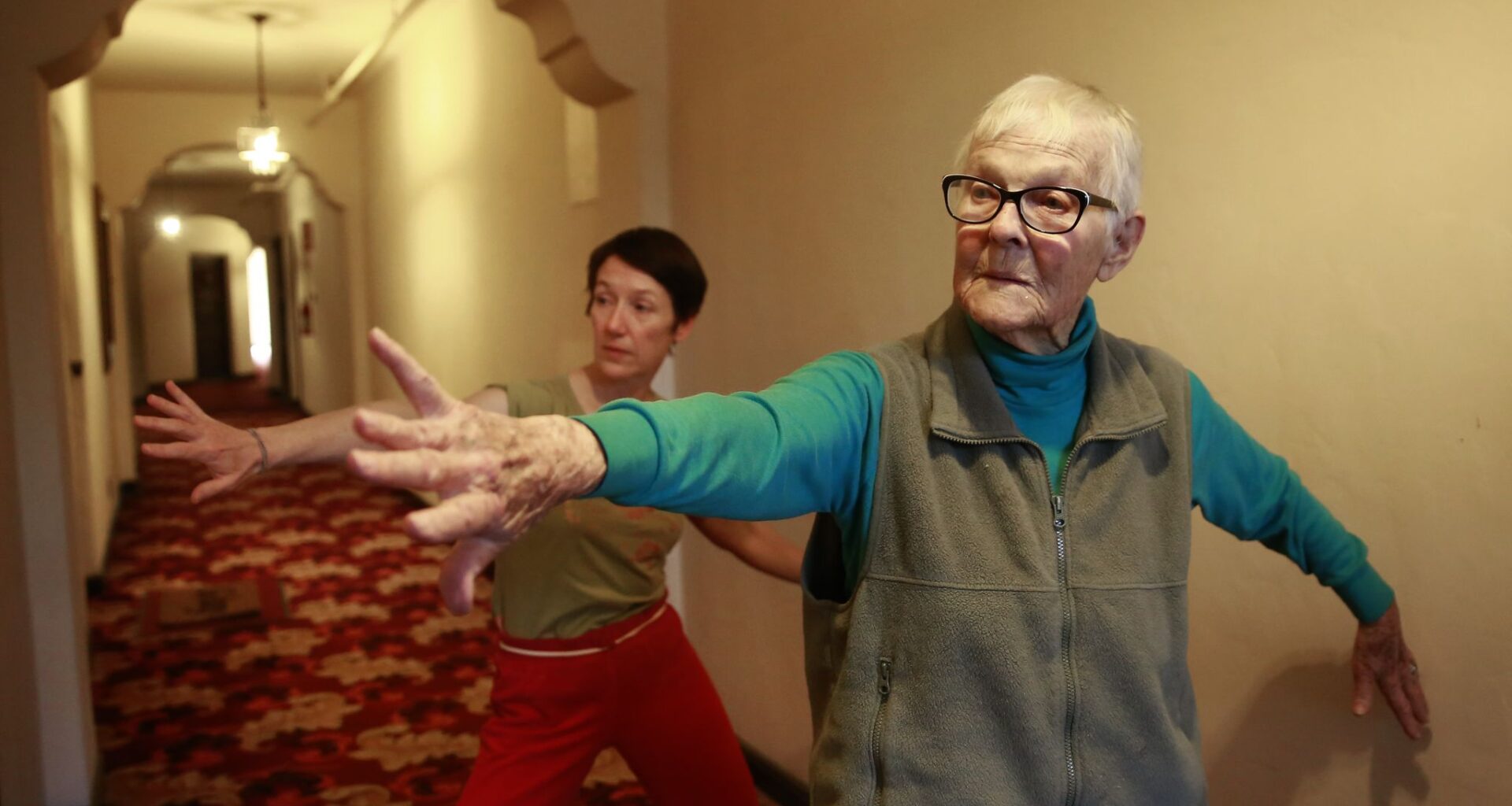
Judy Job, then 93, and Christy Funsch, artistic director of the postmodern company Funsch Dance Experience, practice tai chi in March 2018 in Oakland.
Michael Macor/S.F. Chronicle
Judy Job at age 93 at her home in Oakland, Ca in March 2018.
Michael Macor/S.F. Chronicle
Judy Job, then 93, and Christy Funsch, artistic director of the postmodern company Funsch Dance Experience, practice tai chi in March 2018 in Oakland.
Michael Macor/S.F. Chronicle
When Judy Job was still teaching tai chi and studying dance in 2018 at age 93, the Chronicle sent a photographer and critic to document it. Job didn’t see what all the fuss over her age was about. She was doing what she had done all her life — and would keep doing for eight more years.
With roots in modern dance dating to the 1939 Golden Gate International Exposition on Treasure Island and beyond, Job had become an Oakland tai chi instructor and built a loyal cadre of students who would follow her anywhere — even to the memory care facility in Castro Valley where she was living.
It was there that she taught her final weekly class on Jan. 2, wearing a Santa hat and leading her regulars through all 64 moves in a practice that she did on her own every day.
Article continues below this ad
But when her students arrived as usual the following week, they found class had been canceled. “That was really a first because she always had energy for everything,” said Susie Williams, a family friend who attended that last class. “She would do tai chi even on airplanes. That’s why she lived so long.”
Job died at Kaiser San Leandro on Jan. 13, said her son James Callahan, of Oakland. The cause of death was heart failure compounded by pneumonia. Job was 101.
San Francisco Chronicle Logo
Make us a Preferred Source to get more of our news when you search.
Add Preferred Source
“She was teaching and doing tai chi right up until her death,” said Callahan, who was his mother’s primary caregiver. “That part of her mind was strong.”
Judy Job, left, dances with her mother, Lenore Peters Job, in this 1939 photo.
Courtesy Judy Job
Job was a 45-year Oakland resident who taught tai chi mainly at DeFremery Recreation Center, in her capacity as supervisor of dance and music for the Oakland Parks and Recreation Department. But she’d grown up in San Francisco as the daughter of Lenore Peters, a famed figure from the Golden Age of modern dance in San Francisco associated with Isadora Duncan, when a performance could command the Greek Theatre at UC Berkeley. Peters and her sister, Anita Wright opened a dance school called Peters Wright that lasted 100 years.
Article continues below this ad
For most of that tenure they operated out of an 1870 Queen Anne-style Victorian on Sacramento Street, in what was then on the edge of the Fillmore but is now called Lower Pacific Heights. Classes were on the ground and top floors, and Judy, an only child, grew up in the flat in the middle. By age 3, her mother had her in performances and by 5, the two of them were dancing a duet called “Mother and Child.” Job was on her way as a prodigy, teaching classes while still a teenager and performing at the Golden Gate International Exposition at age 15 in dances titled “The Swing,” “Looking Glass River,” “Mothers Dance” and “Skaters Waltz.”
Job later formed her own troupe, Job’s Tears, which put on a Christmas program at Grace Cathedral, with her dancing a solo as the Madonna. She later introduced modern dance to the nightclub world along Broadway, in North Beach.
In 1954, as she later recounted, she brazenly walked into the Hungry i nightclub and approached the legendary proprietor Enrico Banducci with the line, “How would you like to have a dance act?” Soon she and collaborator Gloria Unte were putting on performances on the same small platform stage where comedians Mort Sahl and Lenny Bruce appeared.
Her satiric nightclub sketches had titles like “Crazy Man Crazy” and “Love and Marriage.” Her longer and more serious compositions followed a progressive ethos, with titles like “The Informer,” about McCarthy-era artists naming names, and “Guernica,” a reflection on the Spanish Civil War choreographed under the direction of early modernist Anna Sokolow.
“Judy was particularly valuable as a leader of improvisation,” said Joanna Harris, a dance historian who taught at UC Berkeley and Mills College. “She was one of those people who could take any idea, whether it was technical or spatial or from an image, and she could build a dance around it.”
Article continues below this ad
In 1999, Job was awarded an “Izzie” for Lifetime Achievement as part of the annual Isadora Duncan Awards honoring Bay Area dance. In 2000, when she was 76, she performed with Mikhail Baryshnikov and the White Oak Dance Project at Zellerbach Theater on the UC Berkeley campus. An oral history titled “Judy Job: Dancing, Discipline and Determination” was published in 2007 by the Museum of Performance + Design in San Francisco.
Judy Job dances on stage at the California Labor School Cultural Festival in San Francisco on Aug. 13, 1948.
Courtesy of Labor Archives and R
“She was a tremendous inspiration to everyone who knew her,” said her older son, Mat, a composer and guitarist who runs the nonprofit arts organization Arts, History and Politics in Bern, Switzerland. “She led an exemplary life which I try to emulate.”
Judith Marjorie Job (pronounced “Jobe” like the biblical figure) was born Dec. 21, 1924, at Children’s Hospital in San Francisco. By then her mother and her aunt had purchased the Sacramento Street home where they lived and operated Peters Wright Creative Dance. An only child, Job attended neighborhood public schools and the old red-brick Lowell High School on Masonic Avenue, graduating in 1941.
She attended UC Berkeley, where she majored in physical education and joined the dance club Orchesis. Always politically liberal like her mother, Job was 19 and still a student when she was dancing and singing at a union rally when a fellow leftist student named Bill Kerner happened to hear it and approached her afterward.
Article continues below this ad
They were married in 1944, the year she graduated, and moved into a flat on Clay Street around the corner from the school where her mother lived. She later got her master’s in physical education from San Francisco State.
Choreographer Sokolow, who was known for incorporating social justice themes into her work, took an interest in Job and helped her create the solo dance “Guernica,” staged in 1947.
One year later a daughter, Bronwen was born, soon followed by a son, Mathew. Job became co-director of Peters Wright and ran the school with her mother. After Peters retired in 1971 at age 81, Job took over and ran the school briefly with her daughter. The three generations also formed a dance trio, which started performing when Bronwen was 1. She died at 60, in 2007.
Kerner died of an autoimmune disorder at 37, in 1955. A few years later Job remarried. She and her new husband, longshoreman Jerome Callahan, moved to a house on Lopez Avenue in the Forest Hill neighborhood on San Francisco’s West Side, where a third child, James, was born in 1958.
Forest Hill was a planned development with racist residential covenants that in the late 1950s nearly prevented baseball great Willie Mays from buying a house there when the Giants moved west. Throughout the controversy, Job backed Mays all the way.
Article continues below this ad
“My mother supported anti-racism so, of course, she welcomed Willie Mays,” said Mat Callahan. “Every Halloween we went to his house and he came to the door. Willie Mays. Wow. My hero.”
But the relationship with Callahan had failed. “It was great until after we got married,” she later told a Chronicle reporter, with her typical frankness. “I had to go to Mexico for six months to divorce him!”
Judy Job at age 98 attending a performance of the San Francisco Ballet at War Memorial Opera House.
Courtesy of Susie Williams
When she came back, she bought a house in the Grand Lake neighborhood in Oakland. But she still ran Peters Wright in San Francisco and took care of her mother, who had become wheelchair bound. But that didn’t stop the pair from going everywhere — including a concert by the Clash, with son James Callahan, at the Civic Auditorium in 1982.
Lenore Peters died in 1984 at age 94. Job sold the Queen Anne Victorian but the dance school kept going, in various locations, until 2008, when she finally closed it during its 100th anniversary year.
“Judy knew all these mother figures: the woman who first taught Martha Graham technique here, all the (Isadora) Duncan people,” Harris told a Chronicle reporter in 2018. “Her body knows all the forms, and she still has that dramatic presence that makes the dance look wonderful.”
In the early 1970s, Job had been rear-ended at a stoplight in Oakland. Her back injury was so severe that a doctor told her she would never dance again, and her rejoinder was, “We’ll see about that,” said her friend Williams. “That was her spirit. Nobody could tell her what to do.”
She was introduced to tai chi during a trip to China with her first husband, and began studying it under Simmone Kuo at her studio at Portsmouth Square in San Francisco’s Chinatown. She then embarked on her long teaching career at DeFremery Rec.
“After the accident she had some limitations and was looking for ways to heal,” said Dorothy Ferguson, a student of Job’s for 40 years. “Tai chi is stabilizing and gentle, and she taught it with a dancer’s discipline which included ballet stretching.”
Word got out about this unique combination and she never had trouble attracting students. Her reputation helped. “She’s a legend in the Oakland dance world,” said Harris.
Choreographer Christy Funsch got word and came to a dance class Job was taking at Shawl-Anderson Dance Center in Berkeley. They got to talking and Funsch built a piece around the California Dancing Girls, a dance troupe that Lenore Peters performed with in the early 20th century.
The California Dancing Girls pose on Seal Rock, circa 1912. Judy Job’s aunt, Anita Peters Wright, founded the group in San Francisco; a century later, the photo inspired Christy Funsch’s postmodern work “Mother, Sister, Daughter, Marvel.”
/ Courtesy Judy Job
The piece, titled “Mother, Sister, Daughter, Marvel,” was premiered by the Funsch Dance Experience at ODC Theater in San Francisco in 2018. The show was advertised by a vintage picture of the California Girls in Greek sea nymph costumes taken on Seal Rock off Ocean Beach, which was reimagined in Funsch’s piece.
“Judy was a delight. She was incredibly serious about her work but also very, very funny,” said Funsch, who has since moved Funsch Dance Experience to New York City. “I’m ever grateful for the time I got to hang out with her.”
Their collaboration included audio recordings that were integrated into the score for the performance, and Job danced a brief solo as a marigold flower in a granny dress at a matinee.
“The modern dance interpretation of Judy’s performance had the same free spirit vibe that she always embodied,” said Ferguson, who attended Job’s last stage performance. “She was remarkable in being able to summon up her inner little girl. She couldn’t be contained.”
When the COVID-19 lockdown came and DeFremery Rec closed, Job moved her tai chi classes to the roof of her 1920s apartment building in Oakland, near Lake Merritt. She later returned to DeFremery Rec, where she taught until December 2024, when progressive dementia compelled her son, James, to move her to Willow Creek Memory Care, in Castro Valley.
Her longtime caregiver, Lakwai La, visited her every day, and every Friday came the regulars for tai chi class, right up until Jan. 2.
Among them was Ferguson, an Australian who said she would have moved home long ago were it not for Job.
“She was my friend for 40 years and she gave me a sense of my body and movement that I never had before,” said Ferguson. “She always looked 20 years younger than she was and she looked damned good even at that last class when she had a fever.”