
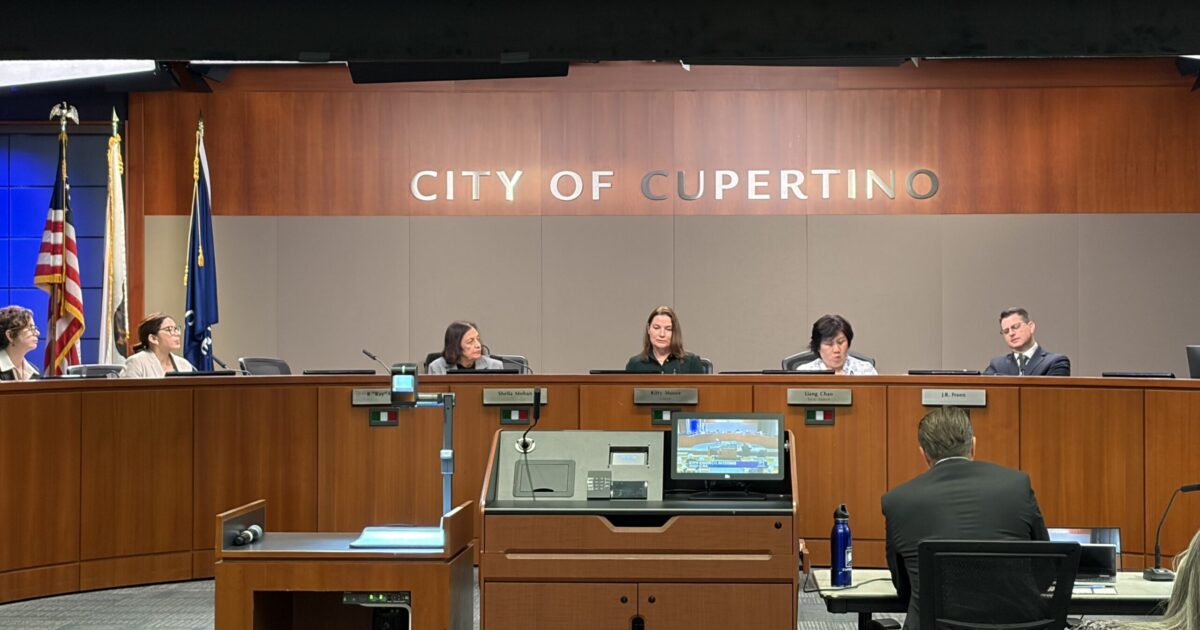
Cupertino officials are asking residents if they’re willing to pay more taxes, as the city faces mounting financial pressures and rising service costs.
The City Council on Tuesday directed staff to poll residents on a potential increase to the city’s utility users tax, signaling that as the most likely path toward placing a measure on the Nov. 3 election ballot. Officials also considered other revenue generating options, such as increasing the local sales tax or updating the city’s business license tax, which hasn’t been revised since 1992. City polling will include an additional question tied to a potential parkland zoning related measure.
Councilmembers will review the polling data at a future meeting and consider whether to place a measure before voters in November.
The city’s utility users tax is set at 2.4%. The proposed increase to 4.8% would apply to services such as electricity, gas and telecommunications, though older adults are exempt to protect people on fixed incomes from rising utility costs.
Councilmember Sheila Mohan prefers a combination of two different taxes, which she said would be better than doubling the current utility tax.
“I think it would make sense not just to increase the (utility tax) at the current rate, but to at least look at some possibilities in terms of modernizing the tax base and see where that leads us,” Mohan said at the meeting.
The move comes as Cupertino grapples with budget concerns, including a proposed increase in its services contract with the Santa Clara County Sheriff’s Office, which could go up from about $19 million to nearly $26 million annually. City officials said negotiations are ongoing and a counterproposal has been submitted, but no agreement has been reached.
Councilmember Liang Chao said she supports raising the utility tax, but is hesitant to raise sales taxes. She said the city should explore what she called a “modernization of tax,” including whether newer services like internet usage should be considered.
Mayor Kitty Moore supported polling residents on a utility tax increase, while opposing the idea of taxing internet access.
“I like the idea of perhaps going to some polling regarding, extending the (utility tax), but I don’t like the idea of expanding, to either cable or internet, making it a little harder for people to have Wi-Fi,” Moore said at the meeting.
City officials acknowledged the tradeoffs between the different options. A staff presentation noted roughly 28.8% of sales tax revenue would come from non-residents, making it a potentially less burdensome option for locals. At the same time, officials warned that without additional revenue, the city may need to scale back capital improvement projects or other services to maintain core operations such as public safety and street maintenance.
Councilmember J.R. Fruen emphasized the importance of gauging public sentiment before making a decision. He urged staff to craft polling questions that clearly measure whether residents would support higher taxes.
“If we’re going to poll anyway, then I would want to have a little bit more information than just the one question,” he said at the meeting. “Maybe people are only okay with 2.4%. Maybe we even discovered that 2.4% is too much for folks right now. I think it’s worth finding out where the pressure point is.”
Cupertino resident Peggy Griffin asked the city to revisit other revenue options, including sales taxes and recreational fees, while warning that increasing utility taxes could disproportionately impact younger residents.
“The young people are going to be paying the tax because the seniors are exempt — that’s not fair,” Griffin said at the meeting.

Rhoda Fry, a resident of more than 40 years, said the city should focus on revenue sources beyond taxing residents, noting that Cupertino’s business license tax is lower than in neighboring cities and could be updated. Cupertino’s business license tax generates about $14.19 per capita, significantly lower than cities such as Mountain View at $66.82, Palo Alto at $80.93 and San Jose at $88.66, according to a staff report.
“The city should have business license taxes that are comparable to those of our neighbors,” Fry told San José Spotlight.
Fry also questioned whether the city needs to conduct a poll.
“We should look at how Cupertino residents voted on recent sales tax measures to see if there’s an appetite before spending time and money on a poll,” she said.
Contact Maryanne Casas-Perez at [email protected] or @CasasPerezRed on X.