
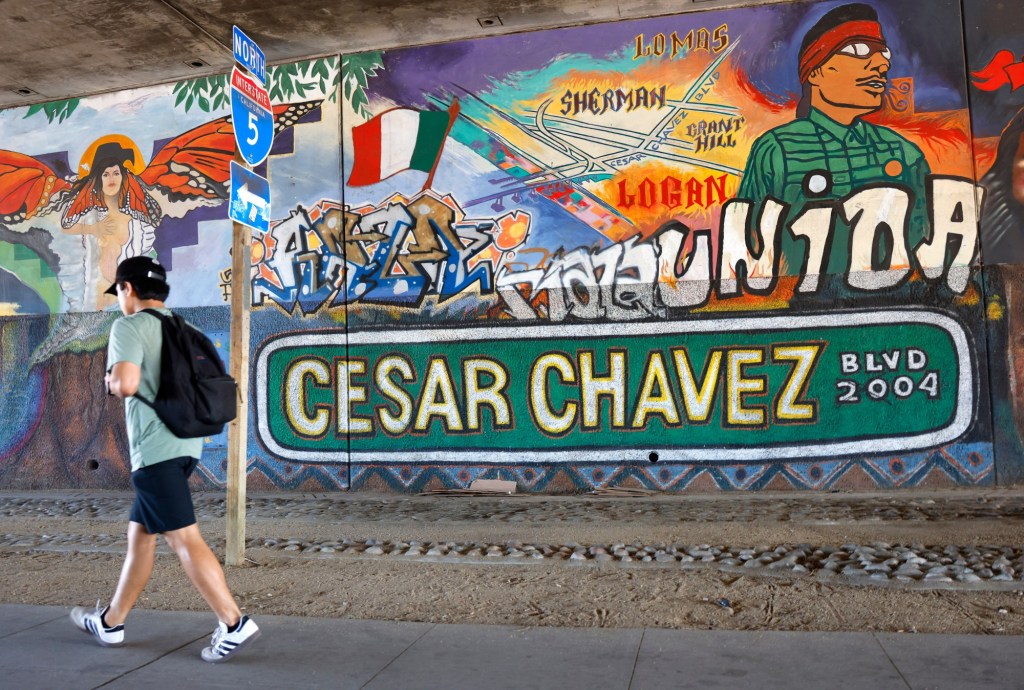
California’s legislative leaders are designating a new state holiday this year: Farmworkers Day.
The move to change the March 31 state holiday named for Cesar Chavez comes on the heels of accusations that the late farmworker rights leader raped longtime ally Dolores Huerta and sexually assaulted female followers as young as 12 during the 1970s.
Legislative leaders announced the redesignation of the state holiday on Thursday, and also vowed to work with local governments and school districts to address laws and statutes related to other renaming efforts. Gov. Gavin Newsom also signaled his support for the effort.
“California’s farmworker rights movement never has been about one individual. To the survivors who have found the courage to come forward, uplifting the movement’s values of dignity and justice and demanding accountability, our hearts are with you always,” said Assembly Speaker Robert Rivas, D-Hollister, and Senate President Pro Tempore Monique Limón, D-Santa Barbara, in a joint statement.
“From the beginning, the movement has been rooted in those lasting ideals of fairness and respect. And at its core, it is about the women and men whose hard work feeds our nation, and whose bravery — together with countless supporters — has fueled a persistent fight to secure essential worker rights and recognition of their humanity,” they added.
On Wednesday, Assemblymember Alexandra M. Macedo, R-Tulare, introduced legislation also to rename the March 31 holiday Farmworker Day.
She, too, said the movement was never about one person but rather “the millions of workers who sweat, toil and aspire for a better life.”
Newsom would need to give approval to legislation redesignating the holiday. He applauded the Democratic legislative leaders in a post on social media on Thursday.
“Given the horrendous allegations that were made public for the first time yesterday, this is a welcomed change,” Newsom said.
During a news conference on Wednesday, Newsom said he was “processing” the news, noting there are many schools and streets all around the state named for Chavez.
“We’re just going to have to reflect on all of that and reflect on a farmworkers movement and a labor movement that was much bigger than one man and celebrate that,” Newsom said during a news conference. “That will be our focus as we process what the next steps are.”
In 2000, California became the first state to designate Chavez’s birthday as a day to honor the civil rights leader. State employees were granted a day off, and schools were required to teach students about his legacy and his involvement in the labor movement in California.
But calls to remove Chavez’s name from sites, streets and events across Southern California rang out this week following an explosive New York Times report Wednesday on the allegations against Chavez.
The city of Duarte canceled its Cesar Chavez Day of Service events scheduled for Saturday. Also canceled was a Cesar Chavez Memorial Breakfast hosted at Cal State San Bernardino, an event that typically honors local leaders and Latino community members in the labor movement.
Local officials in Los Angeles and Santa Ana, too, promised to back efforts to rename local holidays and parks that bear Chavez’s name.
Huerta, who will turn 96 on April 10, told the newspaper that Chavez drove her to a secluded grape field in Delano in 1966 and raped her in the vehicle. She said she never reported the attack out of concerns for police hostility toward Chavez and the labor movement, and because she feared she wouldn’t be believed.
The New York Times report also quoted a woman who said Chavez took her into his office when he was 45 and she was 13, kissed her and pulled her pants down. She said dozens of sexual encounters followed over the next four years, though she says none involved intercourse.
The Times said accounts of alleged abuse of the two then-minors were independently verified through interviews with those they confided in decades ago and also in more recent years. Elements of their stories were also corroborated in documents, emails, itineraries and other writings from union organizers, supporters of Chavez and historians, the story says.
The Associated Press contributed to this report.