
Disgust. Outrage. Betrayal.
Those are plenty of reasons to knock Cesar E. Chavez off the lofty pedestal where he resided for farmworkers, and especially the Latino community. They once adored him and would go to any lengths for him, including marching 366 miles in a historic protest from Delano to Sacramento in 1966.
The founder of the United Farm Workers should now be thrown onto the heap of men whose sexual abuse can never be defended, no matter how much good came from their work. His name no longer deserves a place on street signs, a national monument, countless parks, a Navy vessel or a state holiday.
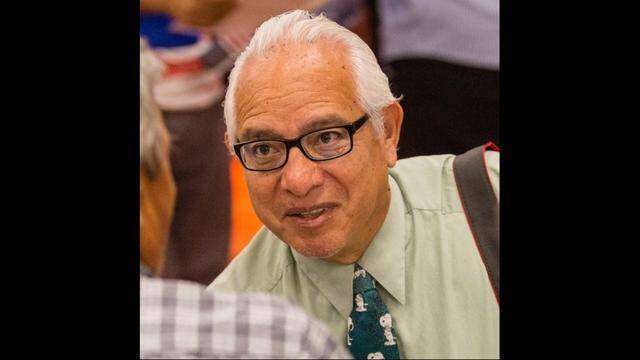 Juan Esparza Loera
The news that Chávez sexually abused minors and twice raped UFW co-founder Dolores Huerta is shocking. These types of abuses should never be tolerated, especially from someone so revered in the farmworker community.
Now the man credited with improving field conditions for workers is justly reviled.
“As a young mother in the 1960s, I experienced two separate sexual encounters with Cesar. The first time I was manipulated and pressured into having sex with him, and I didn’t feel I could say no, because he was someone that I admired, my boss and the leader of the movement I had already devoted years of my life to,” said Huerta, who will be 96 next month, in a statement. “The second time I was forced, against my will, and in an environment where I felt trapped.”
Huerta kept the secret for 60 years, she said, “because I believed that exposing the truth would hurt the farmworker movement I have spent my entire life fighting for.
”Wednesday’s story by New York Times reporters Sarah Hurtes and Manny Fernandez (a Fresno State graduate) includes allegations by Ana Murguía and Debra Rojas that Chávez sexually abused them when they were in their teens.
This was a man who manipulated media attention in the 1960s to draw attention to the struggles of farmworkers who often toiled with too little pay and benefits.
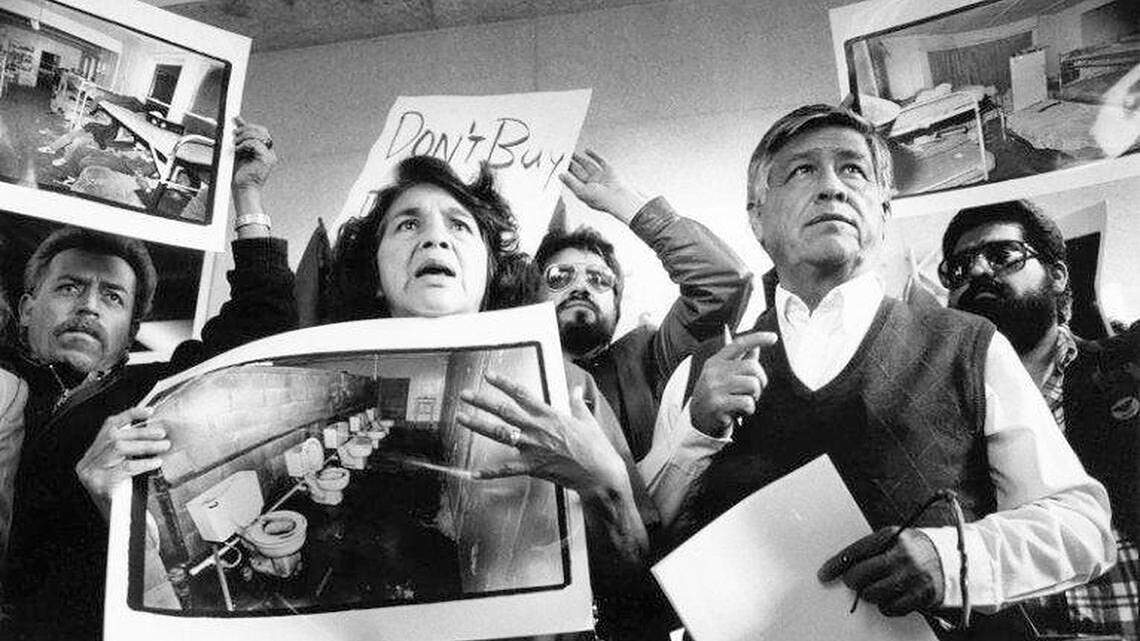
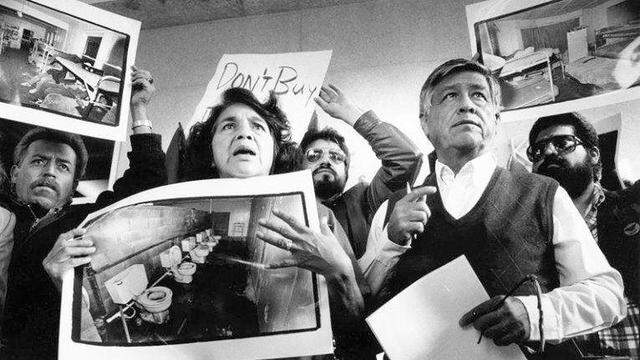 United Farm Workers leaders Dolores Huerta and Cesar Chavez display photos of the conditions that farmworkers endure in San Joaquin Valley farm labor camps at a news conference outside U.S. District Court in Fresno, California, on Nov. 21, 1989. RICHARD DARBY Fresno Bee file
He was on a 1969 cover of Time magazine. National television networks covered his 1968 fast to rededicate the movement to nonviolence. Sen. Robert F. Kennedy showed up for the end of the fast, adding more fuel to the Chávez legacy. Catholic masses were held daily during the fast.
His 1965-70 grape boycott galvanized college students into action and molded UFW members into valuable organizers. His union helped create the landmark Agricultural Labor Relations Act in 1975 to help protect farmworker rights.
He breathed life into Teatro Campesino, which helped propel theater co-founder Luis Valdez to Hollywood. His organization shaped leaders like Eliseo Medina, state Attorney General Rob Bonta and the late Los Angeles labor powerbroker Miguel Contreras.
After his death in 1993 at the age of 66, the labor leader’s supporters began commemorative marches, pushed for a postal stamp with his image, and heralded a movement that saw the children and grandchildren of field laborers get an education and become lawyers, teachers, doctors and more.
President Joe Biden — who hired Chávez’s granddaughter Julie Rodríguez Chávez as director of the White House Office of Intergovernmental Affairs — placed a bronze bust of the labor leader in the White House. In 1994, President Bill Clinton posthumously presented Chavez with the presidential medal of freedom.
There’s no room for Cesar Chavez today
The world once had a place for the tireless work of Cesar E. Chavez and his drive more than six decades ago to organize farmworkers in an effort to rightfully gain better working conditions in a multi-billion agriculture industry that relied on cheap labor for its fortunes.
Today, the world is better off without Chavez. Specifically, his standing as an icon who for decades was the only Latino who was held up as a role model for a generation itching to avert work in the fields in favor of education and its life-changing experiences.
This week’s revelations are heartbreaking, not because I was friends with the UFW leader, but because I met many people who believed in la causa (the cause). I saw the drive of Roberto Bustos, known as El Capitán, of Tulare, to organize the 1966 march to Sacramento. I witnessed the persistence of retired college instructor Venancio Gaona in getting a school named for Chavez and partnering with the Fresno Unified School District in holding commemorative ceremonies for students. I saw the pride in the eyes of the late Jessie De La Cruz, the UFW’s first female recruiter, in recounting how she hosted union meetings in her Parlier home.
The lesson today is that Chavez was not greater than the UFW. It was people like Huerta, Gilbert Padilla and rank-and-file members who built the union and have kept its mission alive three decades after its founder died.
Huerta’s words are the most damning. If anyone thought a Tuesday report by a San Antonio newspaper was mere allegations that could be explained away, the hammer dropped Wednesday.
“I had experienced abuse and sexual violence before, and I convinced myself these were incidents that I had endured alone and in secret,” said Huerta. “Both sexual encounters with Cesar led to pregnancies. I chose to keep my pregnancies secret, and, after the children were born, I arranged for them to be raised by other families that could give them stable lives.
“I have kept this secret long enough. My silence ends here.”
Huerta steadfastly backed Chavez for decades as he purged longtime staff in the late 1980s, so her statement rings true today. I firmly believe Chavez lost the union with his purge, and that the movement has continued under its own momentum energized by its followers.
In a 2023 talk at Madera Community College, Huerta referred to the sexism she has fought. “I think right now in today’s world we see that people are fighting racism, but we actually have to do it without our own families and within our own friends. Not just the sexism but also the machismo. We’re tired of that machismo. We have to get rid of it.”
Getting rid of Chávez is a good start.
What comes next?
Bravo to those who have moved quickly to erase Chavez.
Fresno City Councilmember Miguel Arias, who helped put the UFW founder’s name on 10 miles of city streets in 2024, will ask his colleagues to remove Cesar Chavez Boulevard.
“Public streets and building names are meant to honor individuals who uplifted our community and represented its highest values,” said Arias in a Facebook post. “Given what we now know, Cesar Chavez’s actions do not meet that standard, and we have a responsibility to act accordingly.”
Fresno State President Saúl Jiménez-Sandoval, who spoke at a Chavez celebration on Sunday, said the Chavez statue in the university’s Peace Garden will come down.
“These profoundly troubling claims about the rape of women and minors call for our full attention and moral reckoning by removing his statue from our campus,” the president said.
Gov. Gavin Newsom, at a press conference in San Lorenzo on Wednesday, said he is open to changing the March 31 state holiday honoring the UFW founder’s birthday.
“It’s about the movement. It’s about farmworkers. It’s about labor. It’s about social justice, economic justice,” he said. “All things that the movement has inspired, and we should all be celebrating.”
There is no delight in witnessing the downfall of the Chavez legacy. He threw a reporter from Vida en el Valle (a Bee sister publication) out of an awards dinner in San José in the early 1990s because he was unhappy with a report in The Fresno Bee. The last time I spoke with Chavez, he agreed to meet for an interview that never materialized because I thought there was plenty of time to schedule one (his mother died at age 99).
For the record, his son, Paul Chavez, was a classmate in my sophomore year journalism class at Delano High School; but that relationship rarely went beyond greetings at union events.
I suggest strong consideration be given to replacing the Chavez holiday with an official Farmworker Day, and that the Fresno boulevard be renamed Avenida de los Campesinos.
We can, and must, separate Chavez from the movement.
Juan Esparza Loera retired in November after covering the Central Valley for 50 years, including 35 years as editor of Vida en el Valle and more recently as Opinion Editor at The Fresno Bee.
This story was originally published March 19, 2026 at 6:13 PM.
.jpg)
Christopher Kirkpatrick is senior editor of The Fresno Bee and Vida en el Valle.