
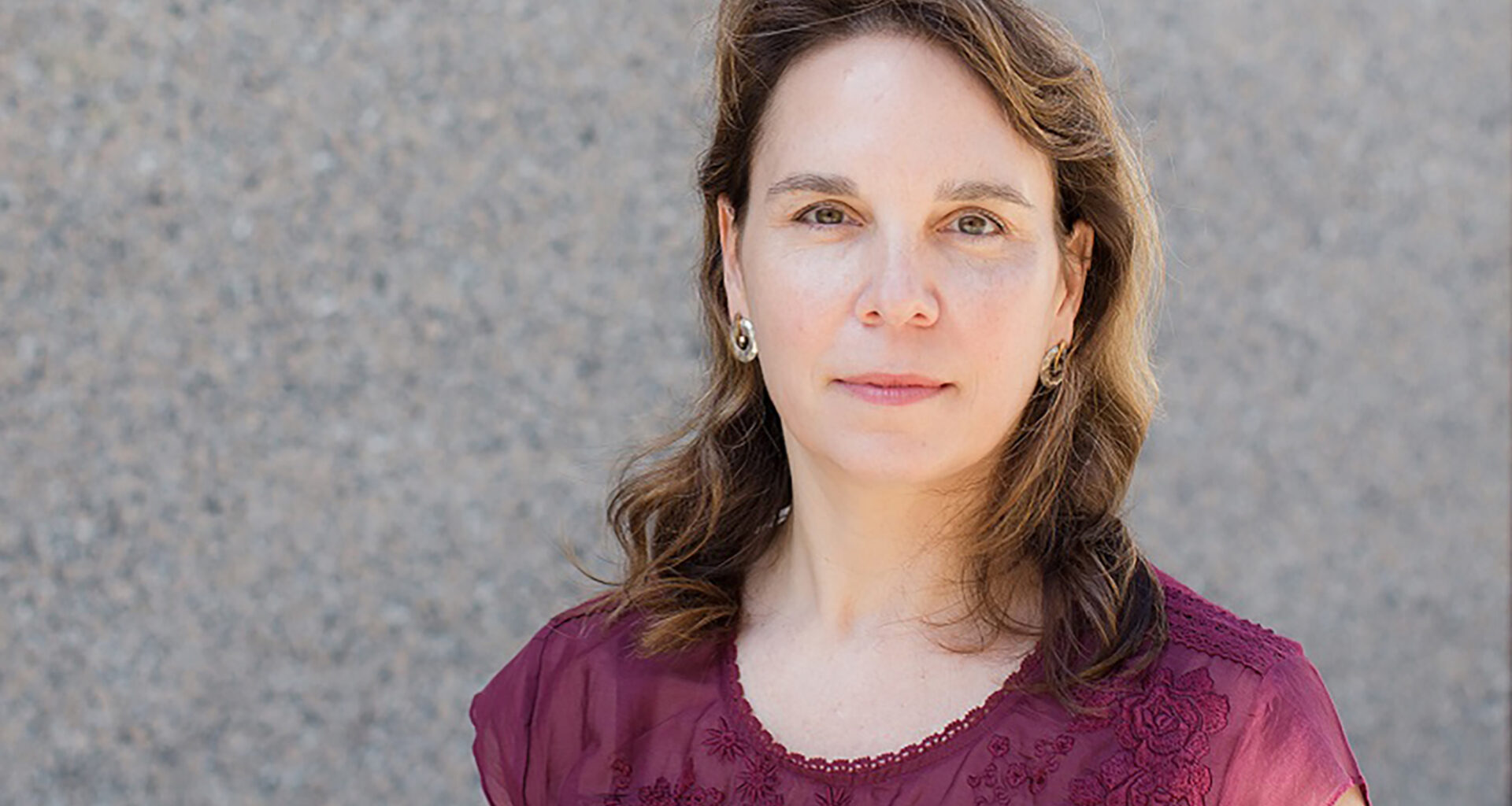
UC Irvine criminology professor Charis E. Kubrin has been debunking the myth that immigration to the U.S. increases crime for two decades. In June, she will receive her field’s highest academic honor, the Stockholm Prize, for that research.
Courtesy UC Irvine School of Social Ecology
Charis E. Kubrin thought it could be a prank.
The UC Irvine professor had gotten an email telling her she was nominated for the Stockholm Prize in Criminology, an accolade that amounts to her field’s version of a Nobel Prize. After 20 years of studying and writing about immigration and crime — and specifically how immigration does not make crime go up — Kubrin was used to seeing dismissive, sneering and even misogynistic takes in her inbox. This was different.
Article continues below this ad
“I remember literally running into my husband’s office and saying, ‘Come look at this email, I think I’m being punked,’” she recalled.
San Francisco Chronicle Logo
Make us a Preferred Source to get more of our news when you search.
Add Preferred Source
In November, the Stockholm Prize in Criminology Foundation named Kubrin and Vanderbilt University professor Mark W. Lipsey, a scholar on effective rehabilitation methods, as recipients of an annual prize for deepening the world’s understanding of crime, what and who cause it, and effective and humane ways to respond. In Kubrin’s case, she was being recognized for rigorous research that demonstrated in place after place, decade after decade, that immigration to the U.S. does not cause crime to go up; it may even push it down.
And yet, when Kubrin, 55, accepts her plaque from Sweden’s Queen Silvia in June — as well as half of the 1.5 million kronos in prize money (about $163,000) — it will be for research that most Americans flatly reject.
Article continues below this ad
According to a January 2024 survey from the Pew Research Center, 57% of U.S. adults (including 85% of Republicans) believe that migrants bring crime to the U.S. That’s one point shy of Gallup News’ 2007 finding, recorded over more than two decades of surveys asking if immigration makes crime better or worse, from June 2001 to June 2023.
This means that disbelief in Kubrin’s thesis neared its modern record one year before President Donald Trump returned to office with an indiscriminate enforcement campaign that has roiled blue cities, appalled human rights organizations and some federal judges, swelled U.S. detention centers and foreign prisons, and has seen both filings alleging illegal detention and the deaths of detained immigrants soar.
Other Western nations, too, have experienced rising anti-immigrant fervor, promoted by far-right populists and based on racialized stereotypes about non-white immigrants.
The stormy geopolitical context was on the mind of Anne Ramberg, who chairs the Stockholm Prize in Criminology Foundation, when she hosted the winners announcement at Stockholm University in November. Lamenting that it was “increasingly difficult” for researchers to “earn and sustain public trust,” Ramberg said many countries were “witnessing a trend of repression” that contradicted scientific consensus and exploited fears over migration.
“When policymaking becomes driven by populism rather than by evidence, society as a whole stands to suffer,” she said.
Article continues below this ad
Stockholm Prize in Criminology Foundation Chair Anne Ramberg, hosting an announcement ceremony at Stockholm University in Sweden in November 2025, described a climate in which many countries were experiencing a rise in repression that coincided with challenges to democratic norms and a disregard for scientific consensus. “This repressive shift has frequently been linked to migration, accompanied by restrictions on the right to asylum, the weakening of individual legal protections and growing insecurity for immigrants,” she said.
Stockholm Prize in Criminology Foundation
The distance between what is empirically known and what is deeply believed has tormented scholars since before Galileo. But the schism has rarely felt so impassable in American culture, say those devoted to the research sciences.
The Trump administration has canceled billions in scientific research grants, pressured academic institutions to surrender their independence, disappeared climate and health data and promulgated false narratives about elections, COVID-19 and American history.
It is also stymieing efforts by states like California to regulate artificial intelligence technology that’s increasingly sophisticated about forging real life.
Today, growing percentages of Americans believe that climate change is a hoax (15%) and that the 2020 election was stolen from Trump (38%), examples of what theorists describe as a post-pandemic revolt against expertise and a hyperpartisan pull toward preferred facts.
Article continues below this ad
And yet, some of Kubrin’s colleagues say the project of knowledge is in capable hands.
“I think it is a moment of opportunity,” said Harvard University professor Robert J. Sampson, a 2011 Stockholm Prize recipient. “And I think we as researchers need to keep putting the work out here. We need people like Charis out there, despite the fraught nature of it.”
Though immigration shaped her journey (her grandparents hailed from Poland and Russia and her husband is from Armenia), Kubrin came to her life’s work through intellectual curiosity. She met a premise and set about interrogating it. And then, like countless scholars before her, she wrestled with a simple question: How do you convince people of the facts?
Inconvenient truths
In March 2006, Kubrin, then an assistant professor at George Washington University in Washington D.C., came across a New York Times op-ed by Sampson, “Open Doors Don’t Invite Criminals,” which provocatively surmised that a sharp rise in the Hispanic population was why crime rates had plunged during the previous decade.
Article continues below this ad
In 2006, like now, the notion that people from other countries would calm neighborhood strife rather than stoke it met a wall of obstinate denial. Intrigued by Sampson’s points, Kubrin sent him an email asking to see his research. He obliged with a word of thanks. “Yours is the only nice email I’ve gotten all day,” he wrote, Kubrin recalled.
Rather than feel forewarned about wading into the charged immigration debate, Kubrin felt called.
“That gap between what we know and what people believe just got to me,” she said, telling herself, “OK, I want to do research and not only do the research, but bridge the gap.”
Kubrin, who had already examined violent crime in relation to socioeconomics, geography and race, turned the lens to immigration and confronted a cyclical problem: Throughout U.S. history, people with power, influence and resources told people without them that immigrants caused their struggles.
“Historically, immigrants have disproportionately taken the blame for many of society’s problems,” Kubrin wrote in 2013. “It is claimed that they steal jobs from hard-working native-born Americans, they drain America’s health care and educational resources, and perhaps most problematically, they cause higher crime rates.
“Yet, as many scholars already know, a substantial literature consistently finds that immigrants are less, not more, crime prone than their native-born counterparts.”
Kubrin added to that literature and deepened it, said Sampson. “She went on and did all this fantastic research that looked at immigration at the neighborhood level and all these different ways to parse the problem between immigration and crime,” he said.
Identifying a need for “macro-level” research that examined the nexus between crime and immigration at various geographical levels, Kubrin wrote or co-wrote 17 articles and two books about immigration and crime from 2009 to 2025.
In a 2009 paper examining large American cities, Kubrin and her coauthor found that “cities that experienced increases in immigration from 1980 to 2000 also experienced a decrease in violent crime rates,” even after controlling for other variables. A 2012 paper explored why large immigrant neighborhoods in Chicago fared better than those in Los Angeles, a 2014 paper tracking 156 large cities from 1980 to 2010 found that increased immigration corresponded with fewer drug homicides but did not appear to affect other types of homicides, while a 2015 paper found that adolescent violence declined as immigration increased.
While researching a 2020 paper that found that California’s sanctuary status did not adversely affect crime, she rode with police officers who told her they didn’t want to be involved in immigration enforcement, that it made it harder to get victims and witnesses to talk to them.
In 2018, during Trump’s first term, she and her coauthor wrestled with why a century of academic literature hadn’t dented misperception. In short, slow, nuanced scholarship was little match for fast, loud falsities.
“The pace at which academia moves is brutal for policy-making,” Kubrin told the Chronicle. “We expect our research to impact policy? This is taking years and years to do. I get it.”
From left, Cambridge University criminology professor Lawrence Sherman, a member of the Stockholm Prize in Criminology selection jury, informs UC Irvine professor Charis E. Kubrin that she’s a recipient during a Zoom call.
Stockholm Prize in Criminology Foundation
In pursuing its mass deportation agenda, the Trump administration has broadly painted immigrants as criminals, often conflating the civil immigration violations with criminal acts, and pumped or signal-boosted false information about some of the immigrants it has detained and deported.
Sen. Alex Padilla, D-Calif., referred to the administration’s race-baiting pretexts last month, when he slammed Senate Republicans’ immigration subcommittee hearing titled “Somali Fraud in Minnesota — The Tip of the Iceberg,” a reference to Trump’s exaggerated justification for sending immigration authorities to Minneapolis.
“Republicans want to take specific, well-documented cases — and again, cases that are already being investigated and prosecuted — and stretch them into a narrative of widespread abuse by immigrant communities more broadly,” he said. “And we know where this leads. It becomes justification for targeting and expelling entire communities, something that I’m not speculating about — it’s happening in real time.”
For his part, Sampson said he’s not sure why the American public remains so hard to budge — in over two decades of Gallup polling, the belief that immigration increases crime never fell under 42% — but he has a hypothesis.
“My sense is there’s a pretty strong stereotype linking criminality to certain ethnic groups and certain racial groups,” he said. It’s instinctual, he said, and easier to exploit in times of social upheaval. “It’s always been there and it’s still here.”
He also knows the pendulum can swing the other way.
Public concern over border encounters that peaked in December 2024 has had a year to subside and polls show Americans souring on a mass deportation campaign that, in the past 14 months, has convulsed communities and courts with disputed justifications and siege-like tactics that killed two U.S. citizens in Minnesota.
Kubrin — who acknowledges days when she asks, “What’s the point?” — said she’s fully aware of the context in which she’ll be receiving her highest professional recognition.
“It’s not lost on me that I’m getting this award in this area at this particular time,” she said.
And after the prize, the work continues. She’s looking for ways to deepen it, to make sure it doesn’t just “languish in journals.” She’s done two fellowships in the past year with the aim of getting her research to lawmakers, rather than trusting them to find it themselves. And her students — 110 prospective policymakers every year, she said — keep her going.
“My north star is research,” Kubrin said. “I believe in the value of research to answer basic fundamental questions. When I start to feel shaken by all of this, including threatening emails, I go back to what I have control over, which is the research.”