
The hot topic of today’s University Budget Committee was the Voluntary Separation Incentive Program, San Francisco State University’s last ditch effort to reach the goal of lowering tenure density, save money and avoid further layoffs.
It has been about three months since the university slashed the minimum required years of service for VSIP from 10 to five years of service at SFSU and set a maximum of $110,000 in severance pay. The stronger incentive for tenured and tenure-track faculty to resign was intended to address the university’s budget deficit. But according to today’s University Budget Committee update on the VSIP, the target amount of faculty was not met.
In December, the university expected around 60-75 faculty to take up the offer. However, only 38 participants signed up for the VSIP by the March 13 deadline out of 197 eligible faculty members.
The VSIP is one of SFSU’s budget plan measures to address a $20 million shortfall, where the target goal is to save up to $7.5 million depending on participation levels. To counter the low number of VSIP participants, Ingrid Williams, the senior associate vice president in human resources and primary contact for the VSIP, suggested that the university will open up the program to other departments and faculty groups.
“Over the next two weeks, we’re going to review the information to determine if it makes financial sense to open up the VSIP to other faculty groups,” Williams said.
Previously, departments that were not eligible for the VSIP included the physical therapy graduate program, mathematics, race and resistance studies, computer science, American Indian studies, philosophy, the School of Music, public health, special education, School of Social Work, School of Nursing and family, interiors, nutrition & apparel.
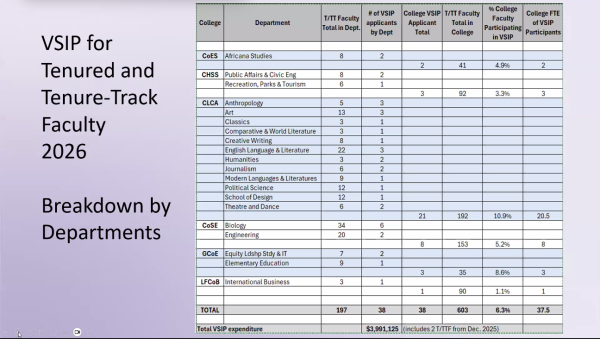 A table of the University Budget Committee’s data from the VSIP’s tenured and tenure-track faculty’s breakdown by departments after the March 13 deadline to sign up, presented during the UBC meeting on Thursday, March 19, 2026. (Courtesy of Ingrid Williams / SFSU University Budget Committee)
Michael Scott, vice-provost for academic resources, said according to his knowledge, the only faculty groups that would be considered for the VSIP expansion would be FERP employees and lecturers who are on formal, 3-year appointment contracts. The university will not be reconsidering any departments currently deemed ineligible.
Exclusions were determined primarily based on tenure density, which is the percentage of an academic department’s total number of tenured or tenure-track faculty, and “because the university needs to maintain business continuity,” according to Williams. During the public forum, Williams said that if the VSIP is expanded to further faculty groups, that would be done within the next couple weeks rather than in the fall semester.
However, there are concerns that expanding the VSIP at this time may disrupt class scheduling for the Fall 2026 semester. Jenny Lederer, associate professor and linguistic programs coordinator for the department of English language and literature, said that the department has many faculty members in the Faculty Early Retirement Program who are not eligible for VSIP.
“An additional VSIP wave this semester could result in a last-minute scramble to figure out how to cover classes for additional faculty departures,” Lederer said. “In order to avoid this disruption, one consideration would be to extend the VSIP offer to more faculty, but do so in fall for a spring departure so as not to disrupt the current Fall 2026 schedule.”
Lederer added that staffing issues are a burden to the English department, especially when they can’t hire additional lecturers, raising concerns of additional teaching and advising workloads.
“Having lots of last-minute staffing issues is a source of increased administrative burden for many of us who also have full teaching and advising loads,” Lederer said.
Vance Vredenburg, chair of the biology department, brought up concerns for his department’s tenure density.
“The reason biology had a high tenure density was not because we lost students,” Vredenburg said. “We were not able to provide work for many of our temporary lecturers.”
According to Vredenburg, the department lost 20 lecturers in light of ongoing budget cuts and six tenured/tenure-track faculty applied for the VSIP.
“When we did not re-hire lecturers it made our tenure density increase dramatically and made us a department for VSIP,” Vredenburg said. “Now, we are facing a potential fall semester with a large number of students and fewer tenured and tenure-track faculty.”
Arno Puder, professor and department chair of the computer science department, voiced concerns over the department’s “lopsided tenure density” that initially excluded computer science from being eligible for the VSIP. According to Puder, SFSU’s computer science department has 14 faculty and 1,400 majors, with several faculty resigning over the past several years.
“We do our best to ensure that our majors can make degree progress, but because of our tenure density, we always had to rely on a little army of lecturers,” Puder said. “About two-thirds of the seats we offer are taught by lecturers. That is just a consequence of our headcount of tenure/tenure-track colleagues.”
Puder commented during the meeting that he believes the university should pay attention to faculty retention.
“While student retention is important, I keep on preaching that we need to pay at least as much attention to faculty retention,” Puder said.
Near the end of the public forum, Scott clarified that the VSIP would not be offered next year.
“This year will be the last year for VSIP. We won’t be continuing to run these programs every year,” Scott said. “I don’t want people to think to expect one next year, because this will be it this year.”