
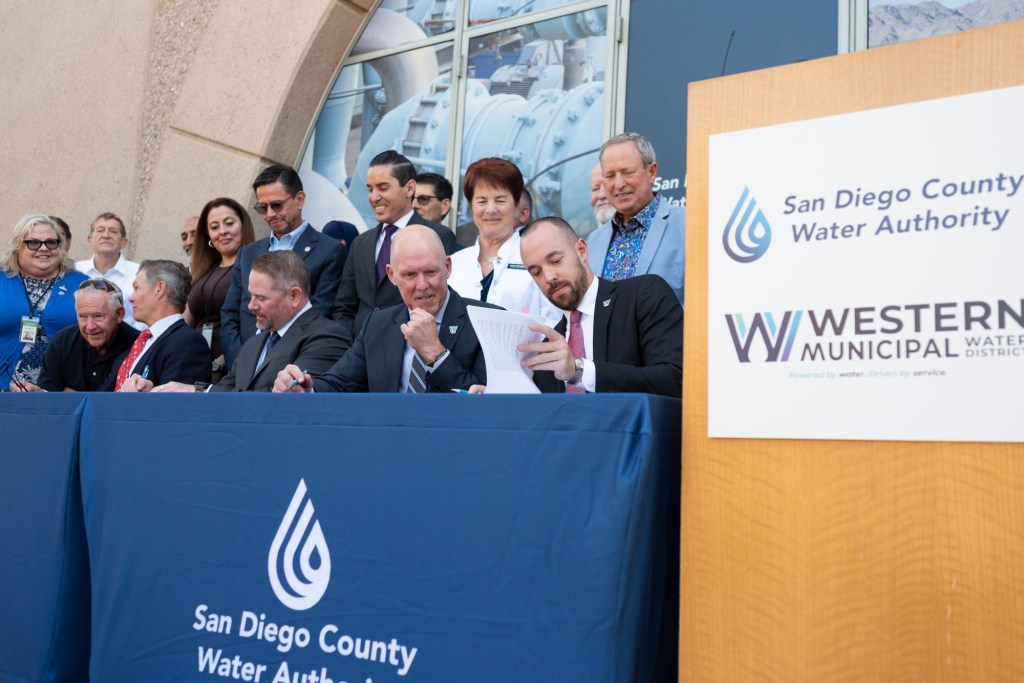
The San Diego County Water Authority has inked its first deal to sell excess water to other communities in Southern California, a landmark overhaul of the water authority’s business model that’s long been promised by top officials.
The water authority’s new agreement to sell water to the Western Municipal Water District in Riverside County will bring in $100 million in new revenue for the San Diego region’s financially strapped water system over the next five years.
That influx of cash could temper future rate hikes for many county residents. But it’s too early to say what impact the deal might have.
“This is going to be groundbreaking for them as much as it is for us,” Water Authority General Manager Dan Denham said of the deal.
The water authority’s Board of Directors unanimously backed the agreement with Western on Thursday.
Over the decades, worries about drought and population growth led the water authority to overbuild the region’s water supply.
Population estimates didn’t pan out and conservation efforts saw residents use less water, leaving the water authority contractually obligated to buy more water than customers need. That requires it to pass on those fixed costs by raising water rates.
County residents have gotten increasingly battered by high water costs, with the water authority’s rates jumping 23% in the last two years.
But water officials see an off-ramp to that cycle with water sales.
Under the newly signed agreement, Western will annually buy at least 10,000 acre-feet of water from the water authority, roughly 3.3 billion gallons, over the next 21 years.
The water authority expects to make $330 million from the deal. A big chunk of the revenue comes up front, with Western buying 30,000 acre-feet of water for $39 million on top of their annual purchase.
Thursday’s deal likely won’t be the last for the water authority.
In an interview, Denham said the water authority expects to sign similar agreements with Burbank and the Three Valleys Municipal Water District in Los Angeles County.
Those deals should be inked before the water authority launches rate talks in the summer.
The sales have been made possible by a settlement last year to a long-running legal fight between the water authority and the Metropolitan Water District of Southern California. Part of the settlement greenlit the water authority to sell water to other water agencies connected to Metropolitan.
Other deals to sell water to states in the Colorado River Basin, such as Arizona, are still years away but progressing, with the water authority approving a preliminary agreement with the federal government last month for eventual interstate water sales.
Water officials expect to unveil their recommended rate hikes in May.
In recent months, the water authority forecast rates to rise between 38% and 65% over the next decade. But those figures didn’t account for money coming in from new water deals.
Revenue from water sales could soften the forecasted rate hikes. But it depends on how the water authority’s Board of Directors wants to spend the new money it has.
The water authority could use the money to pay down debt and invest in its infrastructure, moves that could improve its long-term financial outlook. But it could also put the money toward subsidizing customers’ water bills and make water more affordable.
In an interview, water authority board Chair Nick Serrano, who represents San Diego, didn’t commit to any specific path forward.
“We are going to have a holistic conversation with all of the board to decide what do we want to do in the short-term, the long-term,” Serrano said. “It’s kind of premature to sort of say with some definitiveness.”
New inter-county water deals come at a key moment in the relationship between the water authority and its biggest customer: the city of San Diego.
The city’s $1 billion Pure Water program is expected to come online in 2027. The behemoth recycled water project will complement two similar facilities in Oceanside and East County.
But local communities producing their own recycled water will cut in on the turf of the water authority, which is expecting a 15% drop in sales once the three facilities come online.
Denham expects new water deals will do more than offset the water authority’s losses due to a new era of recycled water.
“Being able to get costs off the books is going to help the city and all member agencies with their overall cost structure,” he said.