
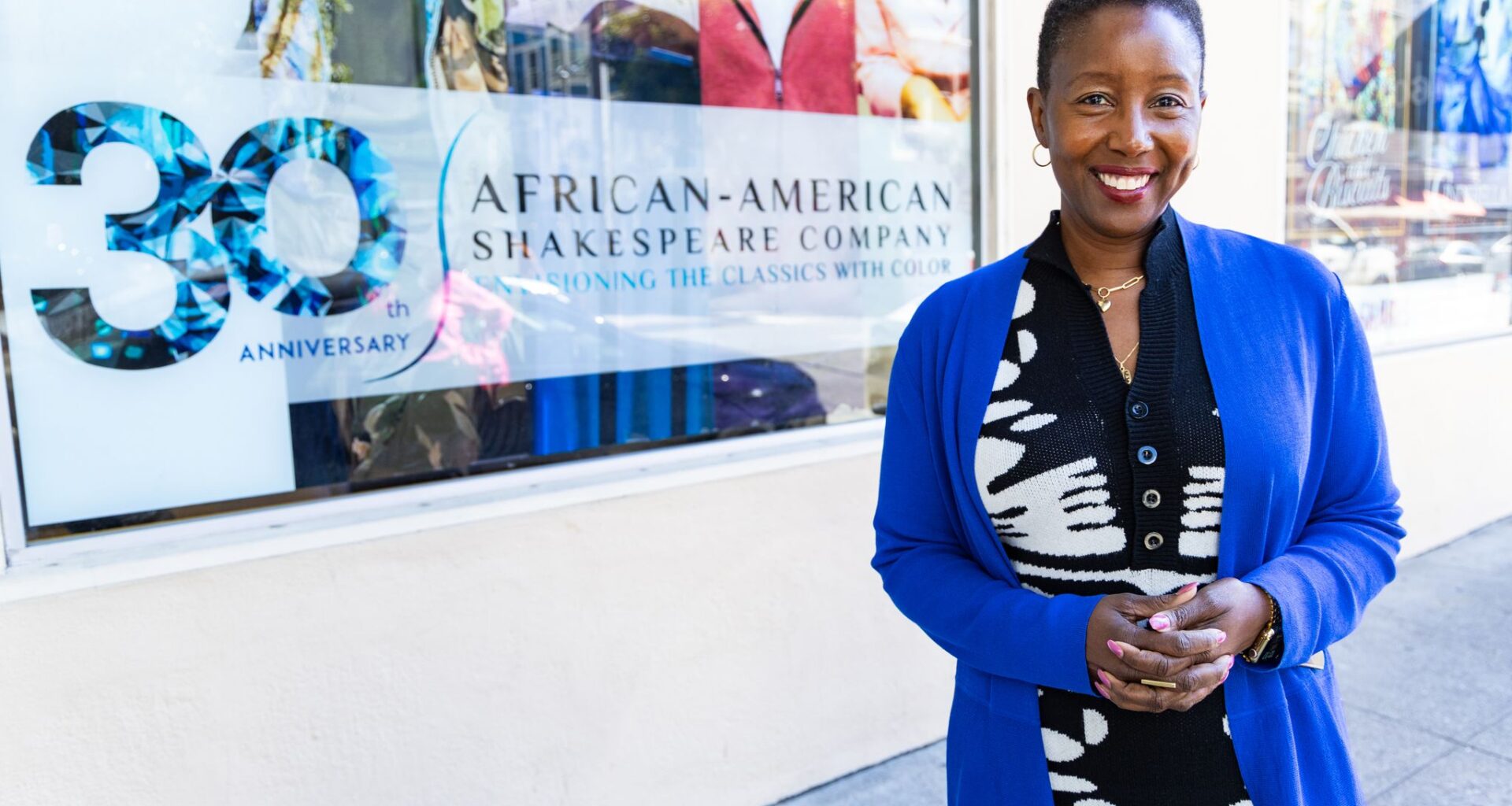
Nataki Garrett, interim artistic director of the African-American Shakespeare Company, poses for a portrait outside the company’s building in San Francisco on March 12, 2026.
Jana Ašenbrennerová/For the S.F. Chronicle
A few years ago, Nataki Garrett was receiving death threats on the job as artistic director of Oregon Shakespeare Festival.
“The reason why I was being threatened was because I was in a position of leadership,” she told the Chronicle of working in Ashland, Ore., whose population is 87% white.
Since January, the leader, whose era-defining OSF term lasted just four years, has been at another helm as interim artistic director of San Francisco’s African-American Shakespeare Company, and she’s optimistic that this new appointment will be less troubled. For one thing, she no longer retains a security detail.
Article continues below this ad
Since returning to her Bay Area roots in 2023, she said, “I’m in a part of the country that doesn’t have an allergy to Black women in leadership.”
She cited former San Francisco Mayor London N. Breed as one case in point. Another is AASC founder and Executive Director Sherri Young.
San Francisco Chronicle Logo
Make us a Preferred Source to get more of our news when you search.
Add Preferred Source
“I’m joining a Black woman leader who’s led an organization for 30 years,” she said, eyeing Young, who was seated next to her during a joint interview at the company’s Hayes Valley headquarters.
Sherri Young, executive director of the African-American Shakespeare Company, poses for a portrait inside the company’s building in San Francisco on March 12, 2026.
Jana Ašenbrennerová/For the S.F. Chronicle
If AASC is a legacy organization with a gorgeous mission — “envisioning the classics with color” — both Young and Garrett are clear-eyed about the challenges the company has faced.
Article continues below this ad
In 2023, it canceled a production of “Death of a Salesman” after actor Richard D. May was struck by a car and killed on the way to his final rehearsal.
Eight months later, Artistic Director L. Peter Callender abruptly left his role after nearly 15 years on the job. The company’s announcement at the time described the parting as a mutual decision. Young cited a “conglomerate” of factors, including different artistic priorities.
“It was simply time — for me and for the company,” Callender told the Chronicle earlier this month. “Leadership transitions at the right moment are healthy for any institution, and I wholeheartedly welcome Nataki Garrett’s appointment.”
Finally, the company was also among the nonprofits affected by chaos at one of its chief funders, San Francisco’s Human Rights Commission, from which Executive Director Sheryl Davis resigned in disgrace following 2024 allegations of mismanagement and conflicts of interest.
HRC Public Information Officer Devi Zinzuvadia explained that her agency made “the difficult decision” last year to cancel one award letter and another “request for qualifications” with AASC; two of the company’s workers became volunteers as a result. Now the agency’s restoring $350,000 of that funding, but AASC publicist Liam Passmore said it was still less than the originally hoped-for amount of $500,000 — a major portion of the theater’s $1.3 million annual budget.
Article continues below this ad
Amid all those difficulties, Young said, “I was just in Whac-A-Mole.” Eventually, she admitted, “I lost confidence in myself.”
Young first got connected to Garrett through Callender, then reached back out as Garrett was transitioning to being an executive coach, in addition to writing a very active Substack, “Be a Ladder Leader,” and continuing to direct as a freelancer, including at West Edge Opera.
At OSF, Garrett initially thought a coach “was something you needed when you were in trouble,” as she put it. But then she got one herself, loved it and learned many of her fellow artistic directors used one, too, but often discreetly. There’s a “stigma” around doing so, she said.
Young thought she was getting a first coaching session from Garrett. Then, when Garrett suggested herself and some others as candidates for interim artistic director, Young realized that’s what she wanted all along for her 32-year-old company but hadn’t allowed herself to articulate.
“I never say what I really want because I’m scared if I do that it won’t come true,” she explained.
Article continues below this ad
Garrett shared some big-picture goals for transforming the company as the two conduct a search for her permanent successor. (Garrett said she’s not interested in that job but is committed to staying until that new person is settled.) Young said the new hire would ideally have deep knowledge of the Bay Area.
As a leader, Garrett said, “If you’re on the ground counting paperclips, then everybody’s focused on the paperclips.” Delegation, trust and empowerment among the company’s eight staffers are key.
“The prerequisite to work with me is that you have to have vision,” Garrett said. “And if you don’t have the right people, then create the ecology in which you can attract the right people.”
It’s also a matter of aligning the team, she added. When workers are asked to work on marketing, she said, they shouldn’t think, “You’re pulling me off something that’s important.”
Additionally, she’s working on the story Young can tell about herself to find the right donors.
Article continues below this ad
Nataki Garrett, interim artistic director of the African-American Shakespeare Company, left, and Sherri Young, executive director, pose for a portrait inside the company’s building in San Francisco on March 12, 2026.
Jana Ašenbrennerová/For the S.F. Chronicle
“Sherri is a standard bearer for culturally specific arts organizations,” Garrett said. The Trump administration’s targeting of those groups, including by rescinding National Endowment for the Arts grants, gives their fundraising special urgency right now. “It’s important that these organizations exist and thrive because they are actually the spaces where people like me come to find our way into an industry that doesn’t have a lot of access points,” she added, citing her own early days at Black Repertory Group in Berkeley.
In positioning herself as a stabilizer, Garrett touts a record of raising $19 million for OSF during the pandemic, saying, “Every breath that organization takes since I left is because I did what I came to do.”
OSF Marketing and Communications Manager Emily Hunter would not confirm Garrett’s claim, noting the company isn’t “in a position to verify a single number with certainty.” She also declined to comment further on Garrett’s leadership but added, “We wish her the very best in this new role.”
Even so, Garrett characterized herself as “the canary in the coal mine” — but one “who got out.” Now, she sees her task as using her experience “in a way that helps support other people.”
Over and over, she said, she sees theater leaders hired for their vision, only to be told when they arrive, “You’ve got to deal with austerity first.” At AASC, her goal is to shore up finances so her successor doesn’t have to put a vision on hold.
By one important measure, the $1.3 million organization already looks more stable than it has in a long time, with two main stage titles in the works. Ted Lange’s “Shakespeare Over My Shoulder,” which examines the authorship of Shakespeare’s plays, is set to run May 12-June 7 at Theater 33 in Union Square, and Tarrell Alvin McCraney’s “The Brothers Size,” to be directed by James Mercer II, has been rescheduled for autumn.
Through the worst of AASC’s trials, Young knew her company was never in danger of closing as so many other local arts organizations have in recent years, from California Shakespeare Theater to Cutting Ball Theater to Peninsula Ballet Theatre. Her question was more about in what form it would continue.
“Am I going to go back to the 1997 format, where there was no staff, there was only an office, there was no payment to the actors?” Young recalled thinking.
“It’s hard to go back that far,” she continued. “It’s like sleeping on a couch. There’s certain things I just won’t do anymore.”