
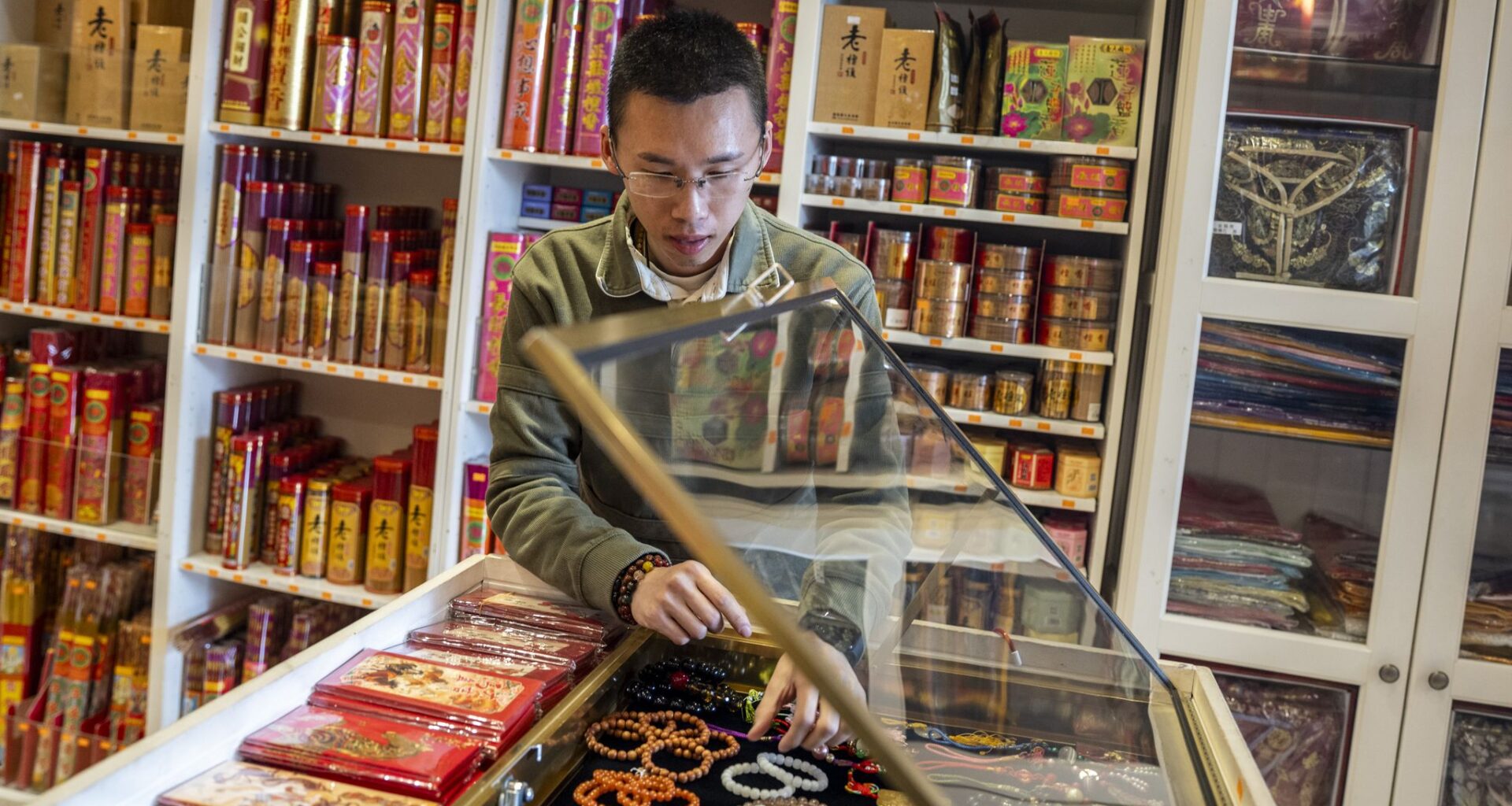
Lucas Li spent the better part of a decade trying to run away from his family business in San Francisco. During middle school, his classmates would make fun of him because his mom operated a business to help people honor their ancestors.
The 27-year-old remembered classmates telling him he was “too religious” and “too Chinese.”
He said he felt he had to hide that he spent most days after school helping at his mom’s Clay Street store in Chinatown, selling incense, joss paper, Taoist funeral offerings and personalized feng shui consultations.
Once embarrassed by his family’s business, Lucas Li now embraces it as his purpose. He’s working to keep Chinese traditions alive for a new generation.
Stephen Lam, Wendi Jonassen
After stepping away for college, he decided to embrace what he now considers his destiny: running his family business, Lion Trading. Li said his work is about “more than selling a product. We help people connect with meaningful traditions.”
Article continues below this ad
Li is one of many younger Chinese Americans in the Bay Area who’ve stepped up in traditional family businesses and are trying to introduce these time-honored services and products to newer, younger and more Western audiences.
San Francisco Chronicle Logo
Make us a Preferred Source to get more of our news when you search.
Add Preferred Source
The younger business owners have had to adapt to challenges their parents didn’t face: historic tariffs, dwindling adherence to tradition, increasing demand for novelty among consumers and lower foot traffic in a post-pandemic San Francisco. But a shared commitment to keeping traditions alive has driven these entrepreneurs.
Lucas Li, 27, who is helping to keep his family’s business of selling Taoist and Buddhist religious products in addition to feng shui consultations, stands for a portrait with mother Magan at their store, Lion Trading.
Stephen Lam/S.F. Chronicle
Li’s mom started Lion Trading in 2013. The pair immigrated from China’s Taishan region when Lucas was 10 years old.
Article continues below this ad
Growing up, Li said, he yearned to better understand his mom’s prayers at the altar and her work with Taoist and Buddhist feng shui masters. He’d ask her, “Why do we burn joss papers? Why do we burn incense? Why do we pray?”
She would explain that these ancient practices “show the deities in our religion that we are practicing in good faith and we’re asking for help in this human world,” Li said.
“The goal for me at this point is to promote these traditions,” Li said.
Left: Fa Yuan Chen, a feng shui master who goes by the name Icy, demonstrates the use of a “luopan” geomantic compass at Lion Trading in San Francisco’s Chinatown. Right: A laughing Buddha amulet, a symbol of prosperity, is seen on a calculator at Lion Trading.
Stephen Lam/S.F. Chronicle
Top: Fa Yuan Chen, a feng shui master who goes by the name Icy, demonstrates the use of a “luopan” geomantic compass at Lion Trading in San Francisco’s Chinatown. Above: A laughing Buddha amulet, a symbol of prosperity, is seen on a calculator at Lion Trading.
Stephen Lam/S.F. Chronicle
In 2024, he said, he had a “spiritual awakening” and decided that instead of rejecting tradition, he wanted to embrace it, becoming the store manager alongside his mom, who remains involved.
Article continues below this ad
Helping customers showed Li the importance of the business. Customers would often come to the store to seek guidance during life-altering events — heartbreaks, failed investments, moves, funerals. The store’s two feng shui masters offer guidance on how to arrange a new home to harmonize the flow of qi, cosmic energy, or how to select an auspicious wedding date, for example. The store also offers delicately crafted paper houses and paper money that Taoists burn at funerals, believing it provides for their loved ones in the afterlife.
“Finding faith and wisdom, it helps you navigate the suffering you’re dealing with,” he said.
He plans to expand the business to a website called Lucy Compass that would offer virtual Chinese astrology readings known as bazi, meaning “eight characters.”
“It’ll honor tradition but it’s made for modern life,” he said.
Left: A barrel of chili sauce undergoing fermentation is seen at Union International Food Co. in Union City. Top right: Felicity Chen, right, stands for a photo with mother Linda Huang, center, and father Daniel at Union International Food Co. The company, founded by Chen’s grandfather, specializes in various Chinese condiments. She’s now working to launch a spin-off brand catering to English-speaking customers while continuing to work alongside her parents. Bottom right: A worker places empty bottles onto a conveyer belt while bottling sesame oil at Union International Food Co.
Stephen Lam/S.F. Chronicle
Top: A barrel of chili sauce undergoing fermentation is seen at Union International Food Co. in Union City. Middle: Felicity Chen, right, stands for a photo with mother Linda Huang, center, and father Daniel at Union International Food Co. The company, founded by Chen’s grandfather, specializes in various Chinese condiments. She’s now working to launch a spin-off brand catering to English-speaking customers while continuing to work alongside her parents. Above: A worker places empty bottles onto a conveyer belt while bottling sesame oil at Union International Food Co.
Stephen Lam/S.F. Chronicle
Like Li, Felicity Chen, 32, also grew up working in her family’s business, which sells fermented traditional Chinese sauces to customers from PF Changs to family-owned Chinatown grocers. She was the family’s default English translator, writing emails, communicating with compliance agencies and meeting federal food inspectors.
Article continues below this ad
Union City-based Union International Food Co. was started by Chen’s grandfather, Huang Yung Pin, who fled from Fuzhou, China, to Taiwan in 1949.
He survived by working in restaurants where he learned to make soy sauce, sesame oil and ferment chili peppers and beans for traditional sauces. In the late 1970s, he immigrated to the U.S. and began door-knocking in Chinatown to sell his sauces.
Chen initially felt that she wanted to forge her own path after college.
She started a business in 2017 called Potli, infusing shrimp chips, sriracha sauce and even honey from her dad’s backyard bees with cannabis.
“It was certainly something where my parents were like, ‘What the heck is happening?’” she said. But starting her own business helped her find her voice.
Article continues below this ad
Today, she works for her parents but is soon launching a spinoff brand to be sold online called Dou, catering to English-speaking customers.
She also is updating the recipes to use healthier ingredients, such as extra virgin olive oil instead of soybean oil.
“Dou is a brand that is about inheritance, honoring the funk that is in Chinese food,” she said.
Kevin Chan, second generation owner of the Golden Gate Fortune Cookie Factory, is seen at the company’s Ross Alley factory in San Francisco Chinatown Thursday, March 12, 2026.
Stephen Lam/S.F. Chronicle
Kevin Chan, 56, is yet another entrepreneur trying to balance his family’s traditions with innovation.
Down a lantern-lined alley in San Francisco Chinatown, Chan runs the Golden Gate Fortune Cookie Factory, which hasn’t changed the basic cookie recipe that’s powered the family business for 64 years.
Chan, who immigrated at 8 with his family from China, grew up working in the cookie factory, which his uncle founded.
“Fortune cookies are my life,” he said. “They’re my mom’s life.” His 76-year-old mother, Nancy Tom, still carries 50-lb bags of flour and sugar.
Maintaining tradition at the Golden Gate Fortune Cookie Factory is expensive. The four vintage cookie machines, which are 72 years old, must be handwashed and owner Kevin Chan had to custom order a replacement for a broken machine part from Texas, costing $800.
Stephen Lam, Wendi Jonassen
Maintaining tradition is expensive, he said. The four vintage cookie machines, which are 72 years old, must be handwashed and he had to custom order a replacement for a broken machine part from Texas, costing $800.
He pays the workers who handmake the cookies costs about $20 an hour, he said, costing him more than machine-made fortune cookies.
Like many others, he’s been hit hard by the U.S. tariffs, which had previously been as high as 145% on some Chinese imports. Although the U.S. Supreme Court struck down most of Trump’s tariffs in February, a 10% levy on most imports remains.
Packaging cost Chan about 50% more than before Trump’s tariffs, he said. But he does not want to raise prices on his customers.
Freshly made fortune cookies are seen at Golden Gate Fortune Cookie Factory in San Francisco.
Stephen Lam/S.F. Chronicle
The “labor of love” is worth it. The factory is a “mini museum,” he said, to show people how fortune cookies were historically made before automation.
Chan has also embraced innovation along with history. Since taking over ownership in 2015, he added matcha, strawberry, chocolate and chocolate dipped flavors and created a gift box that allows customers to personalize fortunes for loved ones.
Mabel Lue, a Foster City resident who grew up in Chinatown and has been a customer for 30 years, said Chan’s fortune cookies are her favorite.
“They’re thinner, crispier, than anywhere else,” she said. “It keeps you connected to your heritage.”
In the long term, Chan said, he’ll have to find new ways to attract foot traffic into Chinatown, which saw a drop in tourists during the pandemic.
He’s worried because his five daughters aren’t interested in taking over. It’s grueling work, sitting in 90-degree heat, necessary to keep the just-baked cookies soft enough to fold into the classic crescent shape. He’s holding out hope one of his kids might step up. For him personally?
“I’ll keep doing this until I die,” he said.
Shelby Wu, owner of Fruitful Dreams, carries a tray of fresh candied fruit snacks, also known as bingtanghulu, at her store in San Francisco Chinatown, Friday, March 13, 2026. Wu, who grew up around her parent’s restaurant nearby, opened her shop last year.
Stephen Lam/S.F. Chronicle