
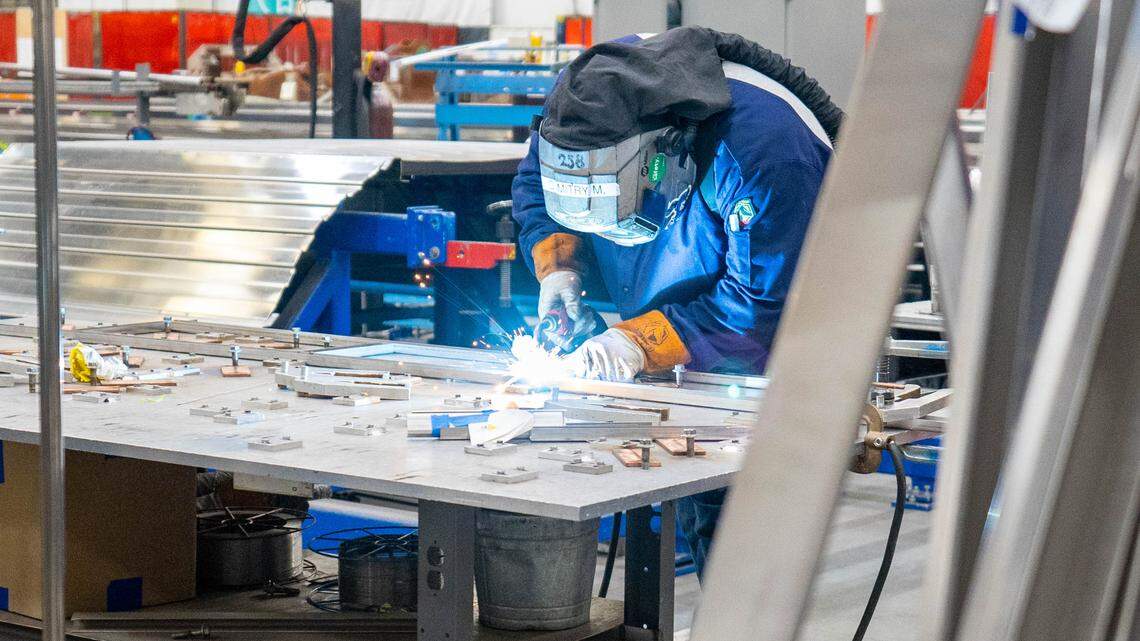
A Siemens worker assembles part of an Amtrak Airo train at the company’s manufacturing facility in Sacramento on Oct. 11, 2023. California could lose more manufacturing jobs without incentives to keep them here.
Cameron Clark
Sacramento Bee file
When a California manufacturing facility shuts its doors, it’s not like packing up a laptop and reopening somewhere else. Manufacturers invest millions — sometimes billions — into heavy equipment, specialized infrastructure and highly trained workers. When those operations leave, the odds of them returning are slim.
That reality should shape how California thinks about manufacturing policy.
Across the country, manufacturing is having a pivotal moment. States are aggressively competing to bring production back home after decades of globalization pushed jobs overseas in search of lower costs and fewer regulatory hurdles. And California, simply put, is not positioned to win in this competition.
Today, 38 states support manufacturing through full investment tax credits or other targeted incentives designed to attract and retain these jobs. California is not one of them, and it’s costing us.
The Golden State was once the undisputed national leader in manufacturing, but that prominence is in jeopardy. In just over two recent years, California lost 82,000 manufacturing jobs. The trend doesn’t appear to be shifting anytime soon.
Manufacturing remains critical to our economy. The sector employs an estimated 1.24 million Californians and generates an estimated $382 billion in economic activity each year. These are good-paying jobs that support families, strengthen local communities and anchor regional economies.
It’s not too late to reverse course, act now and save this vital industry. There is a proven solution on the table: reinstating the Manufacturing Investment Credit.
The Manufacturing Investment Credit is a targeted tax credit designed to encourage manufacturers to invest in new equipment, expand operations and grow their workforce here in California. According to economic analyses, reinstating this credit would help create more than 160,000 jobs and spur $4.5 billion in gross domestic product, while effectively paying for itself through increased economic activity.
In 1994, the legislature created the Manufacturing Investment Credit, and it worked before it was phased out in the early 2000s. Efforts to revive it in recent years have unfortunately not been supported by Gov. Gavin Newsom. This tax credit once helped to create over 200,000 new jobs in the manufacturing sector in just six years. The results speak for themselves.
We already know that tax credits can work when California prioritizes them: Just look at the state’s $750 million expansion of the film and television tax credit last year. Lawmakers rightly recognized that production companies are mobile and will chase incentives offered by other states. The result? California stepped up to stay competitive.
But there’s a critical difference between film production and manufacturing. A film crew can pack up, leave the state and return once a tax credit is secured. Manufacturers don’t have that luxury. Once a factory relocates, the equipment, supply chains and workforce often follow…and they rarely come back.
That’s exactly why the Manufacturing Investment Credit matters. It’s about keeping manufacturers rooted in California and giving them the confidence to grow here instead of elsewhere.
This year, over 25 industry groups — from manufacturers to business associations — sent a letter urging the legislature to include this credit in the state budget. The proposal is modest: $210 million. In the context of California’s multibillion-dollar budget, that’s a small, strategic investment with a significant return.
Manufacturing has ripple effects far beyond factory floors. It touches nearly every corner of our economy, from breakthrough medical innovations and emerging technologies to automation that helps produce the daily goods we all rely on. When manufacturing thrives, so do suppliers, logistics companies, research, education institutions and small businesses.
At a time when California is losing manufacturing jobs and other states are rolling out the welcome mat, inaction will cost the state its competitive edge. If policymakers are serious about protecting middle-class jobs, strengthening the economy, and keeping California competitive, reinstating the Manufacturing Investment Credit should be an easy call.
Lance Hastings is president and CEO of the California Manufacturers & Technology Association.
Related Stories from Sacramento Bee