
In today’s white noise of blaring headlines and sky‑is‑falling narratives, it can be difficult to recognize when a genuine crisis is taking shape. But the hard truth is this: many of California’s public transportation systems are on the brink of collapse.
Across the state, transit agencies are warning that they are only months away from insolvency. Under nearly every scenario, that means higher fares for riders, reduced service and the closure of stations or entire lines. Travel options will shrink dramatically unless urgent action is taken.
While the Bay Area has mobilized around a state loan and a regional sales tax measure to keep its system afloat, no comparable effort exists for the rail networks serving San Diego and Orange counties. Without a coordinated plan, these vital systems face severe disruption.
A strong and reliable transit network is not merely a convenience — it is a fundamental public benefit. Public transportation reduces traffic congestion, offers a lower‑cost alternative to driving, cuts air pollution and supports the creation of vibrant, connected communities. When transit suffers, the impacts ripple far beyond the platforms and tracks.
Much of the current crisis stems from the steep drop in ridership during COVID‑19, a decline from which the system has not recovered. With significant changes in where and how people work and spend their time, transportation patterns must adapt as well.
Metrolink — operated by the Southern California Regional Rail Authority — illustrates these challenges clearly. Ridership remains stuck at roughly 53% of pre‑2020 levels. As a result, Metrolink is projected to collect $40 million less in fare revenue in 2026 than it did in 2019.
This year alone, fare revenue is expected to come in 30% below budget, even as operating costs continue to climb. Costs now exceed 2019 levels by more than $100 million. Compounding matters, existing transportation funding commitments leave little flexibility to fill the gaps.
This financial uncertainty leaves Metrolink unable to sustain current service levels, much less expand them. That means no capacity to grow ridership — or to provide the supplemental service needed for the 2026 World Cup, now only months away, or the 2028 Olympics.
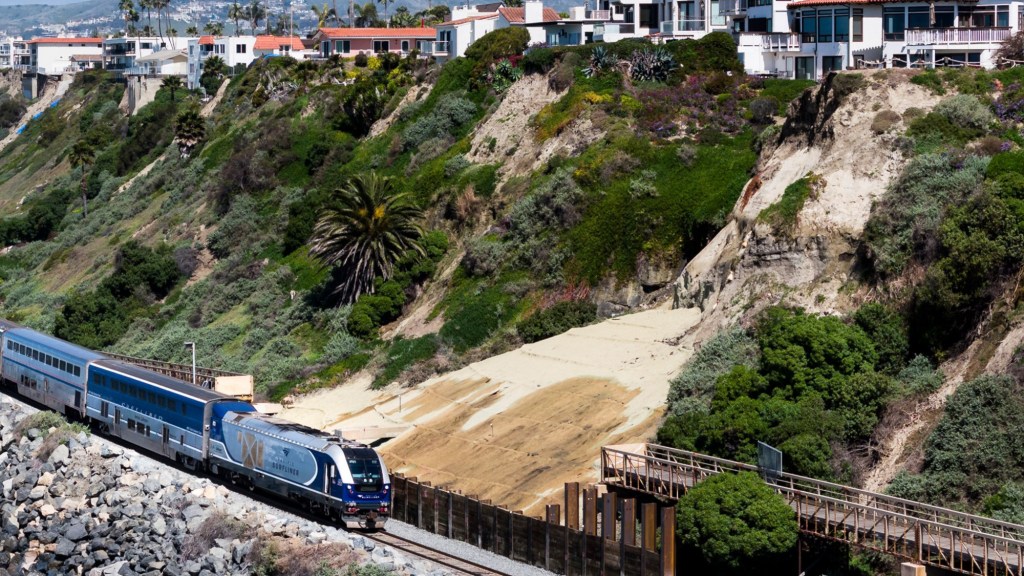
The Pacific Surfliner, funded by the state and operated by Amtrak, and the COASTER, operated by the North County Transit District, are also staring down insolvency. NCTD alone faces a $16.6 million fiscal cliff in 2027, a full year before the Olympics arrive, with no public plan to avoid it.
This is a familiar story across California. Stagnant ridership and ballooning budgets have left agencies deeply strained. But it is also important to recognize that ridership alone cannot solve these problems.
No major public transit system covers its costs solely through fares. Stable funding — from taxes, state and federal sources, and other revenue streams — is essential for operations and long‑term improvements.
Our backs are against the wall, and the stakes could not be higher. Without decisive intervention, we face a future with dramatically reduced rail and transit service and far fewer transportation options.
For the LOSSAN corridor — the 351‑mile rail line stretching from San Diego to San Luis Obispo — the moment demands a new vision. The line must be reimagined to serve more people, more effectively.
Operators along the corridor must coordinate schedules, fares and ticketing; establish ridership goals and strategies to meet them; target capital projects that demonstrably improve service; increase on‑time performance; and reduce closures and delays caused by freight traffic, maintenance and emergencies.
Importantly, they must also rethink revenue generation. Continually seeking more state money while providing less service is a non-starter.
LOSSAN is the nation’s second‑busiest rail corridor and links California’s largest metropolises. Its scenic, low‑stress travel experience holds enormous potential — but only if we modernize and expand how the system operates.
After hosting nine subcommittee meetings on the corridor and authoring legislation requiring local leaders to help chart a path forward, it is clear to me that solutions are not emerging from those closest to the problem. That is why I will introduce legislation to give the state a more active role in decision‑making, and I hope the next governor will treat this with the urgency it deserves.
California must create a sustainable, resilient transportation future. We cannot allow public transit to wither. Now is the time to confront the crisis directly and build the system Californians need and deserve.
Blakespear represents California’s 38th Senate District. She lives in Encinitas.