
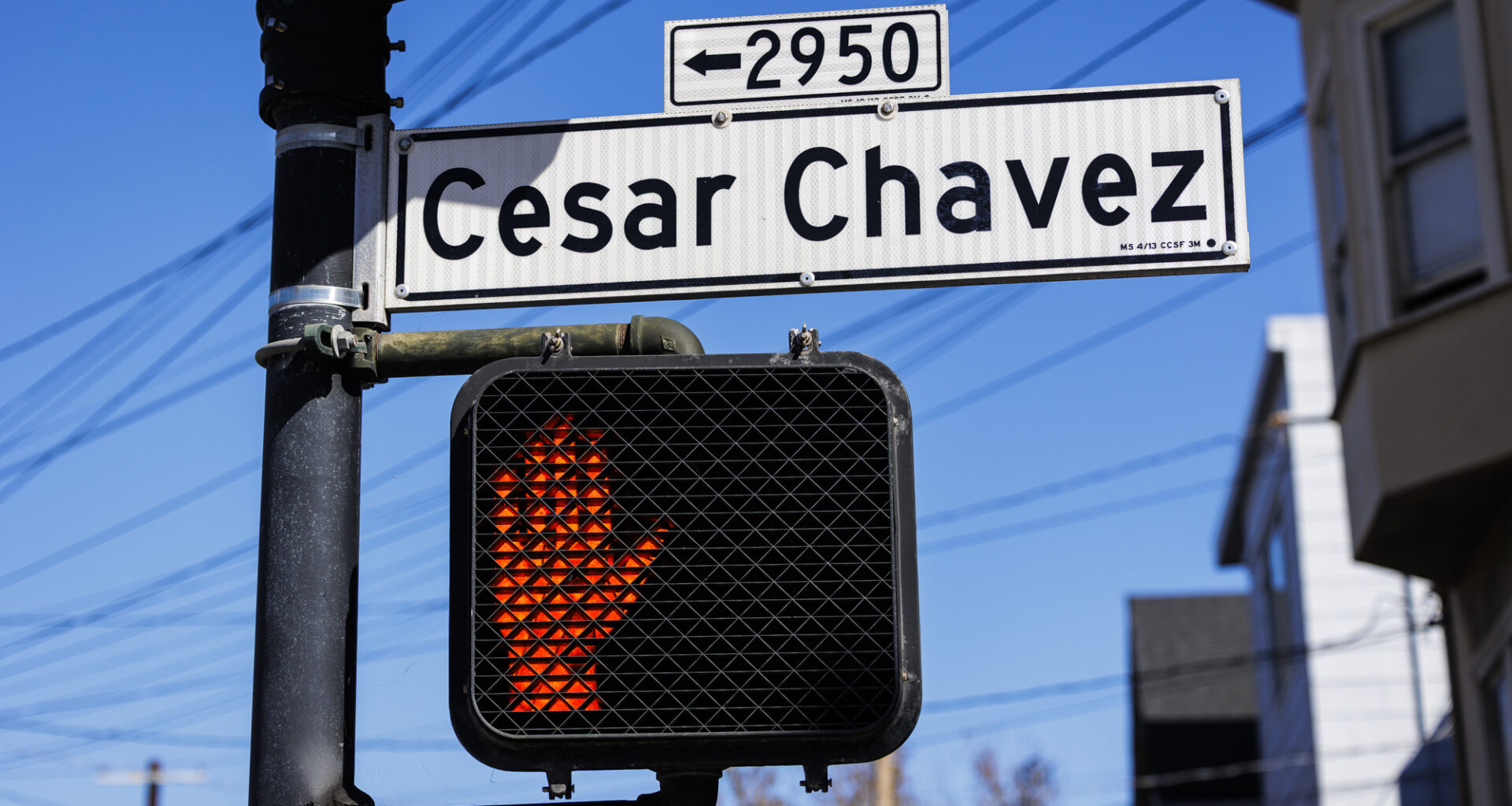
Many Latino San Franciscans saw the dedication as an acknowledgment of the farmworker movement Chavez helped build.
But after allegations surfaced this week that the civil rights icon sexually abused multiple young girls, and United Farm Workers co-founder Dolores Huerta, as he led the movement in the 1960s and ’70s, politicians have quickly proposed stripping his name from dozens of streets, schools, parks and monuments, and the state holiday in his honor at the end of the month.
The revelations have raised questions about how to further the movement’s legacy, without Chavez as the figurehead.
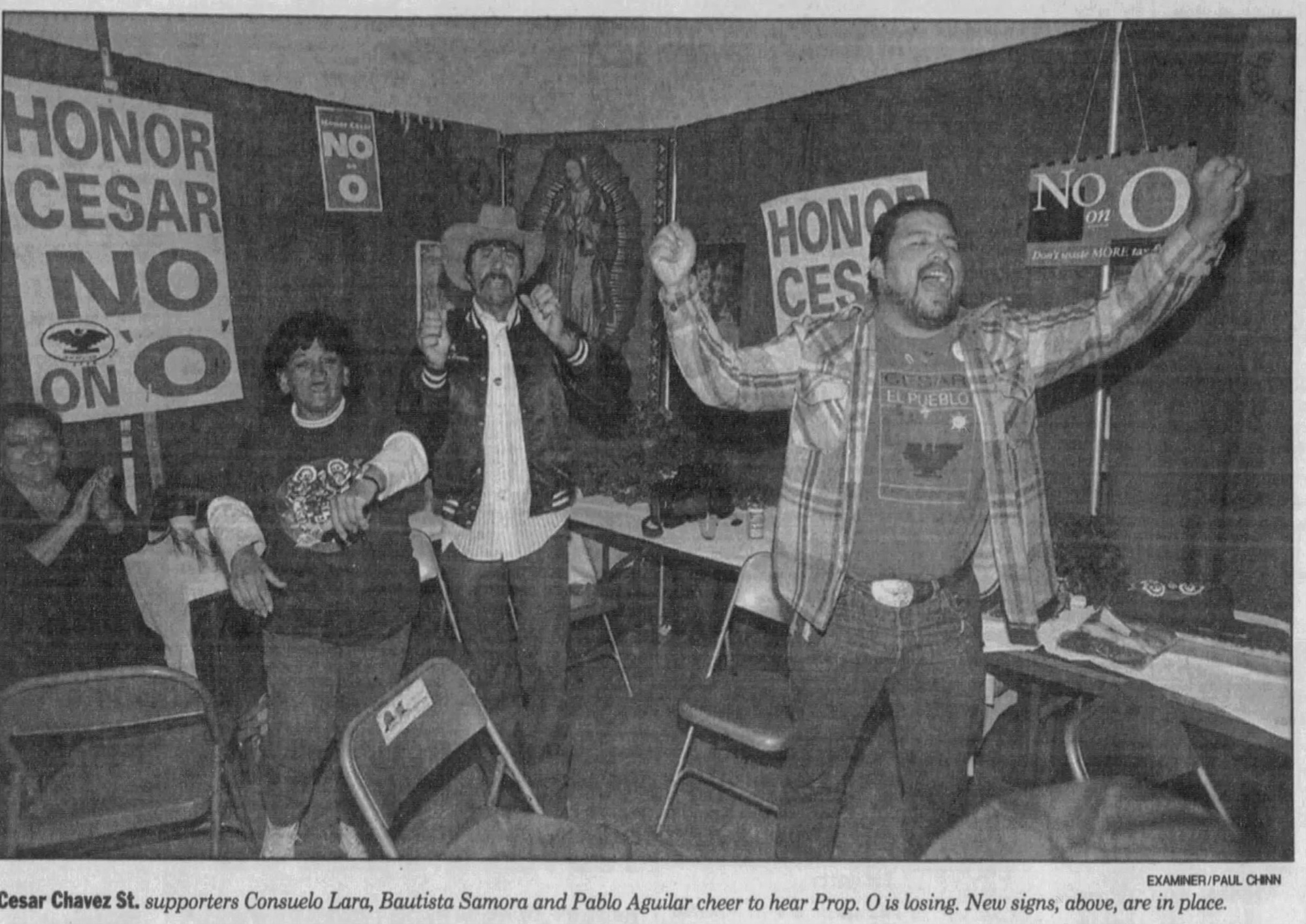 The ballot measure to strip Chavez’s name from the street failed by a wide margin in November 1995, as reported in the San Francisco Examiner, on Nov. 8, 1995. (The San Francisco Examiner via Newspapers.com)
“He was a symbol,” San Francisco State University labor historian John Logan said, “for a recognition of the farmworker movement, of the Chicano civil rights movement.”
“This [is an] incredibly important social movement and incredibly important worker movement,” he said, adding that now, it will be important “to find a way of trying to recognize those things without using his name.”
Reckoning with abuse
On Tuesday, The New York Times published an investigation revealing accounts from two women, now in their 60s, who said that they had been assaulted repeatedly by Chavez for years in the 1970s, beginning when they were 12 and 13, and he was in his 40s.
Huerta came forward with her own allegations that on two separate occasions in the 1960s, Chavez had pressured her into intercourse and later raped her.
Within hours, local officials and organizations across California launched efforts to strip Chavez’s name from public view. Sacramento’s mayor appointed city council members to rename Cesar Chavez Plaza in the state capital.
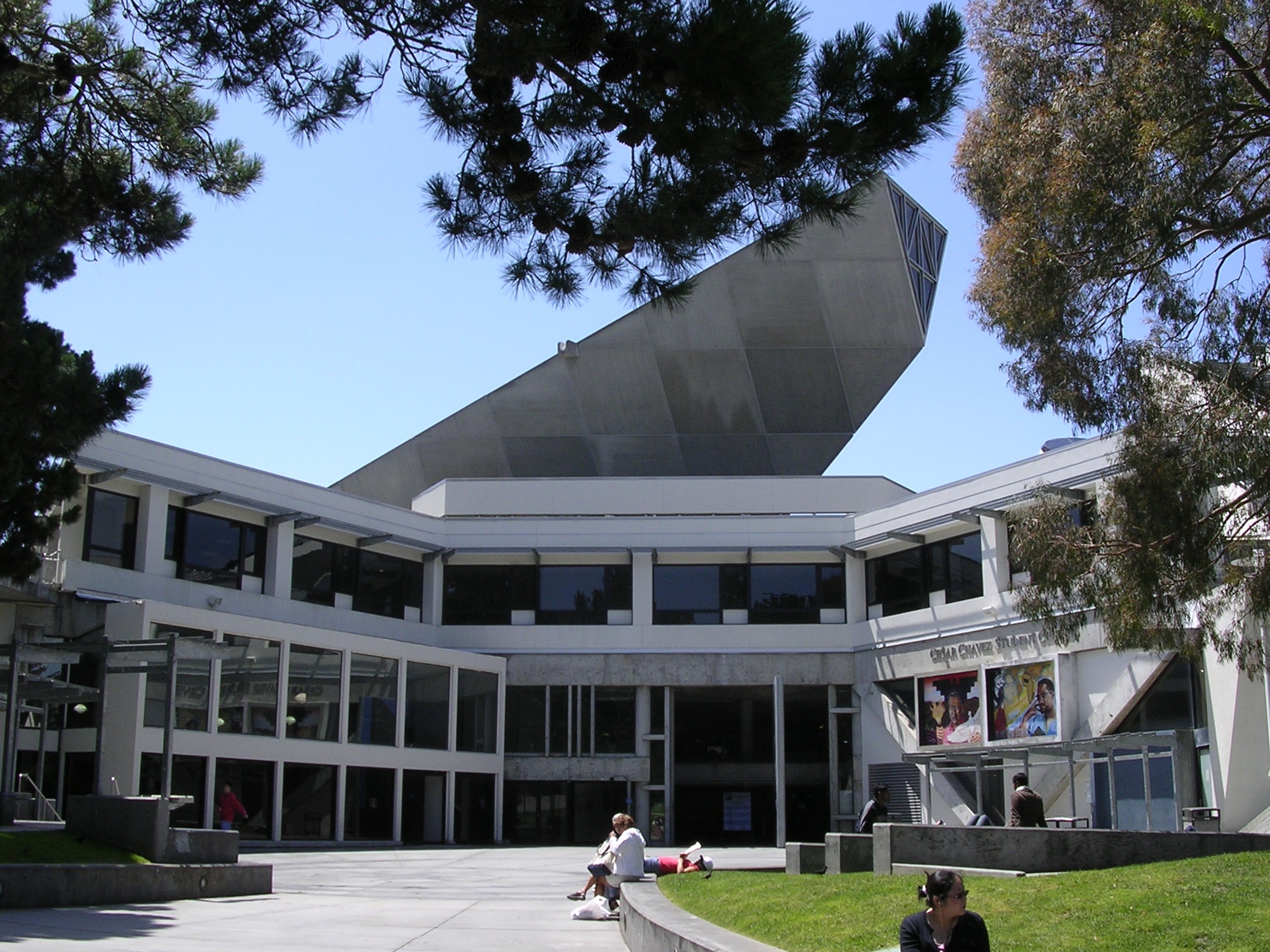 The Cesar Chavez Student Center at San Francisco State University on June 24, 2005. (Brian Trejo/Wikimedia Commons)
Fresno officials set a meeting for this week to remove Cesar Chavez Boulevard street signs and groups at San Francisco State and Sonoma State University announced plans to shroud his image and name on campus murals and on buildings.
Early Thursday, California Assembly Speaker Robert Rivas and Senate President Pro Tempore Monique Limón announced legislation that would rename the state holiday honoring Chavez at the end of March to Farmworkers Day.
“This moment calls for honesty. It calls for reflection. And it calls for a renewed commitment to the values that the farmworker movement was built on,” Rivas said, speaking on the California Assembly floor on Thursday.
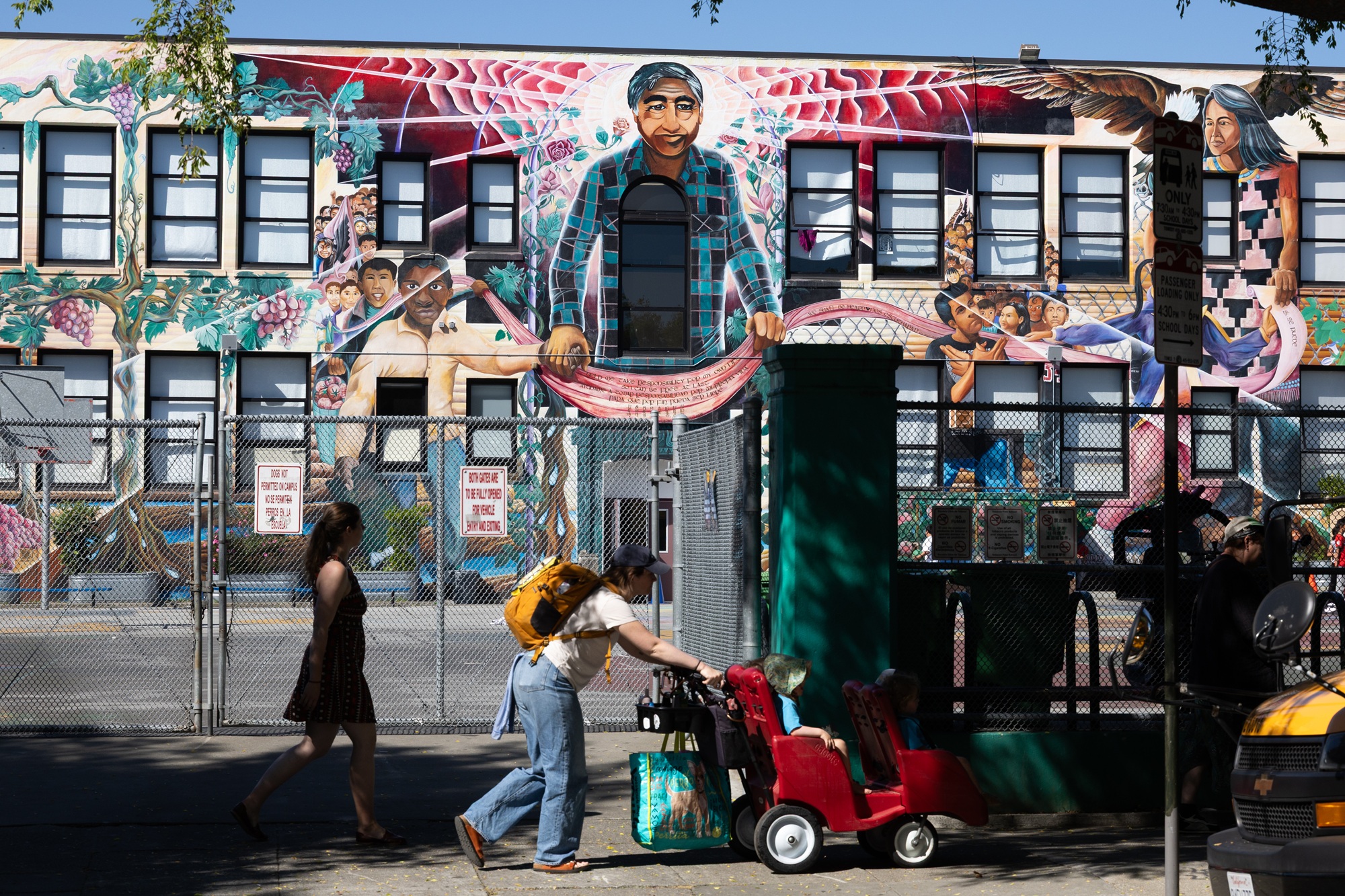 Pedestrians walk past César Chávez Elementary School on March 18, 2026, in San Francisco, California. Labor activist César Chávez has been accused in an investigation of sexual abuse of women and minors. (Benjamin Fanjoy/Getty Images)
While San Francisco leaders haven’t taken any concrete steps to strip Chavez’s name from the street, or from the public elementary school renamed in his honor around the same time, it seems more than likely in the coming weeks.
“My office will support community efforts to remove Cesar Chavez’s name from any District 9 institutions,” said Supervisor Jackie Fielder, who represents the Mission, which includes both sites.
“I think there should be no hesitation,” said former Supervisor Susan Leal, who served from 1993 to 1997, and helped lead the renaming effort.
A divisive renaming
Leal said the decision to name Army Street after Chavez was meant to acknowledge “unrecognized work of a lot of farmworkers.”
“The meaning of having Cesar Chavez Street is that it signifies we have a place here too,” Maria Paya, a grocer in the Mission District, told the Los Angeles Times that year.
But by the time the new street signs were unveiled that April, the decision had already sparked controversy, and a campaign to repeal the name change. Opponents put a citywide measure on that year’s general election ballot to restore the road’s name to Army Street.
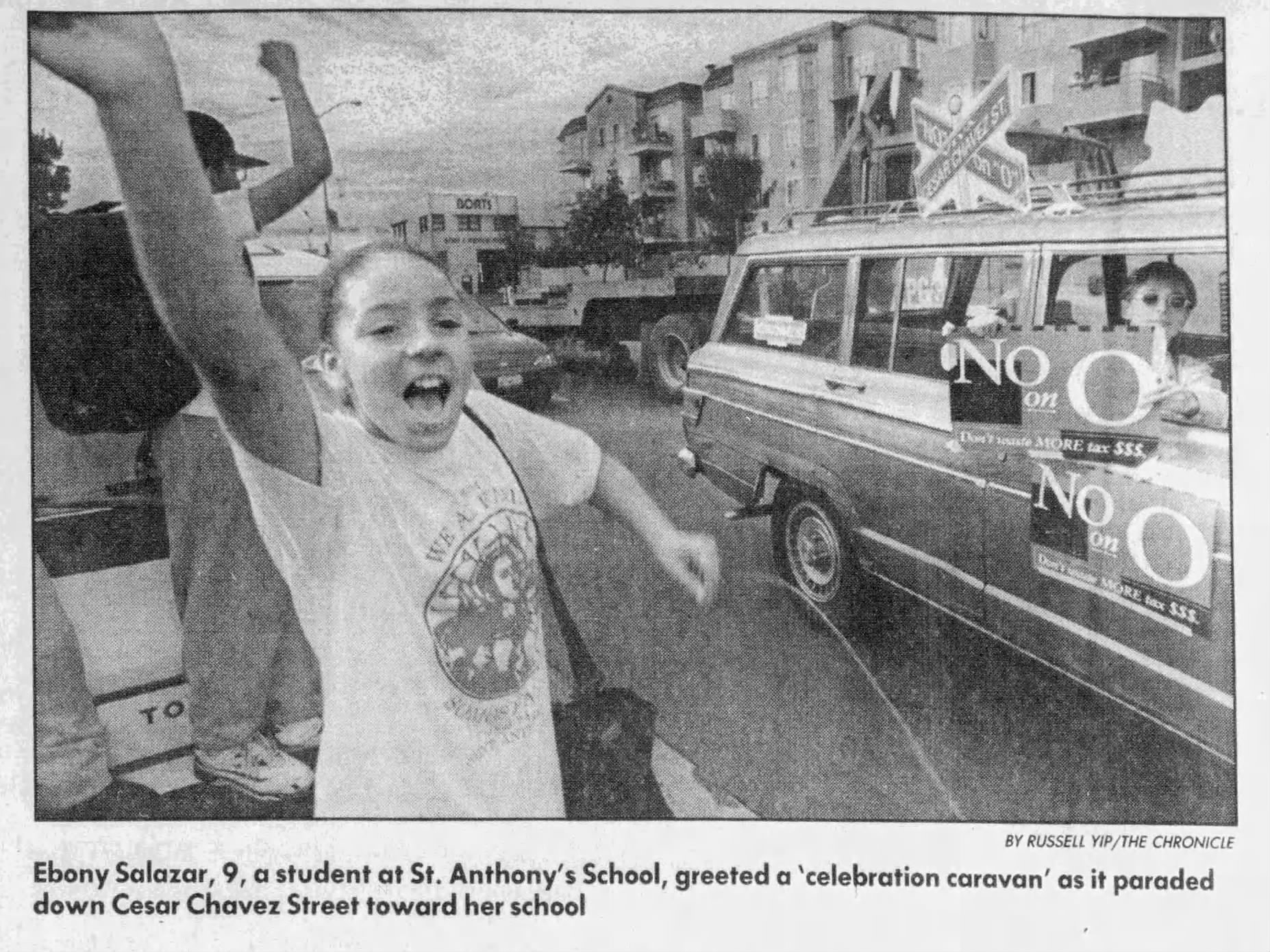 Opponents of the ballot measure to restore Cesar Chavez Street to Army Street celebrate with a caravan after it failed in 1995, as reported by the San Francisco Chronicle on Nov. 9, 1995. (The San Francisco Chronicle via Newspapers.com)
The battle became one of the most divisive that election cycle, according to newspaper reports at the time, pitting residents of the then-predominantly Latino Mission District, backed by thousands of United Farm Workers volunteers who traveled from as far as Bakersfield to campaign, against wealthy, majority white Noe Valley residents and small business owners who said they had an affinity for their addresses, and the 140-year-old Army Street name.
The renaming came at a time of heightened anti-immigrant sentiment, Leal said, not unlike today. The year prior, California voters passed Proposition 187, which aimed to block undocumented immigrants from accessing most health care services, public education and social services.
“If you would come up with another San Franciscan who was not of the farmworker movement, I think he might’ve gotten more support. It was not unlike Prop. 187,” Leal said.