
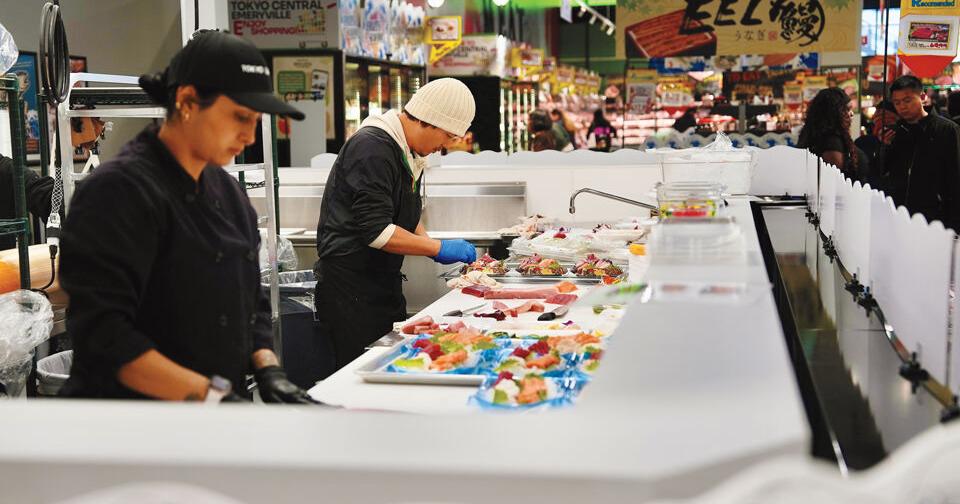

Fresh sushi, sashimi, and other Japanese fare is prepared at Tokyo Central Specialty Market in Emeryville.
Courtesy of Bay Street Emeryville
In the United States, grocery stores are typically places to buy, well, groceries. Not so much in Japan, says Kazuhiro Takeda, director and general manager of Osaka Marketplace, a Japanese-style store with two Bay Area locations and another on the way in Pleasant Hill.
“In Japan, food and culture are closely connected,” he explains. “We wanted Osaka Marketplace to be more than just a place to shop—it’s a place to experience Japanese food, traditions, and community.”
This means that Osaka not only carries hard-to-find-outside-Japan imported food, homewares, and beauty products but hosts annual events such as the Osaka Summer Festival, which highlights the city’s famed street fare. Takeda’s stores also feature fresh-cut sushi and food courts serving up made-to-order ramen, tempura, curry, and other popular dishes.
They facilitate a lively, immersive experience that blurs the line between eating and shopping in the spirit of Eataly—but with a Japanese focus.
“[The city of] Osaka is … known for its love of food and entertainment, and that spirit inspires our mission. We aim to make our customers’ daily lives more enjoyable through delicious experiences,” says Takeda. “Shopping at Osaka Marketplace is designed to feel like a small trip to Japan.”
The Osaka team hopes that the Pleasant Hill store, Osaka’s largest and most ambitious effort to date at 49,000 square feet with a separate, Japanese pop-culture–themed food hall, will serve as a destination for curious foodies up and down Interstate 680, from Sacramento to Dublin. It will also have some competition by the time it’s scheduled to open in July. Two other massive Asian grocery stores have opened in the East Bay this year featuring similarly dynamic shopping and dining experiences. At the end of January, Tokyo Central Specialty Market unveiled a new 40,000-square-foot location at Emeryville’s Bay Street mall. Boasting special Japanese food and cultural events, a hand roll restaurant, and even a Japanese vending machine section that kids will love, the chain also aims to be a one-of-a-kind draw.
“Our approach is centered on creating a shopping experience that feels like an authentic cultural experience,” says the store’s strategy division manager Koji Ichise.
Additionally, a vast outpost of H Mart is now in Dublin in the former Orchard Supply Hardware space near the intersection of interstates 580 and 680. (H Mart also recently announced a future location in Fremont that will be the Korean American chain’s biggest store in the United States.)
With about 100 U.S. locations, H Mart has become somewhat of a cultural phenomenon for its enormous selection of Asian goods and lively food halls packed with made-to-order Asian fare, as evidenced by a shout-out in Michelle Zauner’s best-selling 2021 memoir Crying in H Mart. The long-delayed Dublin store debuts March 26 and includes an 8,552-square-foot food hall.
But is there enough demand in the East Bay to support three new mega-markets? The region’s existing (and growing) Asian demographic provides an obvious built-in customer base. But particularly in the food-obsessed East Bay and greater Bay Area, interest is far broader, says Tokyo Central’s Koji Ichise.
“Asian cuisine has increasingly become a part of everyday meals, not only for Asian customers but also for non-Asian customers. … We believe the focus is shifting from simply being a store that sells Asian ingredients to becoming a place that delivers unique and memorable dining experiences.”
That outlook is seconded by Takeda, who targeted Pleasant Hill for a new Osaka Marketplace despite the area’s relatively low Asian population.
“I’ve been surprised to see how many non-Japanese customers now have detailed knowledge of Japanese products—some even know items I wasn’t familiar with,” he says. “The Bay Area is diverse and food-driven, and I believe stores with a clear identity and strong customer focus can succeed.”
Big Deals
What to expect at the East Bay’s three new Asian mega-markets.
Tokyo Central Specialty Market, Emeryville
Opening date: January 31
Other Bay Area locations: Cupertino
Offerings: Billing itself as the “ultimate one-stop destination for your Japanese grocery and lifestyle needs,” the grocer and retailer offers a huge variety of premium Japanese goods that include groceries, seafood, Wagyu beef, produce, snacks, and an extensive selection of alcohol, including 200 varieties of sake, as well as household, health, and beauty products.
Grab and go: Sushi, bento boxes, a hot buffet bar, and ready-to-go food trays are available for a quick bite or takeout. The Emeryville location also offers special onigiri made with rice that is milled fresh every morning.
Made-to-order: This location is home to a 1,625-square-foot restaurant, Hand Roll Factory, that serves à la carte hand rolls made with warm Hitomebore rice, toasted Ariake seaweed, special vinegar and soy sauce blends, and fresh fish such as premium bluefin tuna.
Events: Special happenings throughout the year may include shochu tastings, bluefin tuna cutting demonstrations, and fairs celebrating and highlighting culinary delicacies from Okinawa, Tokyo, and other Japanese regions.
Bonus: Tokyo Central is the exclusive U.S. seller of Jonetz, a popular line of products from discount Japanese chain and sister company Don Quijote.
H Mart, Dublin
Opening date: March 26
Other Bay Area locations: San Francisco and San Jose (2)
Offerings: The largest Asian supermarket in the U.S. carries a vast selection of Korean and other Asian groceries and food products. Stores typically offer homemade kimchi and other Korean side dishes and snacks, meats, a live fish seafood counter, alcohol including Korean soju, and an in-house bakery.
Grab and go: Rice bowls and plates with grilled meats, sushi, japchae stir-fried glass noodles, and roasted Korean sweet potatoes are among the ready-to-eat dishes prepared in-house.
Made-to-order: A standalone food hall populated by vendors from local Asian restaurants serving Korean fried chicken, tofu stew, baked goods, and more.
Events: TBD
Bonus: The Dublin location features a 3,100-square-foot outdoor seating space with a small kids’ play area.
Osaka Marketplace, Pleasant Hill
Estimated opening date: July
Other Bay Area locations: Foster City, Fremont
Offerings: Customers can expect imported Japanese groceries, snacks, fresh produce, meats (such as A5 Wagyu beef), seafood (including seasonal fish from Japan), and sake and other drinks, plus home goods and beauty products.
Grab and go: Sushi and sashimi will be prepared daily at the seafood counter, while bento boxes and baked goods will be made in-house.
Made-to-order: A 9,000- square-foot food hall adjacent to the market will serve up ramen, katsu, tempura, and more in a fun setting designed to reflect elements of Japanese pop culture such as anime and gaming.
Events: An annual Osaka Summer Festival and fall Beauty Fair, with other special events throughout the year.
Bonus: Osaka is currently aiming to open 12 new stores across the Bay Area over the next 10 years and is actively considering locations in Dublin and San Ramon.
The flood of new Asian markets extends beyond the East Bay, including several Bay Area establishments.China Live
The San Francisco hot spot is opening a new two-level restaurant and market spin-off called Asia Live in Santa Clara’s Westfield Valley Fair shopping center.
Hashi Market
The Japanese grocer will bring its first West Coast store to Cupertino.
Jagalchi
This Mega Mart offshoot opened a 75,000-square-foot complex in Daly City’s Serramonte mall, complete with two bars and a restaurant.
Mega Mart
The international Korean supermarket chain recently launched its third Bay Area store in East Palo Alto. Its previously planned Dublin location appears to be on hold for now.
T and T Supermarket
Canada’s largest Asian grocery chain is opening three Bay Area stores in Millbrae, San Francisco, and San Jose.