
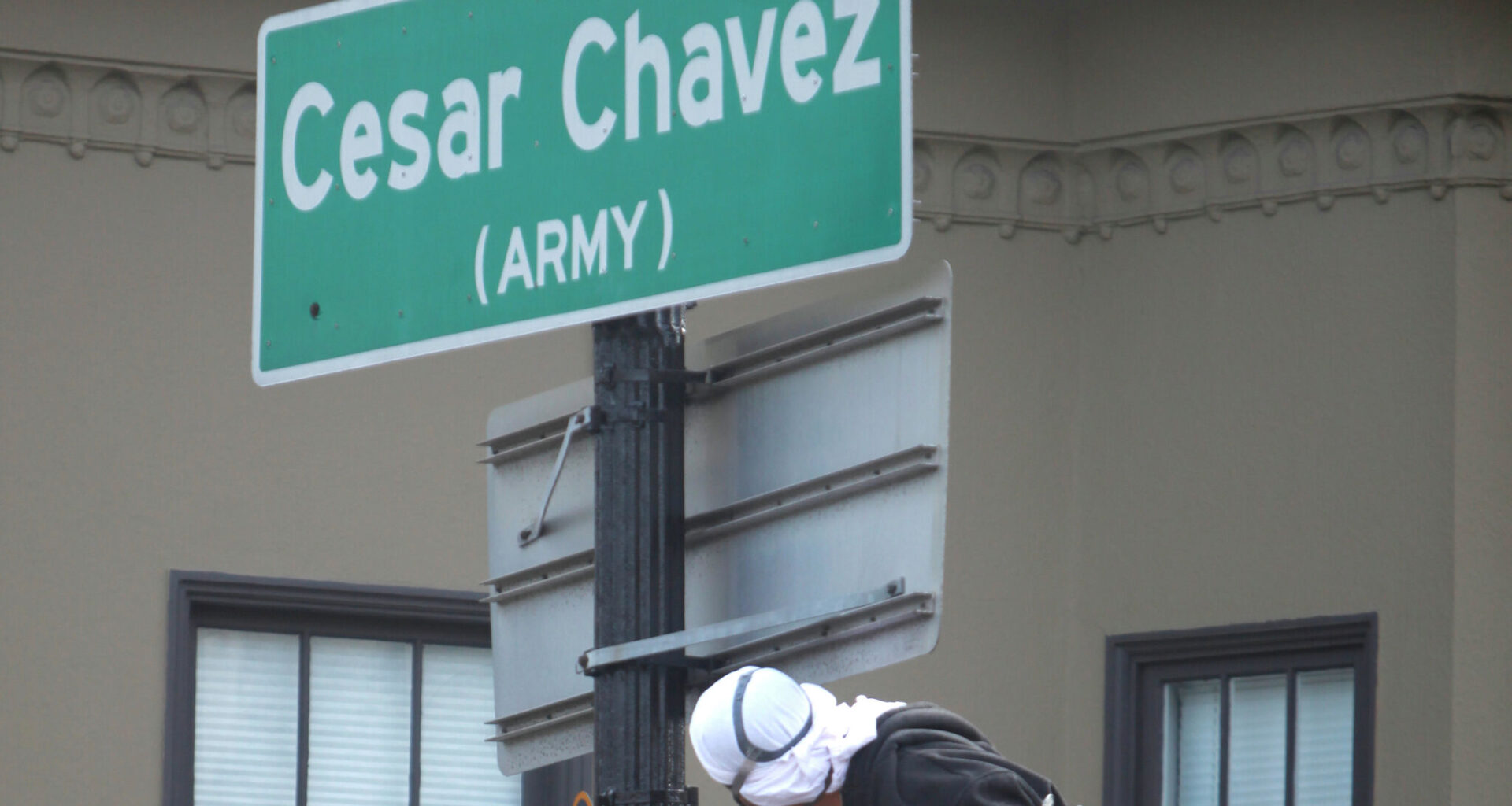
A worker prepares a sign for Cesar Chavez Street when it was renamed from Army Street in San Francisco in 2014. Some groups are pushing to rename sites named for Chavez after sexual abuse allegations against the labor rights icon were publicized.
Lea Suzuki/S.F. ChronicleJoel Pett/Tribune Content Agency
Regarding “Cesar Chavez’s name is all over the Bay Area. Will streets, schools and parks get renamed?” (Bay Area, SFChronicle.com, March 18): As a Latino business leader in San Francisco who has supported Dolores Huerta’s Girl Scouts Latinas initiative, I am grieving and reflecting alongside our community as we absorb the recent, devastating allegations about Cesar Chavez.
Huerta has now said that she was raped by Chavez and that she stayed silent for decades to protect the farmworker movement she helped build. Her choice to carry that wound quietly so the cause could survive is heartbreaking and morally clarifying. It forces us to confront how often women’s pain has been the hidden cost of our heroes’ public legacies.
San Francisco and the Bay Area have a proud history of reexamining who we honor in our public spaces. At this moment, we should seriously consider elevating Huerta’s name on our schools, streets and institutions — not to erase history, but to tell a fuller truth about it.
Article continues below this ad
Putting Huerta’s name on these places would affirm what she has embodied for more than six decades: that real leadership puts community above ego, justice above image, and survivors’ humanity at the center of our story.
Carlos Solórzano-Cuadra, CEO, Hispanic Chambers of Commerce of San Francisco
Keep Sunday parking free
Regarding “Could San Francisco revive Sunday parking meters to fund Muni?” (San Francisco, SFChronicle.com, March 17): It’s with great indignation that I read that the San Francisco Municipal Transportation Agency may consider charging for parking meters on Sundays.
San Francisco Chronicle Logo
Make us a Preferred Source to get more of our news when you search.
Add Preferred Source
In recent years, the agency has done its best to eliminate parking spaces in the city — to the detriment of senior citizens, disabled drivers and struggling small neighborhood businesses.
Article continues below this ad
Transportation planners (seemingly younger people who ride bicycles) have ignored the needs of the majority of citizens. Only 16% of San Francisco residents are frequent bicyclists. Yet the agency has prioritized cyclists and misguidedly changed the city’s street architecture to eliminate parking.
Now, with outrageous irony, there is another suggestion to increase fees on the remaining parking spaces to help make up for the agency’s large budget deficit.
The city should have left a good thing alone; with more parking meters, there would be more revenue.
Karen Cliffe, San Francisco
Hold yourself accountable
Regarding “Family of 5-year-old sues California ski resort over a hot chocolate burn” (California, SFChronicle.com, March 18): It seems to me that we have become a society of blame. People do not want to take responsibility for anything.
Article continues below this ad
In this case, why didn’t the parents check the heat of the cup before their daughter drank her hot chocolate? Instead of doing the responsible thing, they blame the server and the resort.
As a therapist, I work with many teachers, and listening to them talk about their difficulties with parents, I see the same thing. It’s never their child’s fault; it’s the educators, the schools, the friend of their child.
Wake up, people, it is time to take responsibility for ourselves, our problems, our country and our actions, and how they affect the world.
Cindy Richardson, Santa Rosa
Penalize distracted drivers
Regarding “Drivers are watching YouTube and TikTok behind the wheel. Experts say it’s getting worse” (Tech, SFChronicle.com, March 17): Why are people who willfully do not look at the road while driving treated any differently from intoxicated drivers?
Article continues below this ad
Guest opinions in Open Forum and Insight are produced by writers with expertise, personal experience or original insights on a subject of interest to our readers. Their views do not necessarily reflect the opinion of The Chronicle editorial board, which is committed to providing a diversity of ideas to our readership.
Read more about our transparency and ethics policies
I’d feel a whole lot safer sharing the road with a driver over the legal limit who is looking at the road than with a sober one who, given the choice between looking ahead and staring at their phone, chooses their phone.
Why are these people not sent right off to jail while losing their licenses, too? The reason the phenomenon is on the rise is that it’s not being treated seriously with big penalties.
Larry Schorr, San Francisco