
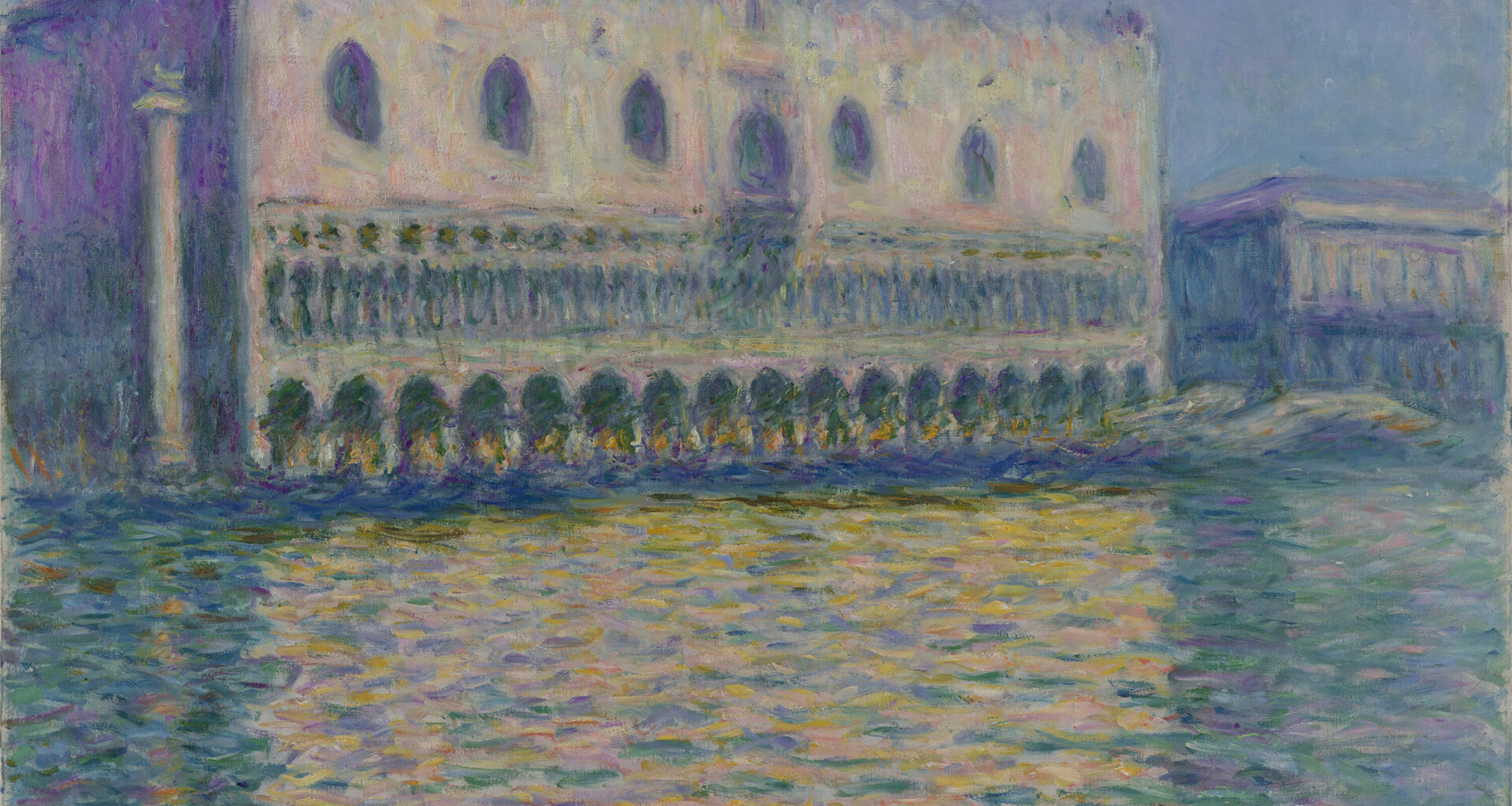
Without Venice, Claude Monet may have never become known for his iconic water lilies.
That’s the bold thesis of “Monet and Venice,” a new exhibition of the impressionist’s work opening March 21 at the de Young museum in San Francisco. Monet had canceled his planned 1907 exhibition of his water lilies after he became dissatisfied with his progress on the canvases. Then when his art dealer, Paul Durand-Ruel, brought up questions of the series’ marketability, the French painter decided to give up his water-lily project “once and for all.”
Monet’s wife Alice Monet suggested a trip to Venice, which would give her husband an opportunity to work on something other than the flower-dappled waters that had overtaken his soul. What was supposed to be a two-week sojourn stretched into a two-month creative transformation.
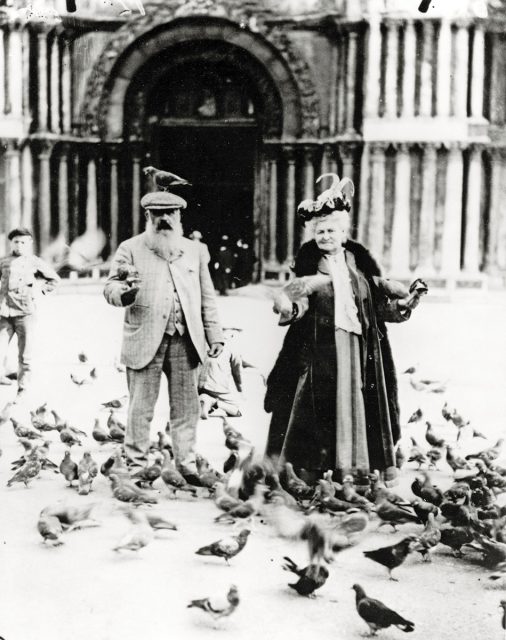 Claude Monet and his wife, Alice, St. Mark’s Square, Venice, October 1908 (b/w photo) by French Photographer, (20th century); Musee Marmottan Monet, Paris, France. Courtesy of the Fine Arts Museum
“My trip to Venice has had the advantage of making me see my [water lily] canvases with a better eye,” wrote the artist after his stay in Venice, where he hopscotched around various homes and hotels, a map of which is part of the exhibition. He returned to the project he had renounced — and went on to become famous for his shimmering, watery tableaux filled with lilies.
Melissa E. Buron, director of collections and chief curator at the Victoria and Albert Museum and the exhibition’s co-curator, had a hunch about the Monet-Venice connection before she found the quotation that underscored her thesis.
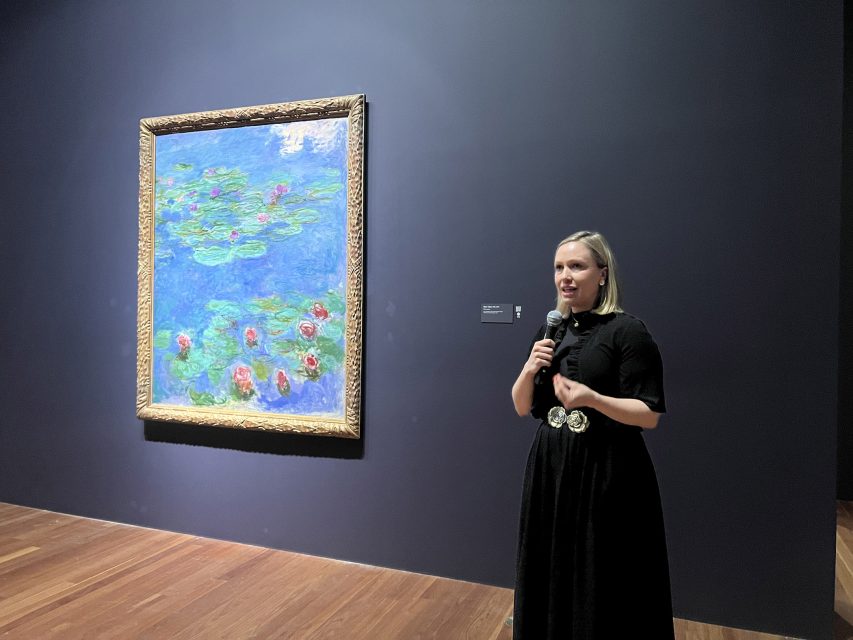 Co-curator Melissa E. Buron with Claude Monet, “Water Lilies,” ca. 1914-1917. Photo by Julie Zigoris
“As an art historian, you make certain assumptions and do your best to contextualize,” Buron said. “But it is really incredible to have, in Monet’s own words, this confirmation that Venice made him see his paintings with a better eye.”
The exhibition, in turn, becomes about the nature of inspiration itself — a process Buron, who formerly worked for the Fine Arts Museums in San Francisco before moving to London, learned as she went through a curatorial journey putting together the show. Buron said it felt appropriate that the exhibition was returning to the city in which the idea for it was born — and also that it was happening on the centenary of the French impressionist’s death on Dec. 5, 1926.
Lessons from Monet emerged: a change of perspective can help in the creative process, moments of self-doubt can fuel one’s work and one is never too old to achieve a vision. Monet was 68 when he left for Venice.
“Monet thought it was too late to go to Venice,” Buron said. “But he will go on painting for nearly two decades after that, making the work for which he is most famous.”
Monet’s preoccupation with water is a constant in his career, whether he’s depicting scenes in Paris or London or Venice, and “Monet and Venice” has canvases that portray scenes from the Normandy coast, Parliament and the canals.
Having swapped his Seine studio boat for a studio gondola, Monet crafted canvases composed of rippling water, shimmering light, and pastel architecture — but no people. Quite unlike Venice.
“It’s swarming with people,” said Lisa Small, senior curator of European art at the Brooklyn Museum. “And it was in 1908, too, when he was there, but he made a decision to not see or not paint any of that.”
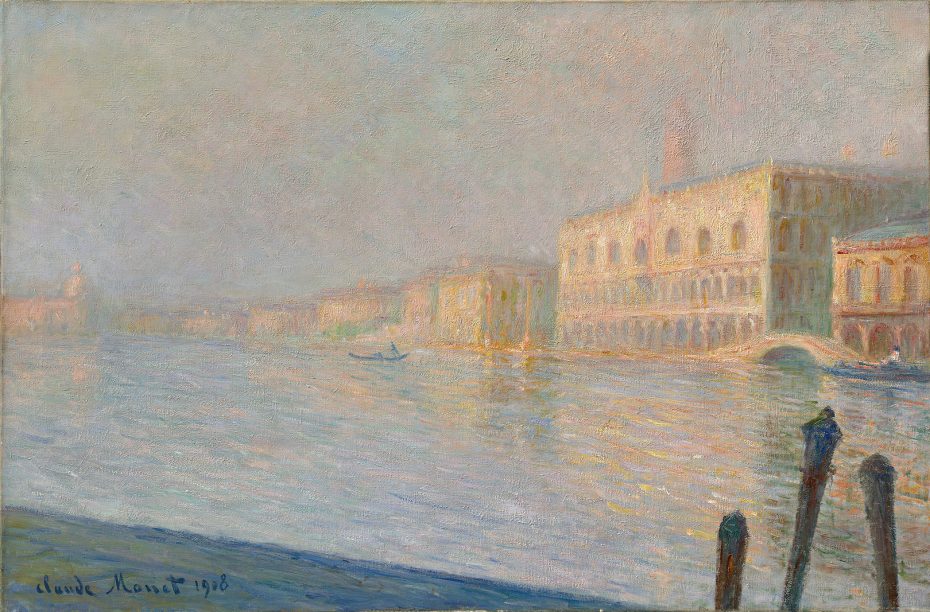 Claude Monet, “The Palazzo Ducale,” 1908. Courtesy of the Fine Arts Museum.
The museum previously held exhibitions focusing on Monet’s early and late years; using the Venice approach felt like a way to examine the middle, Buron said, at a time when the museum needs shows with big names to pull visitors in.
Co-organized by the Fine Arts Museums of San Francisco and the Brooklyn Museum, “Monet and Venice” gathers together more than 20 of the artist’s 37 Venetian canvases. It’s anchored by two of his masterpieces, “The Doge’s Palace” and “The Grand Canal, Venice.” Yet it stretches beyond the impressionist’s work to highlight how La Serennisima inspired other artists such as Canaletto, Pierre-Auguste Renoir, John Singer Sargent, J. M. W. Turner and James McNeill Whistler and includes maps and prints of the city.
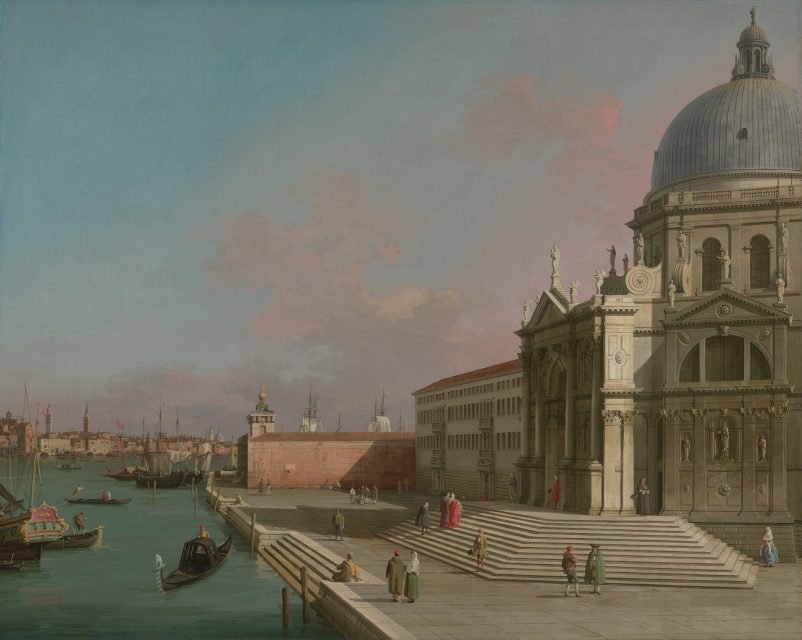 Canaletto (Antonio Canal), “Venice, the Grand Canal looking East with Santa Maria della Salute,” 1749-1750. Photo by Randy Dodson, courtesy of the Fine Arts Museums of San Francisco
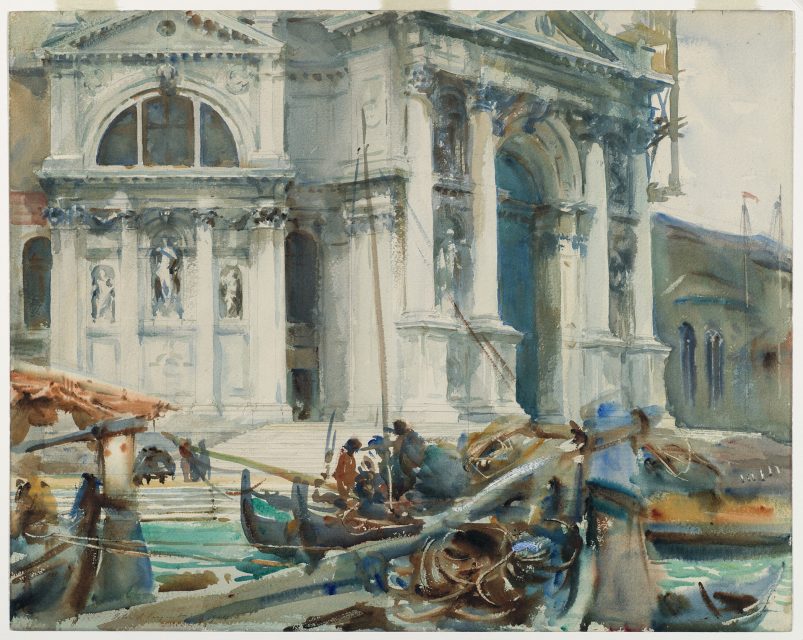 John Singer Sargent, “Santa Maria della Salute,” 1904. Courtesy of the Fine Arts Museum.
Running through July 26, San Francisco is the last stop on the two-city exhibition. It is meant to be in dialogue with “Drawn to Venice” on until Aug. 2 at the Legion of Honor.
While it’s often difficult to see a painter as famous as Monet in a fresh way, “Monet and Venice” aims to do just that. The paintings it inspired may never have existed without the influence of Monet’s wife. As Buron points out, it’s essential to surround yourself with people who believe in you.
“If not for the dedication of Alice Monet, encouraging him to go to Venice to continue painting, who knows what might have happened,” she said.