
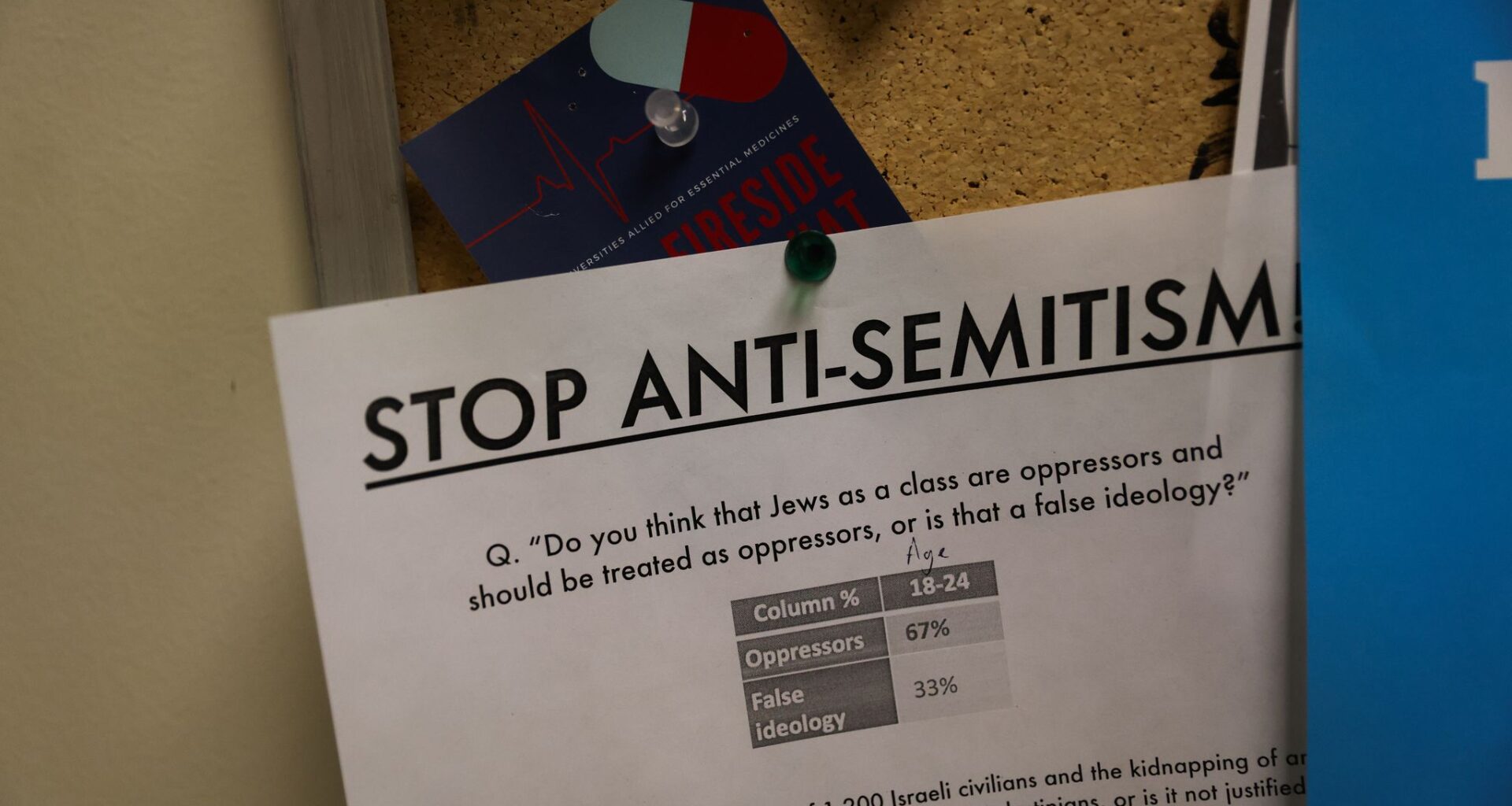
A flyer about antisemitism is posted on a UC Berkeley bulletin board outside professor Ron Hassner’s office on March 18, 2024.
Gabrielle Lurie/S.F. Chronicle
UC Berkeley has settled a Zionist organization’s lawsuit by agreeing to instruct students, faculty and staff on the dangers of antisemitism and to pay $1 million to cover the group’s legal fees and costs. But the settlement does not appear to have accomplished the suit’s main goal: requiring student groups to allow Zionists, who define Israel as a Jewish state, to speak at their meetings.
The suit by the Louis D. Brandeis Foundation, filed in 2023, accused UC Berkeley of discriminating against Jews by allowing student groups to bar Zionists as speakers, a policy then followed by 23 of the 100 organizations in Berkeley’s 1,100-student law school, according to the suit.
In a statement Thursday announcing the settlement, the Brandeis Foundation declared that the university had agreed to ensure that student organizations “cannot exclude persons from … speaking regardless of their support for Israel or Zionism.”
Article continues below this ad
But the settlement says only that the bylaws of student organizations registered with the university, which define such things as an organization’s overall mission, cannot prohibit any category of speakers.
Registered student organizations, or RSOs, “may not limit officers, board members, or speakers based on a category that is protected under federal or state law,” the agreement says. “This does not limit the discretion of RSOs to determine which speakers to invite or the content of and positions taken in any speech sponsored by the RSO.”
San Francisco Chronicle Logo
Make us a Preferred Source to get more of our news when you search.
Add Preferred Source
That means the organizations remain free to make their own policies for speakers at their meetings, said Erwin Chemerinsky, dean of the UC Berkeley Law School.
“Under the settlement, student organizations may continue to have policies as to who they will invite as speakers, including on the basis of viewpoint,” Chemerinsky wrote in a message to the Berkeley law community.
Article continues below this ad
In contrast to a student group’s mission-defining bylaws, Chemerinsky told the Chronicle, the university’s rules, and the constitutional right of free speech, allow those groups to decide whom to invite as guest speakers.
“To the extent their press release says that student groups can’t have policies based on speakers’ viewpoints, they’re misrepresenting the settlement,” Chemerinsky said.
A lawyer for the Brandeis Foundation disagreed.
Anti-Zionism “has been used as a pretext for discrimination against Jews,” attorney Paul Eckles said in an interview. That means, he said, that under the university’s stated policies, “groups cannot discriminate against speakers based on Zionism.”
Under the settlement, Eckles said, such disputes can be referred to a UC Berkeley office that considers complaints of bias, but, if necessary, they will be taken to court.
Article continues below this ad
The 2023 lawsuit alleged a “longstanding, unchecked spread of antisemitism” at UC Berkeley, citing the exclusion of pro-Zionist speakers and the university’s refusal to restrict protests against Israel’s military operations in Gaza, following the October 2023 attack by Hamas.
The settlement requires the university to send an annual message to students that “discrimination or harassment on the basis of Jewish religion … or Israeli national origin will not be tolerated,” and to provide anti-discrimination training to faculty and staff. When reviewing complaints of antisemitism, the university must consider — though it will not be required to follow — a definition by the International Holocaust Remembrance Alliance that says anti-Zionism can be considered antisemitic.