
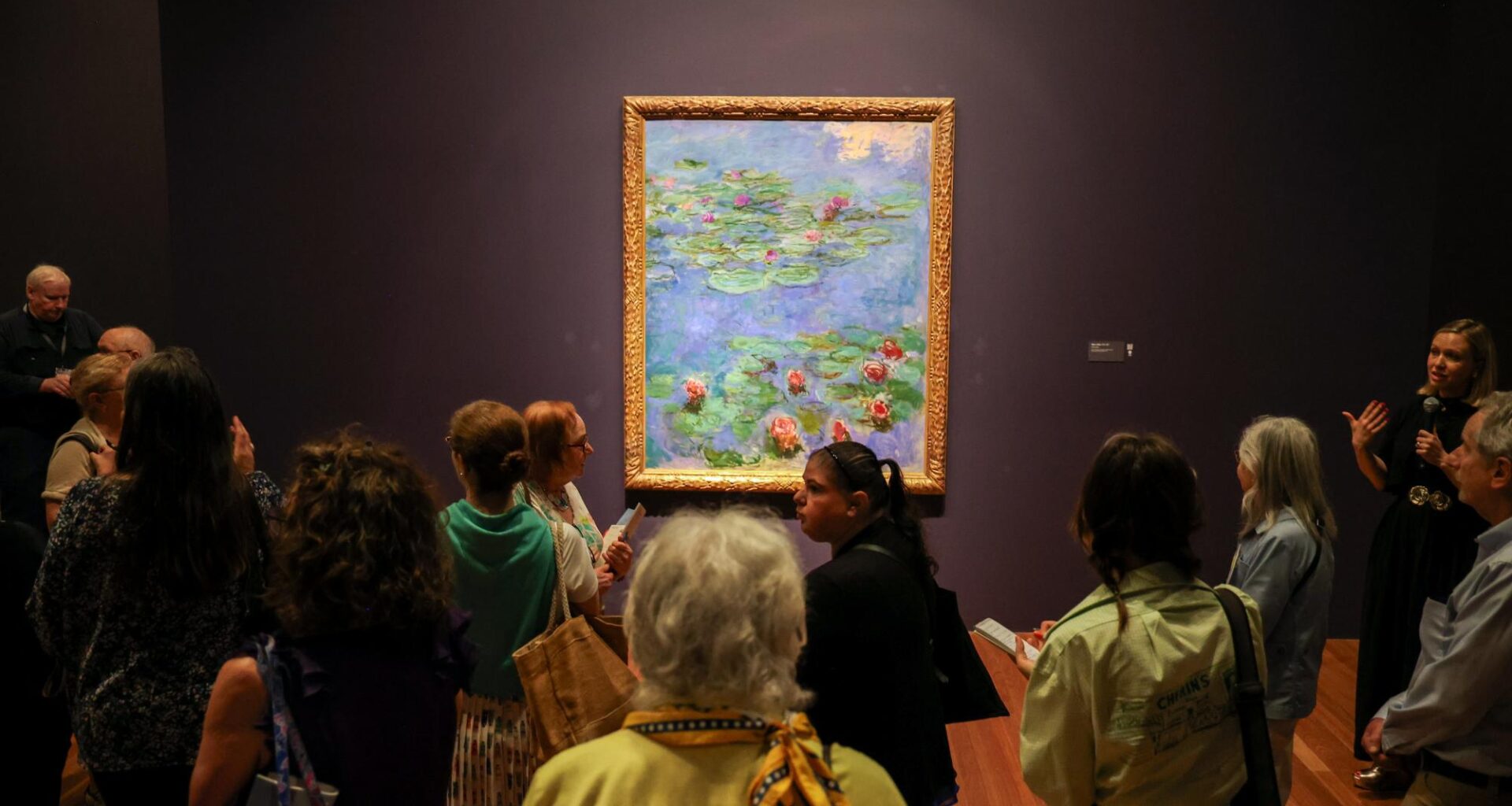
Claude Monet’s first visit to Venice in his late 60s inspired the paintings behind the de Young Museum’s spring 2026 exhibition, “Monet in Venice.”
Opening at the de Young Museum on Saturday, March 21 as a collaboration with the Brooklyn Museum, the collection of works showcases prominent themes of renewal following Monet’s 1908 visit to Venice. At the core of the exhibition resides de Young’s former director of curatorial affairs, Melissa Buron, as co-curator.
“When I left San Francisco a couple years ago, I absolutely left part of my heart here, and part of that was in this exhibition,” Buron said. “When you’re working on an exhibition, it becomes part of your family.”
The Fine Arts Museums of San Francisco are no strangers to housing Monet’s work. Various Monet-centric exhibitions around the world have made their way through museums throughout the years in a continual tribute to the legendary painter.
Stepping up to the podium for opening remarks during the exhibition’s press release on March 18th, FAMSF’s director and CEO Thomas Campbell expressed his elation in reprising de Young’s housing of Monet and acknowledged the labor that contributed to the exhibition.
“I don’t want to let this moment pass without sharing my heartfelt gratitude to the many, many staff members, donors and lenders who have made this extraordinary exhibition possible,” Campbell said. “We are proud to share this magnificent exhibition with Bay Area audiences.”
With a wide spectrum of gratitude for how the “Monet and Venice” came together, Buron and Campbell rushed through their remarks, giddy and eager to show guests the end result.
As attendees were ushered into the Herbst Exhibition gallery downstairs, painted in the shade, “Blue Gaspe,” Buron set the grounds early on with moody, shuttering, black-and-white gondola footage from Venice as she recounted a brief biography of Monet himself.
Monet remains a revered figure of the impressionist movement in the modern art world, but his rise to fine art stardom did not come without challenge from critics.
“These artists are not painting the grand pictures that were of the subjects that were expected by the critics in Paris at the time,” Buron said. “They’re painting loosely, they’re painting with unmixed colors and no one really knows what to do with this group who are breaking all of the prescribed codes of what people thought they knew about art.”
Beyond impressionism, Monet continued to challenge style guidelines as he worked his way through Venice in a two-week trip turned into a two-month long artistic study. Canaletto, a native Venetian painter, served as a major inspiration to the starstruck visitor.
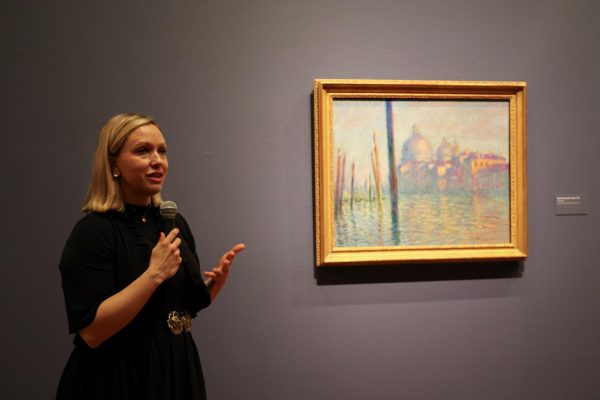 Melissa Buron, co-curator of Monet and Venice and former director of Curatorial Affairs at the Fine Arts Museums of San Francisco, discusses one of Monet’s many pieces created along the Grand Canal in Venice on Wednesday, March 18, 2026. (Klyde Java / Golden Gate Xpress) (Klyde Java)
As Monet gained his chops painting in Venice, he produced a total of 37 known works; De Young is currently showcasing 23.
While de Young owns the majority of the 100+ works by various artists in the exhibition, it enlisted external help from other museums with Venice-related collections. The de Young maxed out of their lender policy of 12 pieces per exhibition in the acquisition of both Monet pieces and auxiliary Venetian scenes.
“One of the interesting challenges is we’re doing a show about Monet in Venice, but we want to include other work,” Small said.
Despite the sprawling multi-room exhibition, Small expressed her desire to showcase all 37 of Monet’s Venetian works as a complete collection.
Wandering through the galleries, Buron and Small made the cautious distinction that Monet’s trip to Venice produced a vastly different collection than his popular serialized works.
Even to a Monet novice, it’s easy to get lost in the dreamy pastels of the Venetian skyline and shimmering canals. Monet’s intentional omission of people from his paintings is a far cry from the Venice we know today, overpopulated with tourists. Despite the exuding pleasure from ornate gold-gilded frames, it is rumored that Monet told a friend he would “not go to Venice.”
“The only suggestion that we have of industry, or tourism, are these bits of gondolas, flicking along the surface of the water. It’s not Canaletto’s Venice. It’s not a Venice of people,” Buron said. “It’s ceremony. It’s a Venice of atmosphere and light and of mood.”
Monet held an inspirational wonder for cities, and his depictions of Venice continue the love letter one brushstroke at a time.
“Monet and Venice” is a diversely biographical reprise of impressionism’s greatest master, giving de Young a continued reputation in the highest attention to fine art. “Monet and Venice” is open to the public from March 21 to July 26, 2026.
“Creative renewal is always possible. It’s never too late. You’re never too old,” Buron said. “Sometimes self-doubt can fuel you to do the work that you were meant to do.”