
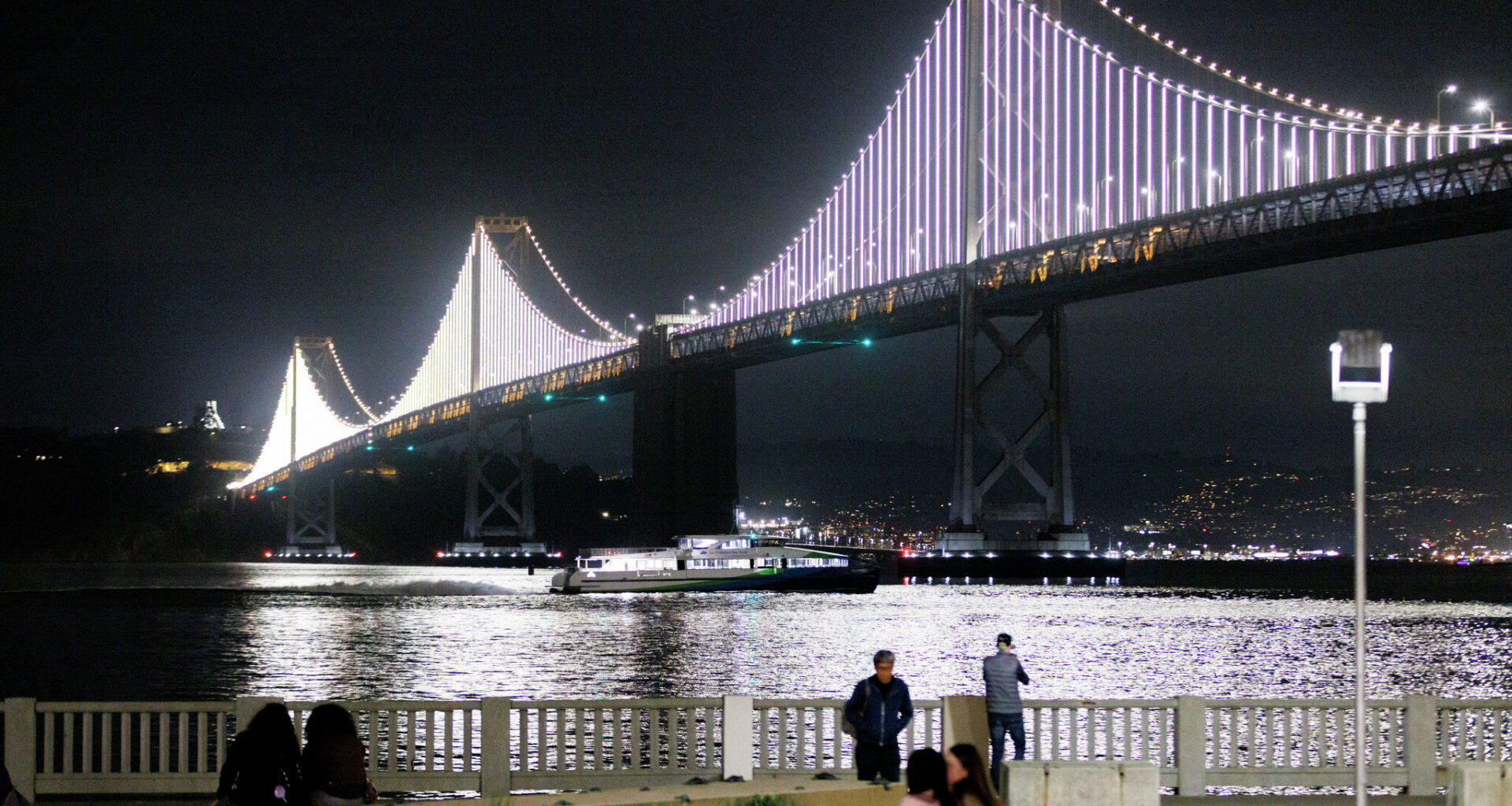
Stand on a terrace near San Francisco’s waterfront, and you’ll see them: Thousands of tiny lights twinkling from the Bay Bridge’s suspender cables, draping the western span like a sequined gown.
“Bay Lights 360” will go live at about 7:30 p.m. Friday night following celebrations with bands, speeches from city leaders and people in blinky costumes. The revelry caps off three years of darkness and a “burn-in” period to ensure they could withstand winter storms. Generated from computers in a Caltrans electrical room on Yerba Buena Island — soon to be transferred to a bunker beneath the bridge — the dancing lights will turn a piece of workhorse infrastructure into an Instagram-worthy tableau.
Artist Leo Villareal is the wizard who created them, sitting on balconies along the Embarcadero and tinkering on a laptop. He’d connected the machine remotely to the control center at Yerba Buena, programming light patterns that would run every night.
“It’s all inspired by the kinetic activity around the bridge,” Villareal said, standing at a waterside pier as dusk gathered on a recent weeknight. He was hunched over a MacBook Pro that he’d positioned, somewhat precariously, on a cement rail, its screen filled with rows of code and real-time simulations of the span.
Overhead stood the canvas itself, a massive steel structure with car headlights winking from its road bed, and gulls flying through its sinewy cables. Villareal wanted to evoke all of these sights and sensations, tweaking the software script to capture light and shadow that he calls “negative space.” To the untrained eye, his improvisations look like pictures that flash across the Bay Bridge cables and towers: champagne bubbles, birds, silhouettes of sharks.
Villareal created the first iterations of “Bay Lights” in 2013 by stringing 25,000 LED nodes along the bridge cables. Years of brute weather and corrosion forced Villareal to retire the lights in 2023, always with the intent of resurrecting them. But getting to this point wasn’t easy. A civic art nonprofit called Illuminate rallied $11 million in donations to rebuild and enhance the project. The team hired crews of engineers to string the LEDs up at night, usually closing a lane of traffic and hoisting themselves up in baskets as cars whooshed by at 50 miles per hour.
For the final stage, Villareal flew from his home in New to San Francisco, where he worked, night after night, from borrowed apartments and hotel rooms that provided a birds-eye view of the bridge. During his final week of programming, the artist and his software expert, Raphael Palefsky-Smith, set their workstation in a vacant luxury condo unit, on the eighteenth floor of a complex on Steuart Lane. They peered down at the bridge towers through untinted window glass, which allowed them to work inside.
Their new version of “Bay Lights” ultimately features 50,000 LEDs, only half of which will be activated on Friday. These bulbs, placed on the exterior or “water” side of the cables, will shimmer over the Ferry Building, Fisherman’s Wharf, China Basin, and the decks of commuter ferry boats. The 25,000 bulbs that line the interior or “road” side of the cables will continue to undergo safety testing. Ultimately, crews hope to turn them on as well so that the whole illuminated spectacle is visible from Oakland.