
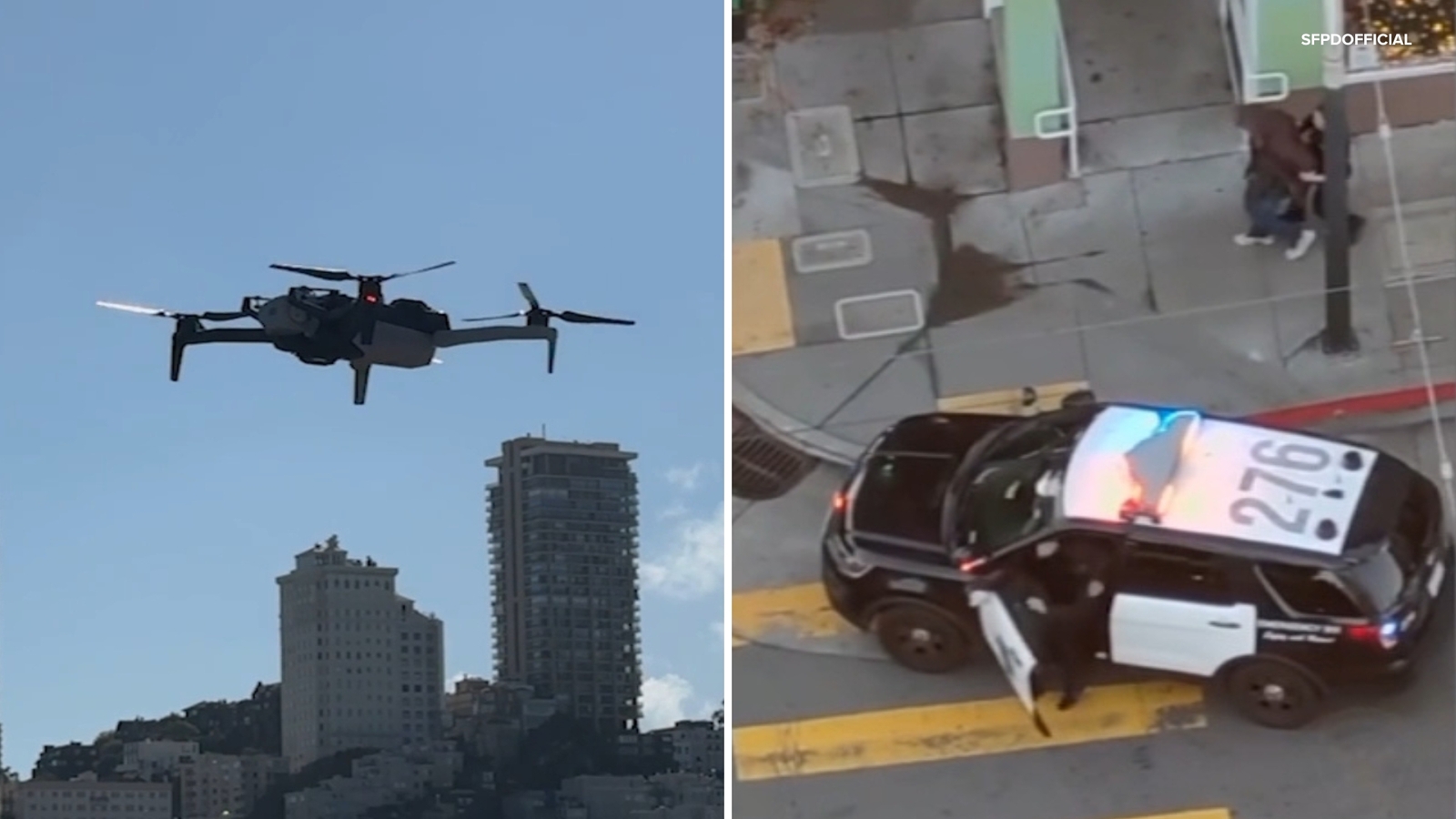
SAN FRANCISCO (KGO) — San Francisco is seeing a sustained decline in crime, a shift police partly attribute to new technology such as drones, even as critics warn the tools raise privacy concerns.
Police say the technology has helped officers apprehend suspects more effectively, while opponents argue it expands surveillance in public spaces.
The San Francisco Police Department has highlighted drone-assisted arrests on social media as evidence of the impact.
ABC7 Eyewitness News was shown dramatic footage captured by police drones, which could be any police show on television.
RELATED: SFPD accepts $9.4 million from cryptocurrency billionaire to relocate Real-Time Investigation Center
San Francisco plans to accept a $9.4 million donation from crypto billionaire and Ripple co-founder Chris Larsen for the police department.
The scenes are real and unfolding in San Francisco. The department’s Real-Time Investigation Center compiles and distributes video from police operations, including drone footage posted online.
All of that video was put together and posted on social media.
How we got here
Car break-ins peaked in 2017 with more than 28,000 reported cases, while retail theft was also escalating. Between 2021 and 2023, multiple surveys found most San Franciscans ranked crime among their top concerns, saying it made them feel less safe.
Police said existing laws limited their ability to monitor crimes in progress. For example, police are not allowed to monitor cameras perched on a building, in real time on a constant 24/7 basis.
In a November 2021 interview, former Police Chief Bill Scott confirmed those restrictions due to local laws. Asked whether police could watch a live camera feed during a possible retail theft swarm, Scott said, “That is correct, we cannot.”
MORE: San Francisco Police order deep cuts to overtime budget amid city’s historic deficit
Former Mayor London Breed argued different technology could help officers.
In March 2024, San Francisco activated license plate readers to curb carjackings and retail theft. A month later, police deployed drones after voters approved Breed’s Measure E.
How SFPD is using drones
Police quickly began documenting arrests on social media, including footage showing suspects fleeing and officers being alerted in real time.
The department said the videos are intended to show residents they are getting what they voted for. Lt. Scott Ryan, who works at the Real-Time Investigation Center, described how the system operates.
“Obviously we hear the need for a drone to go up in the air,” he said.
Operators control drones launched from rooftops across the city. In total, police have 80 drones.
“And then you launch and it will come off the pad,” Ryan said. “It does a quick 360 degree to get oriented and it’s off to where you want to go.”
MORE: Why did SFPD remove the 24/7 command unit from 16th and Mission crime hotspot?
During a demonstration, a call came in about a reported stolen white minivan.
“So far, I can only see a driver,” an operator said as the drone followed the vehicle for several blocks. After the driver parked, undercover officers moved in based on descriptions from the center.
“We had a very hard working force that was out there and now all you’ve given them are the best tools that we have,” Ryan said. “They are hitting their stride.”
Police also now name officers involved in arrests in social media posts.
“Officers O’Keefe and Dudum then immediately place the suspect under arrest without incident,” one video states.
Critics cite privacy concerns
Measure E passed with 54% of the vote, meaning nearly half of voters opposed it.
Zac Dillon of the San Francisco Public Defender’s Office, whose attorneys often represent people arrested with the help of drones, said the technology threatens privacy.
“The right to not be filmed constantly, the right to not be monitored constantly, the right to be out in public in a park and not think you are being monitored or inspected,” Dillon said.
There has also been pushback against license plate readers. There are now 400 across the city, and at least one camera lens was found covered with duct tape.
“People are fed up, annoyed more, mostly with the fact the ever-present surveillance in their lives, so you’re seeing a little bit of a push back there,” said Bill Budington of the Electronic Frontier Foundation.
The impact on small businesses remains unclear. At Henry’s House of Coffee, owner Hrag Kalegjian questioned whether the technology addresses deeper issues.
“The drones and all these other things for me they’re great but they are Band-Aids,” Kalegjian said. “I think the foundation is Proposition 47. We’re still allowing people to steal from us if it’s below 950 bucks. We have to fix that first.”
Police say results speak for themselves
Chris Larsen, founder of the cryptocurrency company Ripple, donated most of the money to fund the Real-Time Investigation Center.
Asked why he became involved, Larsen said, “Well, I think it was just kind getting back to the basics, what makes a city successful or not successful and number one is public safety.”
“If you don’t have that, then businesses don’t come, tourists don’t come, even locales stay where they live and that was hurting San Francisco so we had to fix that first,” he said.
Police say drones have assisted in more than one-thousand arrests since going online in April 2024. With overall crime down, officers say the results speak for themselves.
“We’re absolutely using that as a message to send out that if you come here to San Francisco you’re going to be held responsible for what you’re doing,” Ryan said. “We’re not going to put up with it.”

Copyright © 2026 KGO-TV. All Rights Reserved.