
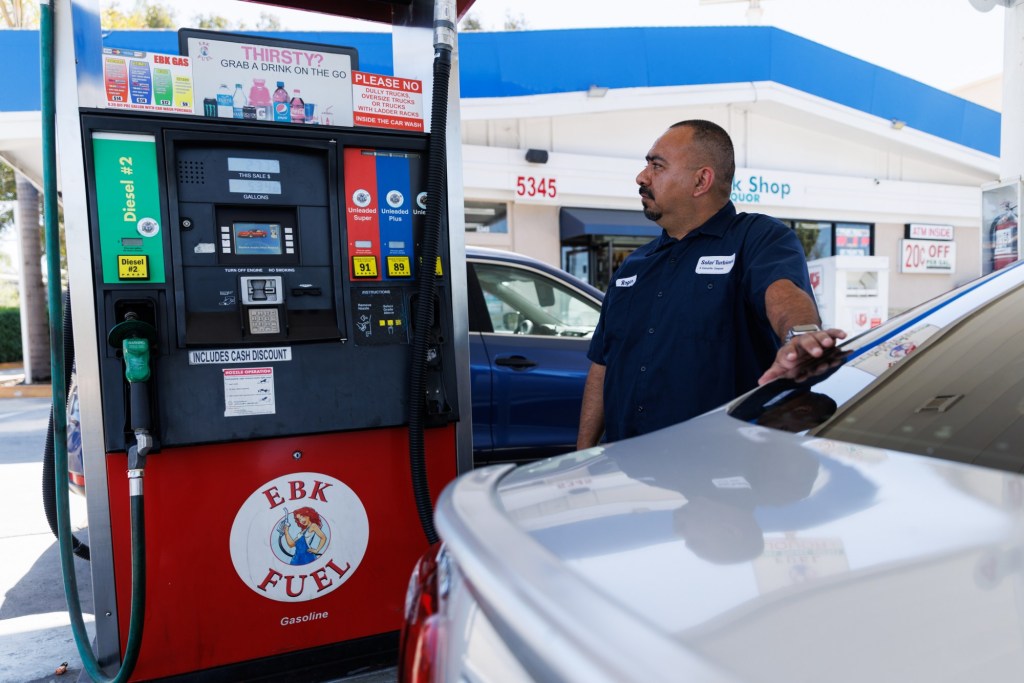
California’s petroleum watchdog says it’s on the lookout for potential price gouging as gas prices keep climbing in the wake of the war in Iran.
The Division of Petroleum Market Oversight, an independent arm of the California Energy Commission, has issued an enforcement bulletin and says it is “closely monitoring” refining wholesale and retail market segments across the state.
The bulletin went on to say that any reports of price gouging “will be taken seriously” and the DPMO is already “engaging with gasoline retailers whose high prices may not be justified by increases in their input costs.”
In a news release, DPMO said it is aware of “a limited number” of gas stations in California charging more than $7, or even $8, per gallon.
In an email with the Union-Tribune, DPMO staff offered some details, saying even before the conflict in the Middle East, when the division sees pricing “that appear to be excessive and disproportionate,” an investigative team “reaches out through written correspondence and interviews” sellers.
But since the start of the war, “we have contacted a number of station owners that meet targeted criteria for our highest priority oversight attention.”
DPMO staff said it has engaged “with multiple stations in Los Angeles and San Bernardino counties, in addition to multiple stations in Northern California.”
The average price for regular-grade gas in San Diego stood at $5.726 on Friday, according to AAA. That’s an increase of $1.04 since U.S. and Israeli forces commenced airstrikes aimed at the Iranian regime on Feb. 28. The all-time high for San Diego, according to AAA, was $6.435 on Oct. 5, 2022.
“Our team is vigilantly monitoring the retail, wholesale, and spot markets,” DPMO director Tai Milder said in the news release. “Any reports of unfair practices or market manipulation will be taken seriously, and we will not hesitate to refer any illegal conduct for further investigation and prosecution.”
Created in 2023 via the passage of Senate Bill X1-2 during a special session of the Legislature, DPMO monitors California’s oil and gasoline companies.
Asked for its reaction to the enforcement bulletin, the California Fuels & Convenience Alliance declined comment. The trade group, based in Sacramento, represents retail convenience store operators, as well as small and minority wholesale and retail marketers of gasoline, diesel and other fuels.
DPMO also sent out a consumer advisory, encouraging California drivers to shop around for less expensive gasoline.
Even when prices don’t spike, there’s often a wide range of prices at California gas stations. Unbranded, or generic, gasoline is usually less expensive than name-brand fuel — sometimes by margins of about $1 a gallon.
For example, each of the 10 cheapest places to buy gas in the San Diego area on Friday sold unbranded fuel, according to GasBuddy, and all of them posted prices below $5 a gallon.
“No public studies have shown that gasoline with brand-name additives is any better for vehicles than unbranded California gasoline,” DPMO said in its advisory.
Gas prices have soared since hostilities began because Iran blocked oil tankers and cargo ships from going through the Strait of Hormuz. The waterway typically accounts for about 20% of the world’s petroleum products and the clampdown has caused crude oil prices to skyrocket.
As of Friday, the futures price for Brent crude — the international oil benchmark — has jumped more than 50% since the start of the conflict that has spilled into neighboring countries in the Middle East. Gasoline is a refined product of crude oil.
“They’ve got to figure out how to get the flows restarted (through the Strait of Hormuz) for things to change and prices to fall,” said David Hackett, president of Stillwater Associates, a transportation energy consulting company in Irvine.
Rapidan Energy Group, an energy market, policy and geopolitical research company based in Houston and Washington, D.C., has described the effects of what it calls Gulf War III as “the largest oil disruption in history.”
The impact has been especially acute on drivers in California, where gas prices are the highest in the country.
According to AAA, the national average on Friday stood at $3.912. That’s $1.75 less than California’s statewide average.