
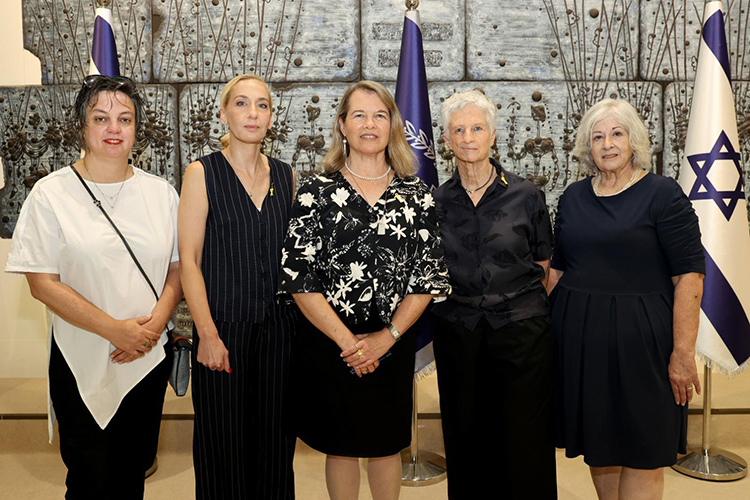
 The Dinah Project’s team, from left: Nurit Jacobs-Yinon, Adv. Lt. Col. (Res.) Sharon Zagagi-Pinhas, Prof. Ruth Halperin-Kaddari, Hon. (Ret.) Justice Nava Ben-Or, and Ita Gibson. (Photo: The Dinah Project)
By Jacob Kamaras
 Jacob Kamaras (Author photo)
SAN DIEGO—The Dinah Project’s landmark book—A Quest for Justice: October 7 and Beyond—received the Ilia Salita Excellence in Research Award at the Jewish Funders Network (JFN) International Conference in San Diego on March 17. The honor marked an acknowledgment not only of rigorous scholarship, but of research that has reshaped global conversations on accountability for conflict-related sexual violence.
The book is co-authored by Prof. Ruth Halperin-Kaddari; Hon. (Ret.) Justice Nava Ben-Or; and Adv. Lt. Col. (Res.) Sharon Zagagi-Pinhas. They are the co-founders of The Dinah Project, named for the biblical Dinah, who was raped by Shechem. The Dinah Project has become a leading resource in documenting the sexual violence perpetrated by Hamas on October 7, 2023, and in advancing frameworks for international accountability.
Halperin-Kaddari—founding academic director of the Ruth and Emanuel Rackman Center for the Advancement of Women at Bar-Ilan University, and a professor of law at Bar-Ilan—said the award highlights “academic research that has enormous impact in real life.” She pointed to a key milestone: Within one month of The Dinah Project publishing its findings, the United Nations secretary-general placed Hamas on the world body’s blacklist of entities that use sexual violence as a weapon of war.
The Dinah Project’s book compiles survivor testimonies, forensic evidence, and legal analysis to establish a clear record of gender-based atrocities committed during the October 7 attacks. It also situates these crimes within the broader context of conflict-related sexual violence, drawing parallels to cases in Rwanda, Bosnia, Ukraine, and among Yazidi communities.
The Dinah Project operates under the auspices of Bar-Ilan’s Rackman Center. Halperin-Kaddari completed three terms on the U.N. Committee on the Elimination of Discrimination Against Women, during which she served twice as the committee’s vice chair, and as the first chair of the Working Group on Inquiries.
Halperin-Kaddari explained that the Dinah Project’s long-term goal “is to set the record straight and to remain in the public awareness, in the court of public opinion, and to counter all the denialism” surrounding the sexual atrocities of October 7.
Early on, The Dinah Project’s founders recognized that even the most rigorous research would need to be accompanied by visibility. As discussed during a JFN conference panel in San Diego, public relations and digital engagement are essential to the effort.
The project’s work also unfolds against a constantly shifting geopolitical backdrop. As conflicts evolve and global attention shifts—especially amid the current Iran war—maintaining focus on the victims of October 7 becomes increasingly challenging.
“We need to adjust,” said Halperin-Kaddari. “It’s long-term work. It’s a marathon, not a sprint.”
Looking ahead, The Dinah Project is expanding its reach in both academic and legal spheres. In October, it will host a conference at Brandeis University, further embedding its work in international academic discourse.
Further, The Dinah Project is developing an academic curriculum on conflict-related sexual violence. The course is designed for use in law schools, medical programs, and gender studies departments worldwide, placing October 7 alongside other global case studies.
This effort reflects a broader ambition: to institutionalize knowledge and ensure that future professionals—lawyers, doctors, policymakers—are equipped to recognize and respond to such crimes.
At the core of this work is an even more ambitious undertaking: constructing a legal blueprint for accountability.
“A major part of our work is developing a legal theory for ensuring accountability and ending impunity for those who are charged with crimes of sexual violence as a weapon of war,” Halperin-Kaddari said. “Our aim is to have this blueprint for accountability be adopted for law enforcement and legal systems globally. This is a very long-term process.”
While rooted in the events of October 7, The Dinah Project also positions itself within a global human rights context.
This was evident from a recent event in New York—held in partnership with the Permanent Mission of the Czech Republic to the United Nations, and featuring a panel with British and Ukrainian dignitaries.
“It demonstrates the universal message that we carry through our work,” Halperin-Kaddari said.
At a time when narratives around conflict are fiercely contested, The Dinah Project insists on evidence, accountability, and remembrance. It challenges not only perpetrators of violence, but also the global systems that too often fail to respond.
By honoring The Dinah Project’s work at the San Diego conference, JFN underscored that research—when grounded in expertise and driven by purpose—can move the world closer to justice.
*
Jacob Kamaras, a former publisher and editor of San Diego Jewish World, is now the executive director of J Cubed Communications.