
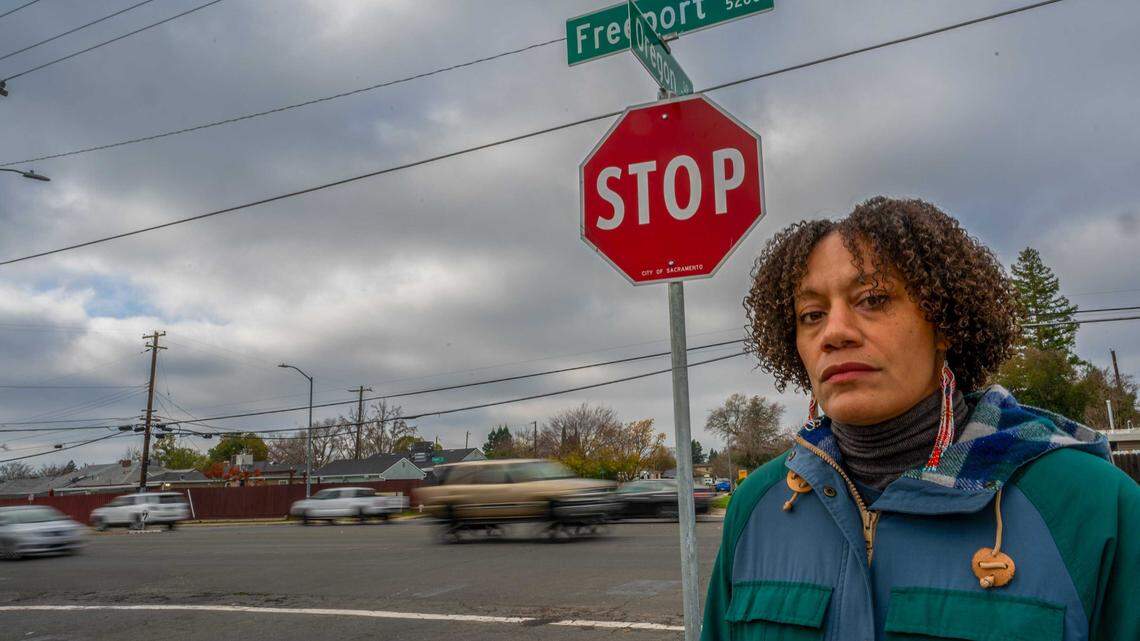
Kiara Reed, executive director of Civic Thread, stands on the corner of Freeport Boulevard at Oregon Drive in Sacramento on Dec. 18, 2024. Sacramento’s plan to redesign Freeport Boulevard for pedestrian and cyclist safety scored 92 out of 100 points in the 2024 Active Transportation Program cycle but did not receive funding after the state slashed hundreds of millions of dollars from the grant program.
Renée C. Byer
rbyer@sacbee.com
The California Transportation Commission approved billions in funding for car-centric projects this week during a record-breaking March heat wave in the state fueled by climate change.
Supporters of the decisions praised the commission for a taking “balanced” approach in the State Transportation Improvement Program and the State Highway Operation and Protection Program — awarding money to safety-enhancing and climate-friendly projects as well as highway projects. But transportation advocates lined up to protest their funding choices for not more urgently prioritizing road safety and climate change.
Several highway-widening projects were approved Thursday afternoon through almost $1 billion in STIP funds, and critics cited a century of research demonstrating that adding lanes to roadways ultimately leads to more congestion within five to 10 years. That additional car congestion produces more local air pollution that leads to worse health in neighborhoods. It also produces more greenhouse gas emissions that contribute to a dangerously warming world.
“Quite simply, highway widening does not work, and it has never worked,” David Martinez of the transportation advocacy group Streets for All told commissioners. “I would encourage you all to not further that problem.”
The funding decisions come after the first Active Transportation Program cycle that weathered drastic cuts under Gov. Gavin Newsom. That program — the only one in the state solely focused on improvements for pedestrians, cyclists and others outside cars — had $400 million clawed back by the state. Last year, commissioners only had $168.7 million to award. About half of STIP’s $950 million went toward projects that included safety elements for pedestrians and people on bikes; more than half did not fund those elements.
What happened with climate, road safety?
Some of the highway-widening STIP projects were in Northern and Central California. Commissioners directed $16.8 million to add 13 miles of new lanes to Highway 101 from San Bruno to the San Francisco County line. They directed $12.8 million toward widening Highway 37, a route in the North Bay that will sink into the sea. They directed $25 million toward adding 3 miles of a “truck climbing lane” to Highway 58 in Kern County, and $17.9 million toward expanding Highway 99 from four lanes to six lanes in north Madera County. They directed $44.3 million toward adding three miles of lanes to Highway 29 by Clear Lake.
Just those five projects received almost 70% of the total amount awarded by the commission in the Active Transportation Program last year.
On Friday morning, many speakers criticized the $17.9 billion SHOPP slate for not having more “complete street” elements — facilities that accommodate all modes of transportation, as opposed to just vehicles. Such improvements are required in many SHOPP projects under a state law known as Senate Bill 960. In SHOPP, which will dole out those billions over the next four years, 45% of almost 600 approved projects included some features for pedestrians, cyclists or transit riders, although not all of them were high-quality elements.
California faces a road safety crisis. About 4,000 people die on the state’s roads each year, and around 1,000 of them are pedestrians. Thousands more survive crashes with serious and sometimes life-changing injuries. The vast majority of fatal and severe collisions are preventable with changes to infrastructure and policy.
Sacramento has been working to prevent such collisions, and commission staff highlighted one of the city’s safety projects in the STIP presentation: a Vision Zero effort to make Marysville Boulevard safer.
STIP is kicking in $9.2 million for safety improvements on the road. Four men have died on Marysville since January 2024: Jordan Nicolas Rodriguez, 38; Alfred Ramirez, 23; Zachery Ryan Taylor, 20; and Bee Lao, 46. No mode of transportation was particularly safe. Rodriguez was biking, Ramirez was driving, Taylor was on a motorcycle, and Lao was on foot.
Related Stories from Sacramento Bee

The Sacramento Bee
Ariane Lange is an investigative reporter at The Sacramento Bee. She was a USC Center for Health Journalism 2023 California Health Equity Fellow. Previously, she worked at BuzzFeed News, where she covered gender-based violence and sexual harassment.