
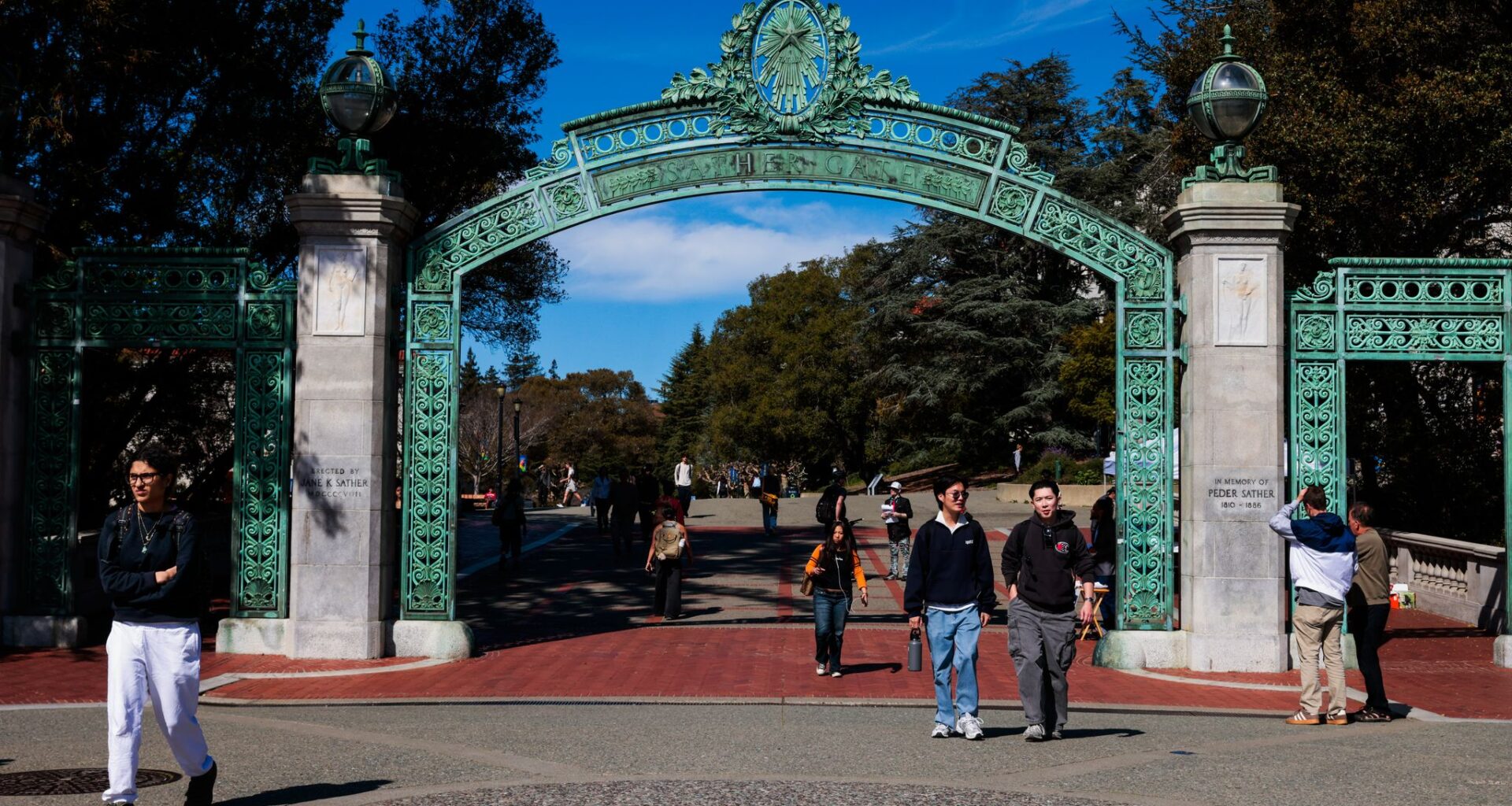
University of California’s chief investment officer Jagdeep Singh Bachher said this week that the school system, including the University of California at Berkeley, faces “probably the biggest question of our lifetime.”
Yalonda M. James/S.F. Chronicle
The University of California’s chief investment officer Jagdeep Singh Bachher said this week that the school system faces “probably the biggest question of our lifetime” as it grapples with changes wrought by artificial intelligence on its students’ job prospects and risks to its $214 billion investment portfolio.
“The biggest thing that is a surprise to me and the team in the last 60 days is how fast we’re all waking up to realize that AI is actually a risk,” he said at a UC board of regents meeting in San Francisco.
“We need to start figuring out, what does the future of every one of our 300,000 students at the University of California look like? That in my humble opinion is probably the biggest question of our lifetime. And you don’t have six years to figure it out. You need to figure that out sooner than later because things are moving at a pace that are alarming to us on a day-to-day basis,” he said, adding that his daughter is preparing to go to college and her future job could be at a company that “doesn’t even exist today.”
Article continues below this ad
For instance, AI can replace a software company’s product, leading to significant stock price drops, rather than the tech boosting their business, he said. Some public software company shares are down 20% this year, he noted.
When asked if UC was overinvesting in AI, Bachher said the university can’t afford to miss out on AI’s growth, even if there is a bubble. He equated the AI boom to Amazon’s rise, which included years of losses until it became a dominant and profitable company.
San Francisco Chronicle Logo
Make us a Preferred Source to get more of our news when you search.
Add Preferred Source
“If you sold your Amazon stock too early … you never took advantage of this growth,” he said.
He noted that Nvidia expects $1 trillion in chips revenue opportunity through 2027, which is unprecedented.
Article continues below this ad
“We’re not managing this money for a year or two,” but rather with a 30-year horizon, he said. “I fully expect even if there is a correction of some sort and things come down in value, having the patience to be able to ride this out over the long run is what is important.”
Bachher said his team must “dissect our portfolio asset-by-asset and ask the question, what could be at risk” of obsolescence like a “horse and buggy.”
He called AI “the biggest technological revolution at the fastest pace … let’s not get caught with legacy assets that might lose their edge very quickly because everyone gets surprised.”
AI has helped make Bacher’s own team more efficient and may cut the need for as many workers in the future, he said.
He joined UC 12 years ago and inherited a team of 50 people managing around $80 billion. Now he has 49 people managing $214 billion, and he predicted that could drop to 35 people in 10 years.
Article continues below this ad
“Weeks and months of work (are) being replaced by minutes and hours literally by just loading up a box of data into Claude or OpenAI,” he said.
Baccher acknowledged that he doesn’t have many answers to AI’s future impact, but reiterated that the university system needs to recognize the many negative scenarios and try to prepare students accordingly.
Even with AI’s impacts, Baccher said one of the “most important skills” for students is learning financial literacy, which UC promotes through free courses at the UC Investment Academy. “There’s no AI agent that is going to do a job for you, that’s going to give you money that you can then put into a bank account,” he said.