
The San Diego City Council voted on Monday to approve lower speed limits on more than 600 miles of the city’s roads, roughly 20% of the network.
Advocates said lower posted speed limits might not be enough to get drivers to slow down, and city leadership agrees more needs to be done.
But as the city’s budget issues continue to make it difficult to fund expensive physical infrastructure, a backlog of thousands of traffic safety improvements is growing. As a result, the city is looking at cheaper and faster options for those projects.
The Comprehensive Speed Management Plan that was approved on Monday is an effort to implement AB 43, a state law that gives cities more control over setting speed limits.
Last year, the city voted to lower speed limits on several commercial corridors. The plan approved on Monday would expand this program to school zones, streets frequented by pedestrians or bike riders, and places with a history of traffic fatalities.
The data makes an obvious point: slower speeds save lives. The National Traffic Safety Board’s 2017 report, “Reducing Speeding-Related Crashes Involving Passenger Vehicles,” shows a 5% chance of a person dying when hit by a vehicle traveling at 20 miles per hour. At 30 miles per hour that, chance jumps up to 45%; at 40 miles per hour, there is an 85% chance of dying.
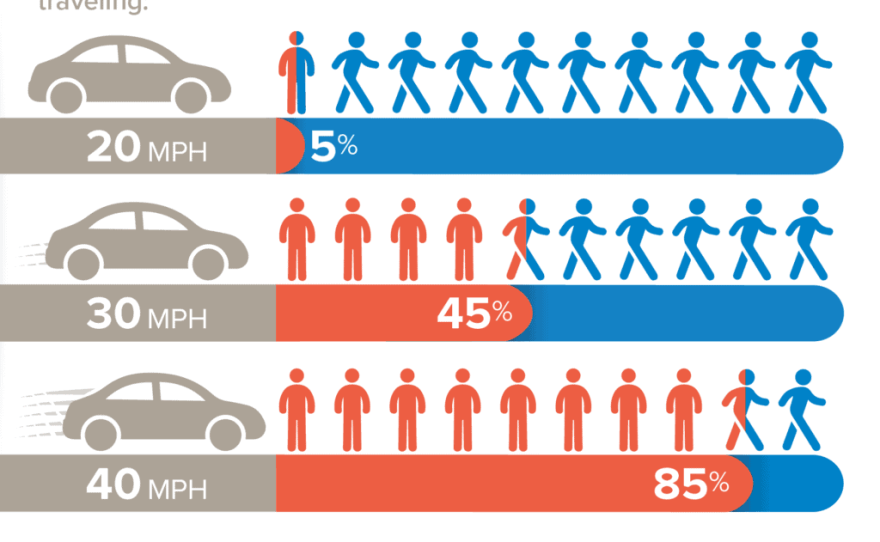
Graphic from Smart Growth America
That’s why the city is aiming to reduce speeds. It will cost $2.4 million to install new signs on all the roads where speed limits will be reduced. This work could start as early as this summer if a special funding request is approved.
Council President Joe LaCava supported the plan and called it an important first step.
“We’ve had conversations for quite a few years about options to reduce speed limits,” LaCava said. “But the California state law really tied our hands. AB 43 really reopened the door and allowed us to make some important changes that were embedded in the speed management plan, brought forward by the mayor’s office, and certainly wanted to seize on that and start making these changes across our city.”
But LaCava said he understands that the reduced speed limits might not be observed.
“We are not so naive to not recognize that,” LaCava said. “In fact, a lot of people continue to ignore whatever the posted speed limit is. But it is a step in the right direction.”
UC San Diego professor Bill Fulton, who served as San Diego’s city planning director from 2013 to 2014, said changing the speed signs alone will have little impact.
“Drivers respond to two things: changes in infrastructure design and enforcement that they can see,” Fulton said in an email. “So, a narrower street will slow traffic down (that’s one of the little-appreciated benefits of bike lanes), and so will a visible police car or red-light camera. Simply reducing the speed limit on its own won’t do much.”
Advocates for safer streets in the Pacific Beach neighborhood of San Diego agreed.
“I think we know that some of the drivers in our neighborhoods will respond positively to the lower speed limits and adhere to them, but a key piece of these changes is going to be enforcement,” said David Cuthell from Beautiful PB. “And whether that means active police enforcement, speed traps, speed cameras, or just infrastructure that’s going to encourage drivers to operate their vehicles at more safe speeds.”
Last week the community suffered its third traffic fatality of 2026, at the intersection of Fanuel Street and Grand Ave. Residents asked the city to address traffic safety following a child’s death on Pacific Beach Drive in January. In both cases, the victim was riding a bike.
Fanuel Street and Pacific Beach Drive are both part of the “PB Pathway” that is supposed to help identify safe routes to ride a bike around the community. Several of these road segments have been identified for speed limit reductions under the new plan, and Cuthell said that tragedies like these could have been prevented if those slower speeds were respected.
“Without knowing all of the details around that particular incident, but knowing some of the details around some of the other traffic fatalities, I think a lot of people can agree that, were all the drivers to be operating their vehicles at a lower speed, it could have potentially prevented some of the deaths and certainly injuries that occur from people driving at too high speeds and recklessly around the neighborhood,” Cuthell said.
Earlier this year, KPBS reported on the decline in police traffic stops that coincided with an increase in traffic fatalities.
San Diego Police spokesperson Lt. Cesar Jimenez pointed to staffing issues and other priorities as possible reasons for the decline in stops, along with new reporting requirements.
He also suggested the use of automated enforcement, such as speed cameras that were authorized by a state bill in 2023, could help.
But Cuthell said building safer streets is a key piece of the puzzle as well.
“There’s lots of options,” Cuthell said. “Curb butt outs are something that we’re very supportive of due to the fact that they’re relatively inexpensive and easy to put in. Speed bumps are another great option. Roundabouts of course, are something that there’s a lot of support for, but are on the more expensive side.”
Cuthell is right — physical infrastructure, like curb extensions, or “butt-outs,” roundabouts, and other markers identified in the city’s Vision Zero documents, can cost a lot of money.
The city’s five-year infrastructure planning outlook identifies billions of dollars in unfunded infrastructure projects. These include projects for stormwater, utilities, transportation, parks, libraries and emergency responders.
And there are over $150 million in unfunded “street and road modifications” that would “help the city get closer to its Vision Zero Goals,” according to the document.
A 2024 report from the nonprofit advocacy group Circulate San Diego found the slow timeline for building safer roadways contributed to the city’s Vision Zero failure. That report recommended a dramatic increase in spending on traffic safety, and a better use of “quick builds” for traffic safety projects.
LaCava said these “quick build” options can help advance projects that would have otherwise taken more time and money.
“The difference between doing a full-blown, concrete, landscaped roundabout, as we see at Foothill, Pacific Beach, versus the quick build implementation of a roundabout can make all the difference in terms of how long it takes us to have the funding to actually implement that,” LaCava said.
The city of San Diego staff report noted that quick builds can accomplish very similar traffic calming effects with far less money, and can be built in a shorter period of time. It said building a traditional roundabout design can cost as much as $13.48 million and take 10 years, while a “quick build” can be done in one year for half a million dollars.
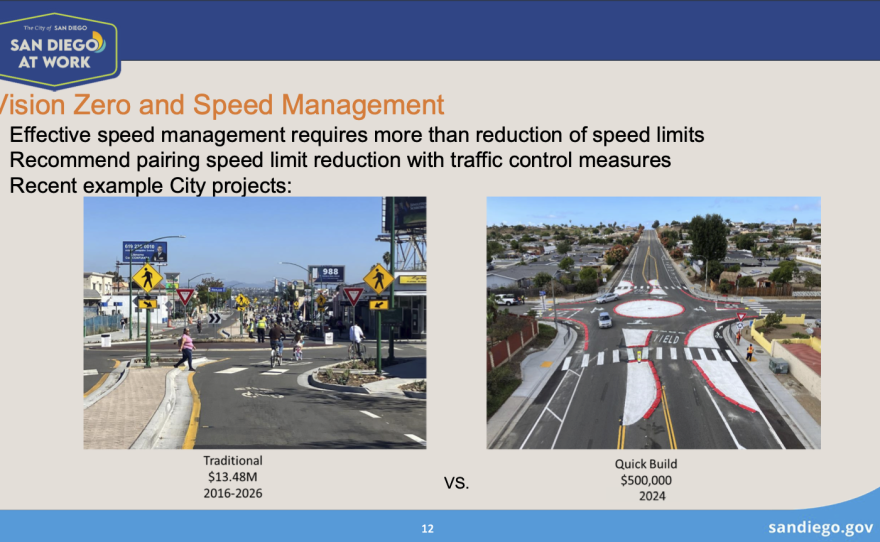
A slide from a city staff presentation on Monday, March 16, 2026 showing the difference between traditional and quick build traffic calming infrastructure.
And the City said in an email, that the quick build option lets them make more street improvements with fewer resources.
“Using a quick build approach shortens the design time, uses less intensive construction methods for faster installation, and allows us to install improvements at more locations,” said Ramon Galindo Senior Public Information Officer with the city of San Diego.
For Cuthell, the question is whether the city will put traffic safety first.
“Everything seems to cost money,” Cuthell said. “Whether it’s expensive roundabouts or even just replacing some of the speed limit signs. So we’re really hoping that the city is going to support this initiative and find the money that is needed to make these changes.”
“The budget is ultimately in the City Council’s hands,” LaCava said, “So we can make those decisions and prioritize what we think needs to be done to eliminate that backlog.”
Residents can request roadway improvements through the city’s Get It Done app, available online.