
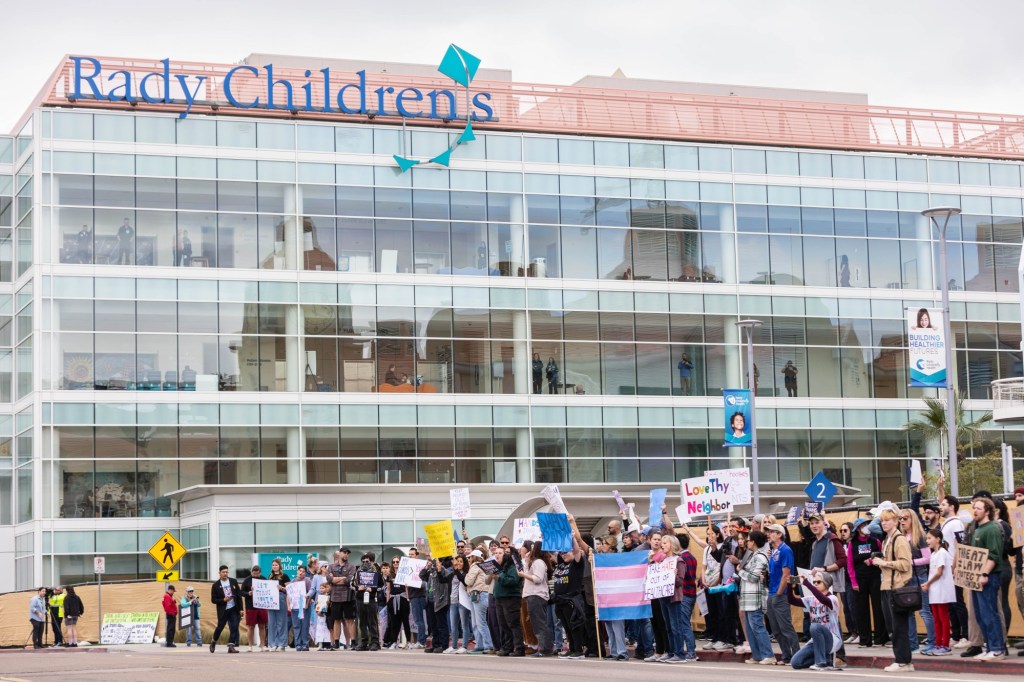
A newly filed civil court lawsuit seeks to take class action against Rady Children’s Health for gutting its gender-affirming care program on Jan. 20 in the face of heavy scrutiny from the federal government.
This new case follows recent action by state Attorney General Rob Bonta, who sued Rady on Jan. 30, alleging that the health system violated an agreement to keep providing gender care and many other services when it merged with Children’s Hospital of Orange County in early 2025.
Bonta obtained a temporary injunction that required Rady to resume all gender care except surgeries as the two sides prepare for a hearing in late April that will decide whether the current status of the program continues.
The new lawsuit is made on behalf of four children, all minors, referred to as A.A., B.B., C.C. and D.D. in the legal complaint, which states that each was receiving gender-affirming care when the program stopped providing procedures and medications in January.
Brought by the Western Center on Law and Poverty, the Impact Fund and the National Center for LGBTQ Rights, the suit claims that cessation of gender-affirming care, especially ending treatments with puberty-blocking drugs, “discriminates against transgender people in violation of California law and will cause serious harm to thousands of young people and their families.”
Focusing on transgender patients, the suit argues, violates California’s Unruh Civil Rights Act because it targets patients “on the basis of their sex, gender identity and disability.”
The four children listed in the suit are each said to have a formal diagnosis of gender dysphoria, a condition described in the Diagnostic and Statistical Manual of Mental Disorders, indicating “a marked incongruence between one’s experienced/expressed gender and primary and/or secondary sex characteristics.”
Losing access to gender-affirming care, the suit states, will cause young patients to “experience known and foreseeable harm, including exacerbation of their gender dysphoria, emotional harm and physical changes that could complicate subsequent medical care.”
Rady declined to comment on the claims; a representative said in an email that the organization does not discuss pending litigation.
The attorneys who brought the case hope that it will represent far more than the four individuals initially listed. About 1,900 patients in San Diego and Orange counties, the suit argues, have been affected by Rady’s gender care decisions, and the suit states that an effort will be made to certify it a class action.
In order for the courts to certify a class action, lawyers must prove that handling all plaintiffs in one group is superior to handling cases individually, that members have a common interest that is similar to that experienced by the person who brought the suit and that the group can be clearly identified.
The lawsuit asks the court to stop Rady from “eliminating, terminating or reducing” its gender-affirming care program and for minimum damages of $4,000 per violation and to declare that the termination of services constitutes “unlawful sex and disability discrimination.”