
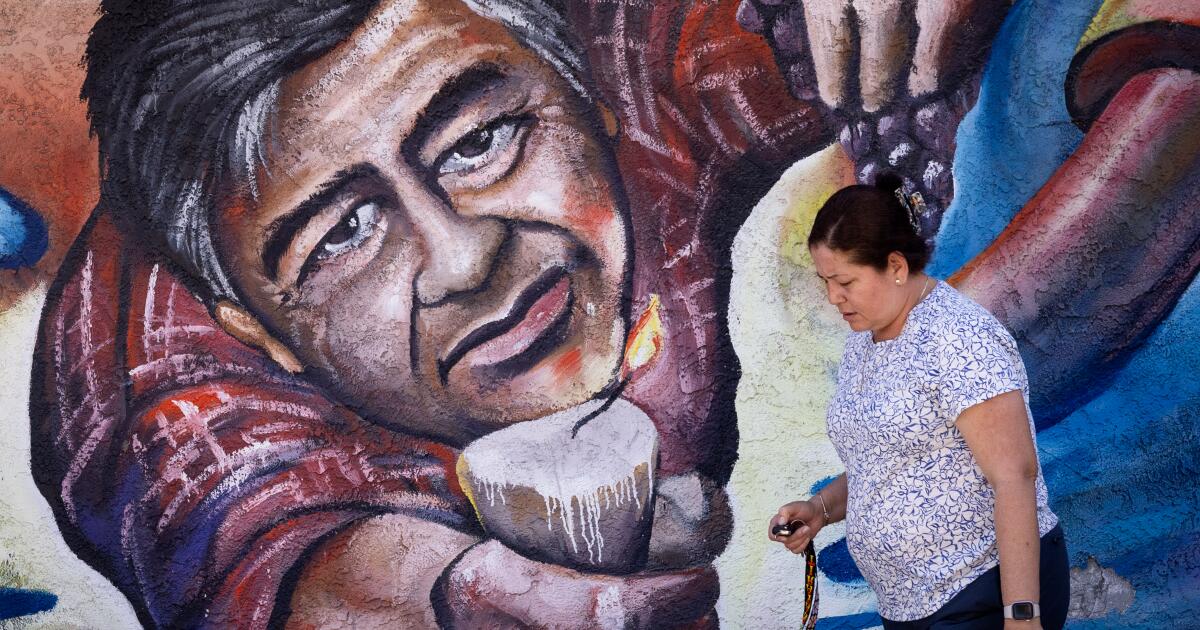
Inside one of the oldest barbershops in Boyle Heights, Rodney Trammell gave an oral history of Brooklyn Avenue before it was renamed after civil rights leader Cesar E. Chavez.
The street, he recalled, was lined with Mexican and Jewish retail stores and bakeries. There was a movie theater and the original Canter’s Deli opened here. Different nationalities and ethnic groups lived and shopped side by side.
Brooklyn Avenue, he said, was Boyle Heights.
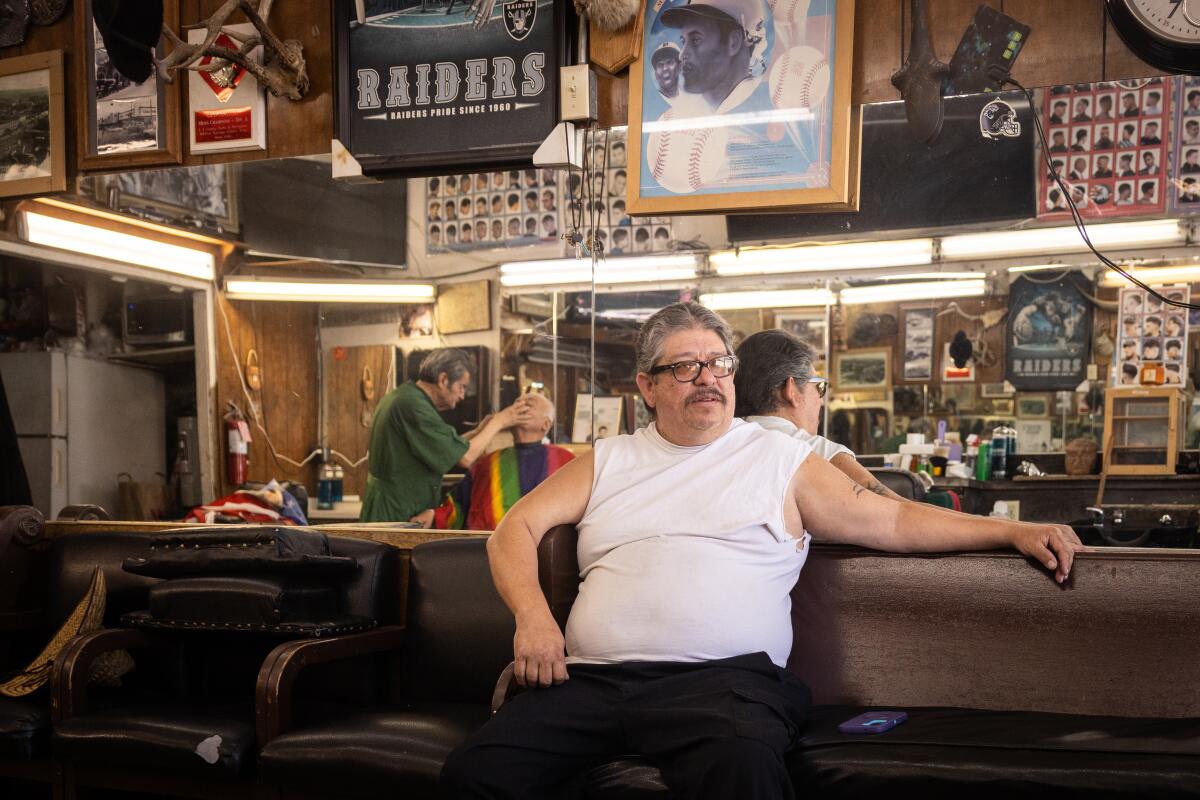
Rodney Trammell waits for his turn at a barbershop on Cesar E. Chavez Avenue, in the Boyle Heights neighborhood of Los Angeles, on Wednesday.
(Etienne Laurent / For The Times)
So when civic leaders sought to rename it in 1993, many in the community were opposed. They were longtime residents and merchants: Jews, Mexicans and Mexican Americans.
The residents lost the battle but refused to accept it. They still refer to the street by its original name in conversations. Merchants — new and old — bear the street name on stores. Custom clothing designers and artists pay homage to it in hats, shirts and artwork.
“To me, it was always Brooklyn Avenue,” Trammell said. “And it will always be Brooklyn Avenue.”
Now amid talks of renaming the street in the wake of sex abuse allegations against the famed labor leader, the old debate has resurfaced, along with the conflicting emotions over it.
Chavez is accused of sexually assaulting two underage girls and raping labor leader Dolores Huerta in the 1960s and ‘70s, according to a New York Times investigation. The accusations have created an outcry to erase Chavez’s name from schools, parks, streets, buildings and holidays.
Concepcion “Connie” Sotelo, who along with her husband opened Los Cinco Puntos, a Mexican carniceria and grocery store, on the avenue in 1967, said she felt terrible to hear about the allegations.
She said people have made hurtful comments to her. “They say things like, ‘Now you have a Mexican Epstein,’” she said. “That hurts, you know.”
She couldn’t help but think of the past when she and others protested that city and county officials were trying to rename Brooklyn Avenue.
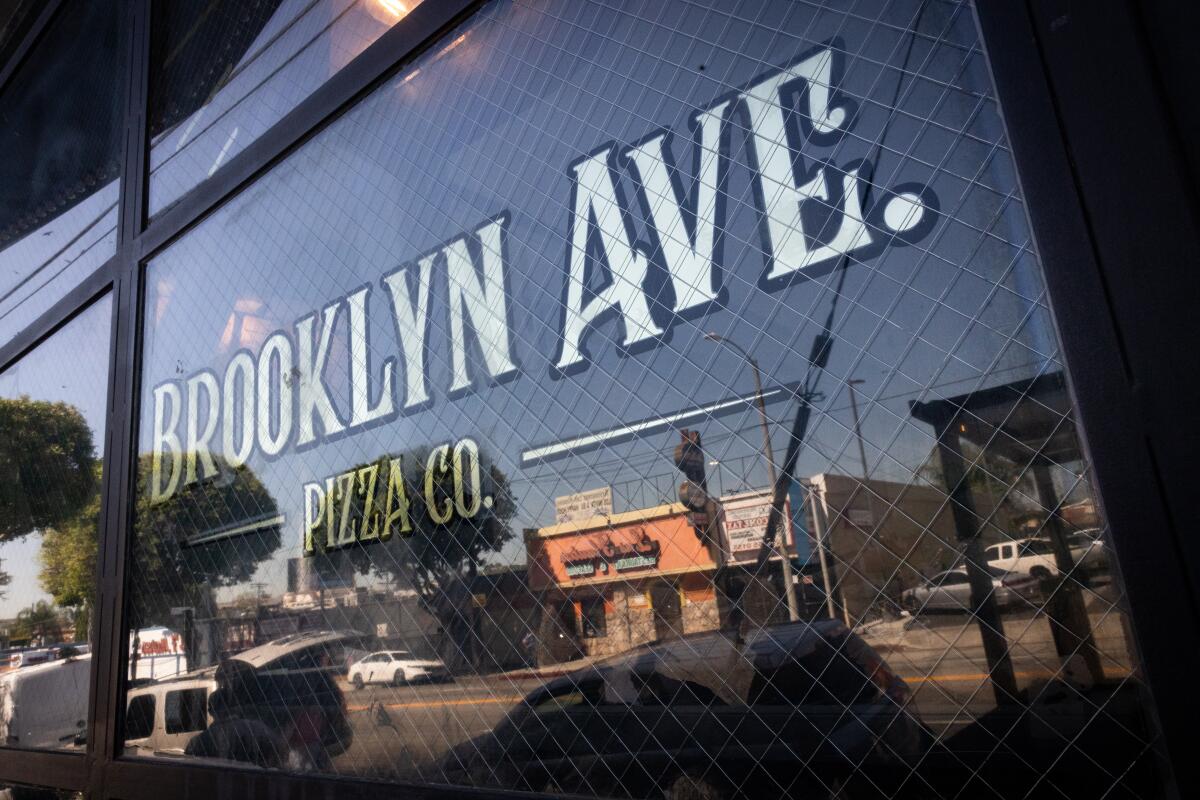
Brooklyn Avenue Pizzeria on Cesar E. Chavez Avenue in Boyle Heights.
(Etienne Laurent / For The Times)
“I feel we were right,” she said. “Not for the reasons we know today, but simply because we wanted to keep it Brooklyn Avenue.
“It was nothing against Cesar Chavez,” she added. “He had done a lot for the Mexican people and farmers, but I never felt it was necessary to name the street after him.”
She said she and her husband signed petitions and wrote letters to city officials opposing it.
Sotelo said the dedication ceremony for the name change occurred outside Los Cinco Puntos. She recalled seeing a large crowd and could hear people cheering and a mariachi band playing.
Mayor Richard Riordan attended, along with Los Angeles County Supervisor Gloria Molina, who along with other Latino politicians spearheaded the effort to rename the street after Chavez.
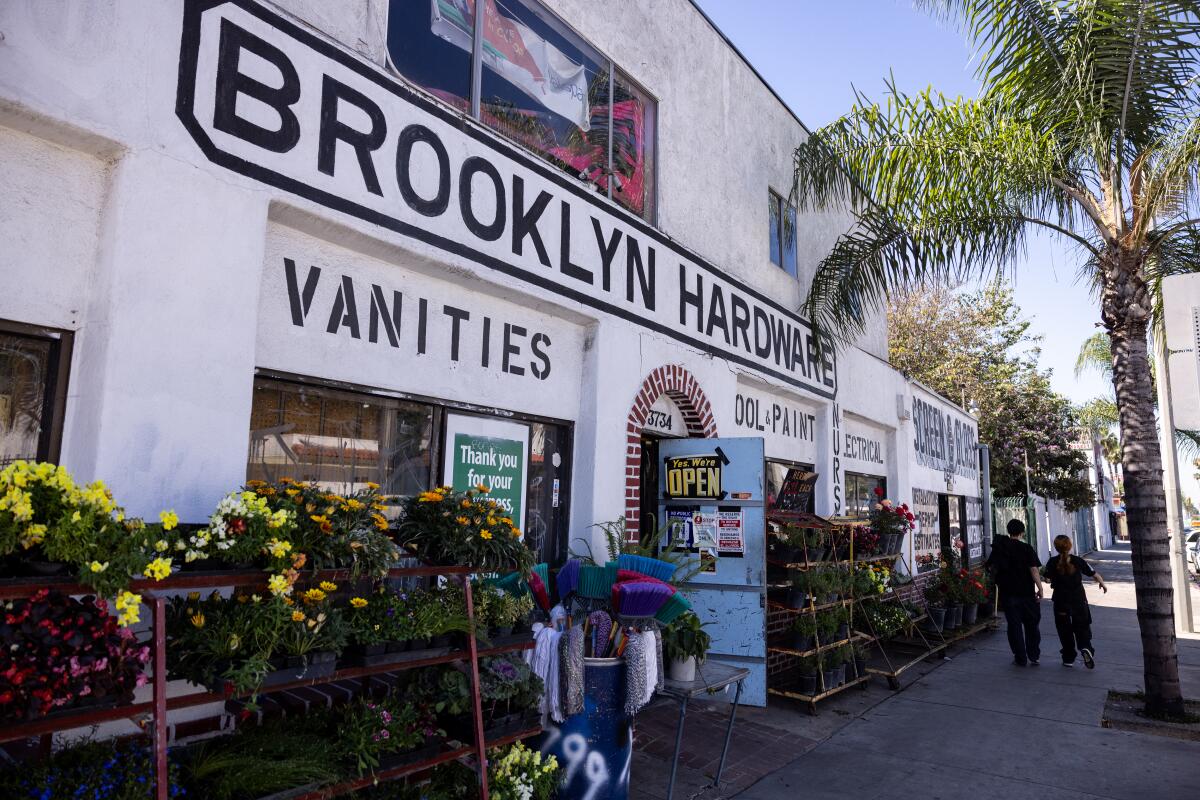
The Brooklyn Hardware store on Cesar E. Chavez Avenue in East Los Angeles.
(Etienne Laurent / For The Times)
Cesar E. Chavez Avenue is more than six miles, cutting through the working-class communities of Boyle Heights, East Los Angeles and Monterey Park.
The area was established by an Irish immigrant named Andrew Boyle in 1858. It was Boyle’s son in-law, William Workman, who subdivided the land and created Boyle Heights, naming the main thoroughfare Brooklyn Avenue
Historians say the street name was part of Workman’s overall effort to entice residents from the Midwest and East Coast. There were also Chicago, St. Louis and Cincinnati streets, and Michigan and Pennsylvania avenues, among others.
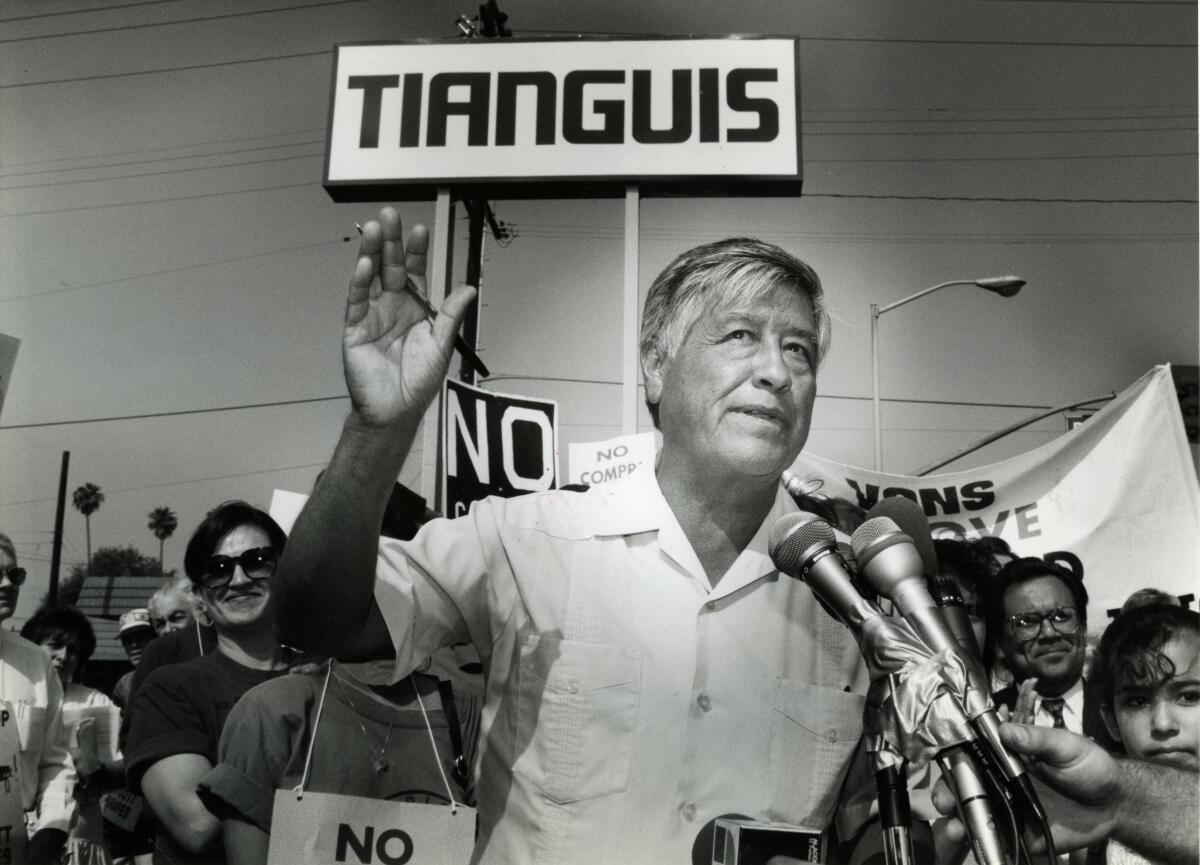
Cesar Chavez, United Farm Workers president, speaks at a rally to boycott Tianguis Market on Brooklyn Avenue in East Los Angeles for selling chemical-tainted grapes.
(Larry Bessel / Los Angeles Times)
The area became home to Jewish, Mexican and Eastern European immigrants. From 1959 to 1962, Cesar Chavez and his family lived in Boyle Heights while he served as executive director of the Community Service Organization.
By the late 1960s, many Jewish residents and European immigrants had moved out of the area. They were replaced mostly by Mexican immigrants and their families, who opened businesses and bought homes.
The region became the birthplace of the Chicano civil rights movement that included the East L.A. Walkouts and the Chicano Moratorium.
The idea to rename Brooklyn Avenue after Chavez was raised by Molina, just a week after his death in April 1993.
The plan was supported by then-Los Angeles City Councilmembers Richard Alatorre and Mike Hernandez, who called for renaming portions of Brooklyn Avenue, Macy Street and Sunset Boulevard.
Abigail Calderon, whose family owns a store on the main street and has studied the issue as part of her doctoral dissertation at Yale University, found that Mexicans and Mexican Americans opposed the change because it masked their deep ties to the old neighborhood, as if they were just arriving and changing things.
She said civic leaders chose a street whose name had become deeply meaningful to people for various reasons. She likened it to Whittier Boulevard, a touchstone of Mexican American culture in Southern California.
“A lot of people would have issues if [officials] wanted to change Whittier Boulevard,” she said. “People attach meaning to it.”
She said the push to rename the street was political too. The proposal came at a time of heated anti-immigrant rhetoric as California was experiencing an economic recession and shift in demographics.
Proposition 187 — dubbed the Save Our State initiative — would be introduced three months after the renaming of Brooklyn Avenue. The decade also saw an English-only movement in the schools that included the passage of Proposition 227 in June 1998. (In 2016, voters approved Proposition 58, which repealed bilingual restrictions enacted by Prop. 227.)
“A lot of big politicians were pushing for [the renaming] because they wanted to make sure Latinos had a space and an area that could be seen as very Latino on the map,” Calderon said.
Vivian M. Escalante, chief executive director and president of Boyle Heights Community Partners, said the sense of political urgency drove it as much as Chavez’s legacy.
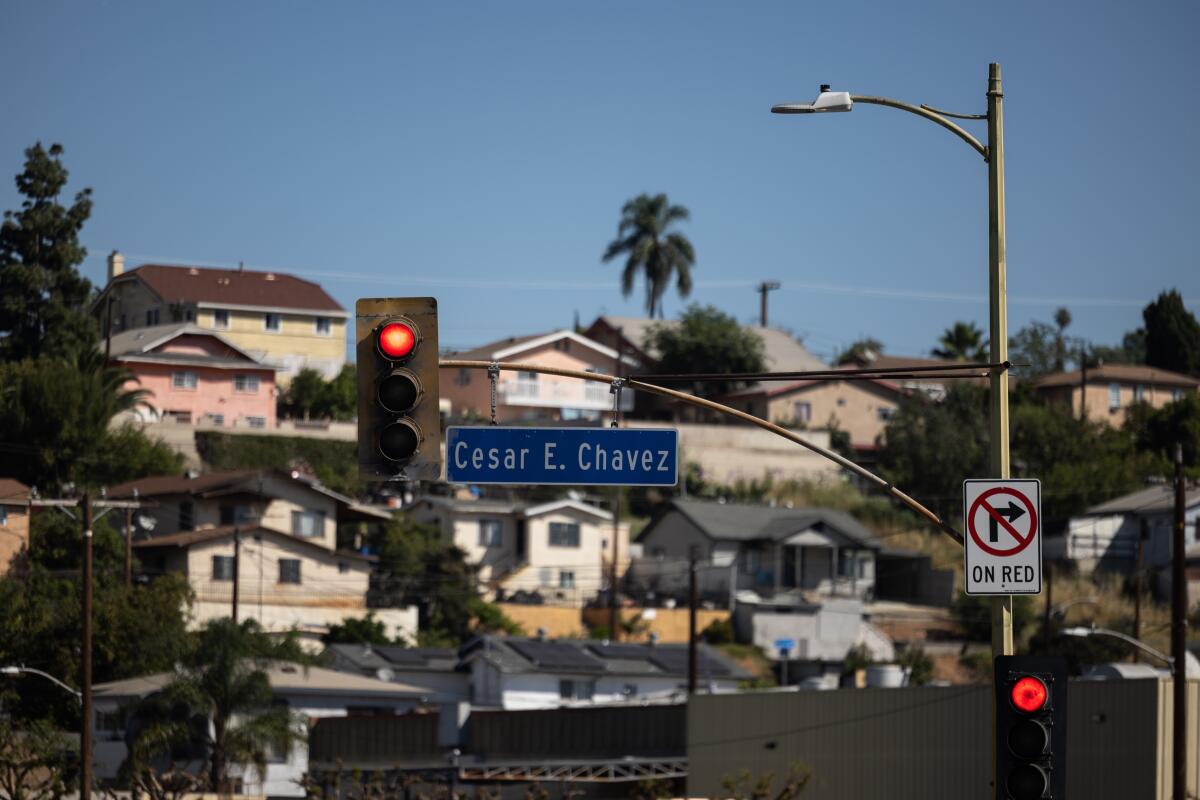
A street sign on Cesar E. Chavez Avenue in Boyle Heights.
(Etienne Laurent / For The Times)
“While the public was told the change was about ‘honoring a hero,’ the political reality was a calculated effort to solidify a Chicano political identity in East Los Angeles, often at the expense of the neighborhood’s multi-ethnic history,” she said.
Escalante and the organization have been calling for the street name to be switched back to Brooklyn Avenue for years.
On a recent Monday afternoon in a small Mexican diner, not far from the 710 Freeway in East Los Angeles, Gricel Gonzalez, 57, gazed out the window at the avenue.
She said she was in her mid-20s when rumors began to circulate that Brooklyn Avenue would be renamed after Chavez.
Growing up, she would often hear her mother and grandmother talk about Chavez and his efforts to help fight for the rights of Mexicans.
“He was a hero,” she said.
But when asked that day how she felt about the recent allegations, Gonzalez froze. She was confused and had not seen the news yet. Upon hearing it her eyes grew wide and her jaw dropped as she shook her head.
She was angry. It had brought back dark memories when an uncle had touched her inappropriately. She was only 8.
Her new judgment on the street name was instant.
“They need to change the name to Dolores Huerta, or any of the other victims.”