
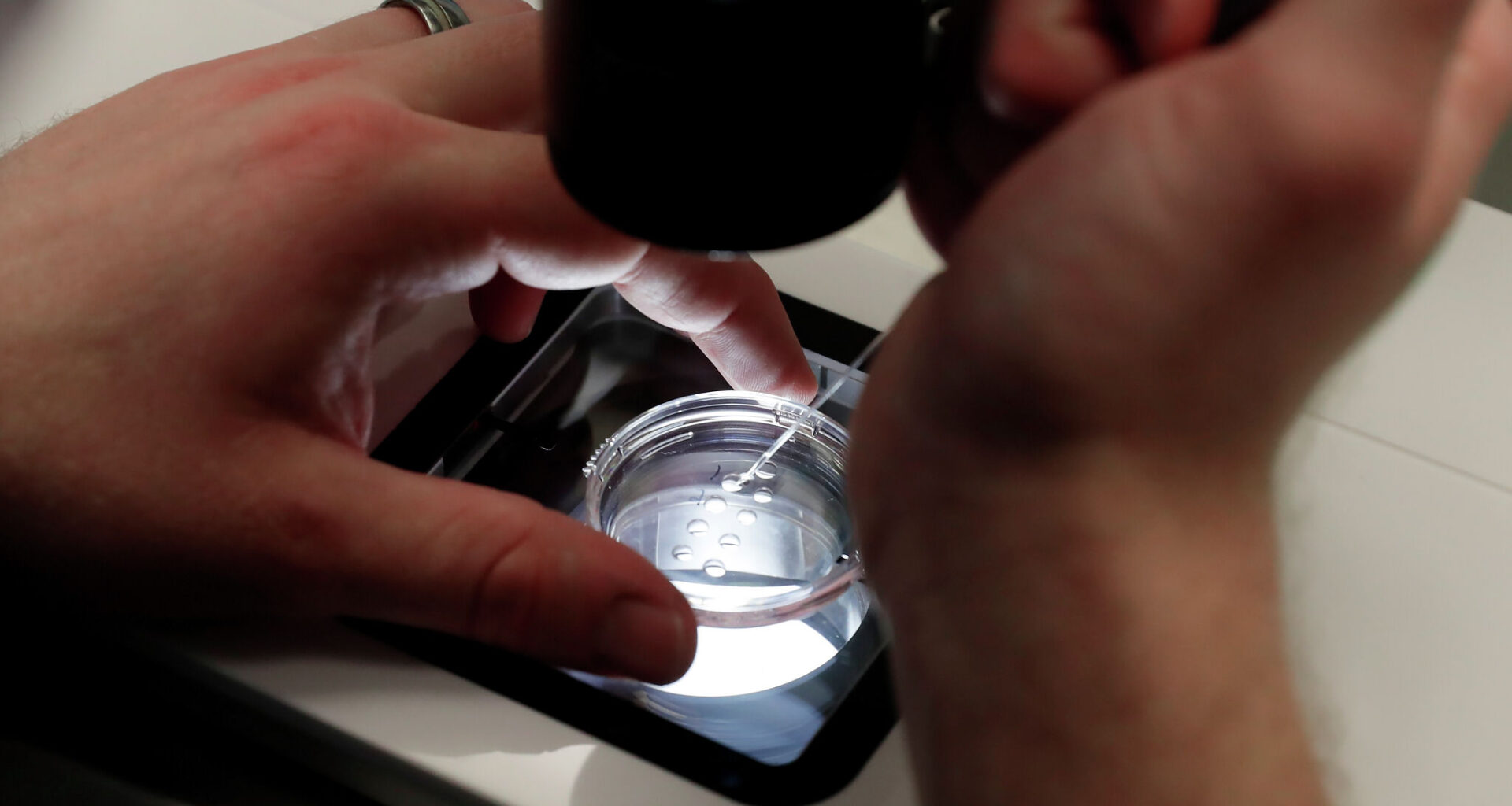
Lab staff prepare small petri dishes, each holding several 1-7 day old embryos, for cells to be extracted from each embryo to test for viability at the Aspire Houston Fertility Institute in vitro fertilization lab Tuesday, Feb. 27, 2024, in Houston.
Michael Wyke/AP
San Francisco has one of the highest shares of babies born through in vitro fertilization in the country, a Chronicle analysis found.
At least 9.4% of babies born in San Francisco in 2024, the latest available data, were born from pregnancies that used assistive reproductive technologies, which by definition includes in vitro fertilization as well as the rarely used gamete intrafallopian transfer, according to CDC data collected from birth certificates. That puts San Francisco just behind three counties in New Jersey.
The data isn’t perfect. While the information is collected on the current standard birth certificate form, several states did not report that information across all years, including Georgia, New Hampshire, North Carolina, South Carolina and Tennessee. And even in places that do collect information about infertility treatments on birth certificates, the actual numbers of births from these technologies may be underreported, the CDC has found.
Article continues below this ad
Still, the numbers are the best available at the county level to measure babies born through IVF, even if they do not capture the entire picture. The numbers also only account for births resulting from IVF, not all IVF usage.
Six of the top ten counties for IVF births in 2024 were in New Jersey, according to the birth certificate data, which is one of several states that requires private insurance to cover infertility treatments. Research shows that comprehensive mandates for insurance coverage of infertility treatments lead to higher usage of ART and higher birth rates. Cost is the number one barrier to accessing fertility services, the Kaiser Family Foundation found.
San Francisco Chronicle Logo
Make us a Preferred Source to get more of our news when you search.
Add Preferred Source
Marin County also joined San Francisco as one of the top locations for ART usage. The two counties were also among the top counties for mothers giving birth at 40 or older.
Dr. Marcelle Cedars, the director of UCSF’s Division of Reproductive Endocrinology and Infertility, explained that San Francisco’s high percentage of IVF births largely comes down to two factors: access to infertility services and wealth.
Article continues below this ad
Cedars said that, though California only just adopted a statewide mandate for infertility coverage, many Bay Area tech companies were among the first to start offering coverage for fertility care like egg freezing and IVF. There are many fertility clinics available in the Bay Area, making it even more accessible.
The Bay Area also has an “older, wealthier childbearing population,” she said, as people tend to wait to have children after being more established in their careers. That also means that people who don’t have insurance coverage are more likely to be able to afford the care on their own.
Beyond that, in her experience, Cedars said, many of the people using fertility care and IVF are those who have frozen embryos in order to have children later, as well as to have the embryos undergo genetic testing.
“A lot of people come in for pregnancies in the future,” she said.
Cedars said that New Jersey likely experiences some of the same factors, with people who’ve worked in New York City and waited longer to have children, living in or moving to New Jersey when they want to start families. The insurance mandate only helps increase access in the region.
Article continues below this ad
And in both San Francisco and Marin — and nearly every place among the top ten counties in 2024 — IVF births have increased notably in the last several years.
Cedars explained that, over the last decade, more people are waiting longer to have kids and more infertility services have opened up, which encourages more people to use those services.
She added that, since California’s coverage mandate went into effect this year, she’s hopeful that even more people will be able to get infertility care, even if they don’t have the wealth to do so on their own.
Article continues below this ad
“The mandate that was passed in California was huge and wonderful to increase access,” adding that she hopes it will increase the numbers of IVF births “in a good way.”