
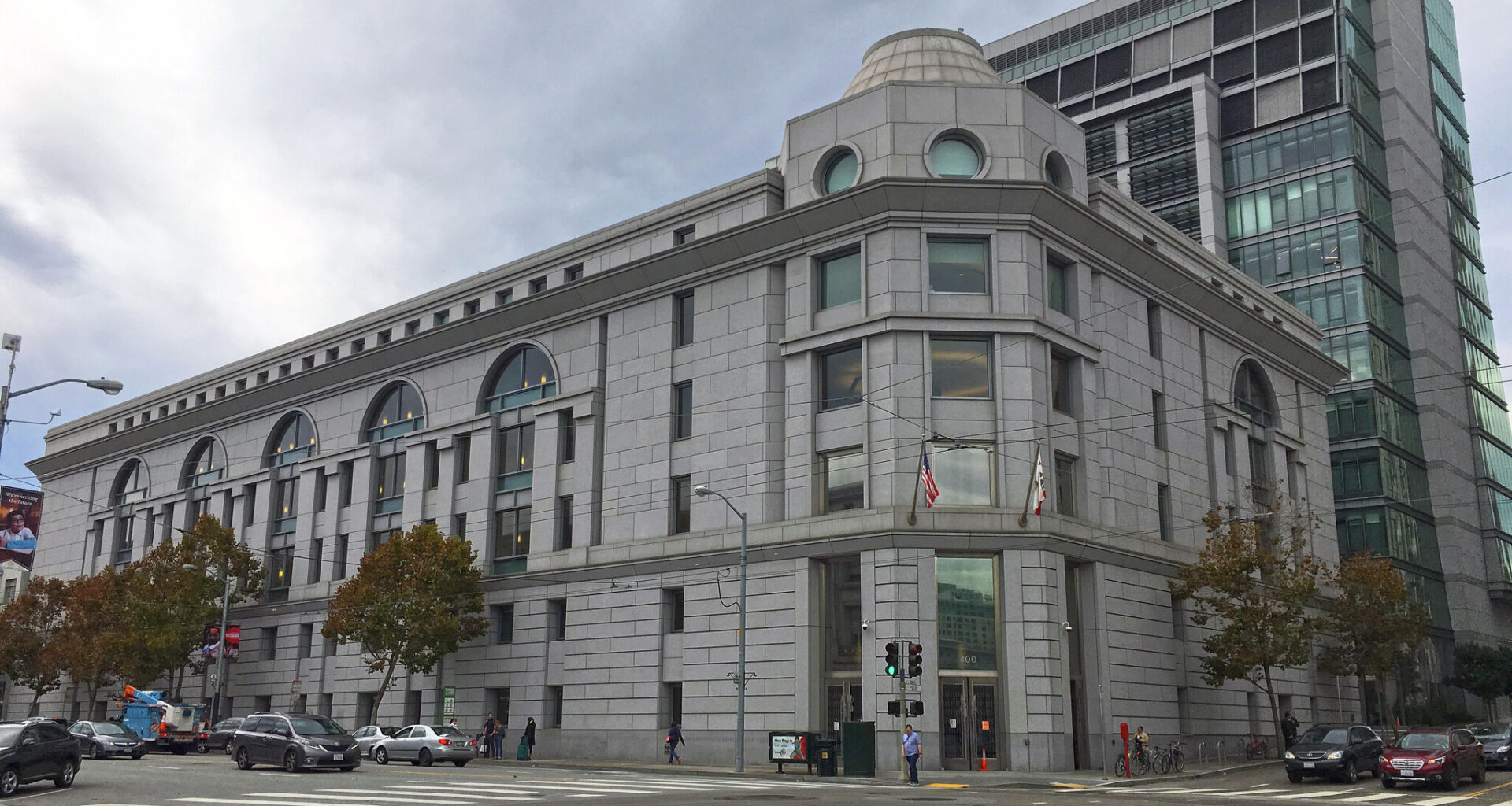
Many documents from the San Francisco Superior Court civil courthouse, pictured in 2017, are not available online, and many records can only be requested in-person or via mail.
Dominic Fracassa/S.F. Chronicle
Judicial elections — and judges themselves — are increasingly being subjected to the same political pressures and hyperpolarization that define the rest of American politics.
In recent years, San Francisco District Attorney Brooke Jenkins has routinely blasted criminal court judges for — among other things — refusing to grant her requests to keep alleged fentanyl dealers in custody. In 2024, two incumbent San Francisco County Superior Court judges were challenged, albeit unsuccessfully, by well-funded election opponents who argued they were soft on crime. An Orange County citizens’ group is currently seeking to recall six probate and family court judges that it believes are biased, with plans to pursue further judicial recalls in Los Angeles, San Bernardino and Sacramento counties.
The June primary election in San Francisco will feature only one contested judicial race. There could have been another: Lawyer Anthony Tartaglio filed papers to challenge controversial Superior Court Judge Michelle Tong — only to backtrack a week later. As I first reported, Tong’s ruling in a 2023 family law case permitted a woman accused of abusing her husband to “abduct” the couple’s son and take him to Kazakhstan; years later, the child has not been returned to his father. (Tong is thus running unopposed, along with 21 other incumbent judges. None will appear on the ballot.)
Article continues below this ad
Tartaglio declined to comment when I asked why he dropped out of the race. But one potential reason could be that judicial elections are arguably the most confusing items on California’s ballot. Strict ethics rules aimed at preserving the integrity of the court process limit how much judges and judicial candidates can speak about specific cases.
If you want to assess a judge’s record in other ways, you mostly can’t.
San Francisco Chronicle Logo
Make us a Preferred Source to get more of our news when you search.
Add Preferred Source
California makes it nearly impossible to review local judges’ rulings to get a feel for their reasoning and temperament.
A host of superior court documents cannot be accessed online. In some counties — including San Francisco — you cannot even request many court documents online or over the phone.
Article continues below this ad
Instead, you either have to mail the request or physically submit it at the courthouse. Be prepared to print out a lot of forms, because you must submit a separate request for each case. (You can access some civil case records remotely and view more sensitive ones at public computer terminals in San Francisco’s civil courthouse, but neither option is available for criminal court.)
Then you’ll likely have to wait a while — we’re talking weeks — for the court to process your request. Once the records are finally available, you’ll need to either physically return to the courthouse to review them or shell out 50 cents a page to have them mailed to you.
Oh, and you have a limited window in which to accomplish all this. The clerk’s offices in San Francisco’s civil and criminal courthouses are open from 8:30 a.m. to 4 p.m., but closed from 12 p.m. to 1 p.m. — the one hour that working people might be able to get away from their jobs.
This, by the way, is just the setup in San Francisco. Each court in each of California’s 58 counties has its own hours and policies. The only thing they seem to share is the complex process for obtaining transcripts of court hearings: You need to track down the court reporter for each individual hearing in a specific case and order the transcript directly from each reporter.
Why are we still using such inefficient, costly and arcane methods in the tech capital of the world?
Article continues below this ad
It’s an intentional choice.
Under the California Rules of Court — adopted by the Judicial Council of California, the policymaking body for state courts — records that aren’t under seal or made confidential by law “must be made reasonably available to the public in some form.” Yet the rules explicitly forbid courts from allowing remote access to pretty much all records that tend to be of public and journalistic interest — such as criminal cases, civil harassment proceedings, divorces, workplace or domestic violence and elder or dependent abuse.
“A right to access on paper isn’t much good if you can’t get access easily in practice,” David Loy, legal director of the First Amendment Coalition, told me.
When I took my concerns to the Judicial Council of California, a spokesperson said nobody was available to speak with me, but directed me to a 2023 report in which the council evaluated its approach to remote access to court records. The report noted that the council historically sought to balance the rights of public access and individual privacy by leaning on a U.S. Supreme Court-endorsed approach known as “practical obscurity,” in which documents are technically open to the public but simultaneously “not easily accessible.”
But post-COVID, the report continued, “public expectations have changed, technology has advanced, and court users expect to be able to get information and records online.”
Article continues below this ad
The Judicial Council report didn’t address how courts should adapt. Instead, it punted that job to the Legislature, which it said was “better suited to balancing competing constitutional, societal, and policy interests and goals with respect to who may access which court records remotely.”
State Sen. Thomas Umberg, D-Santa Ana, a lawyer who leads the Senate Judiciary Committee, told me that he agrees the Legislature should weigh in on remote access, “particularly in light of the fact that the judges themselves often can’t respond to allegations and that it’s becoming an increasing phenomenon to attack judges and the independence of the judiciary using inaccurate information or incomplete information.”
Some argue that increased public scrutiny of judicial rulings leads to more politicized rulings. That may be true. But such extreme pressure is already being exerted on judges — largely because of the current informational vacuum. Easier access to court records would at least allow for the possibility of reasoned debate and a fuller, more factual understanding of what’s going on in the courtroom.
As Loy told me, “Access is an accountability issue. Transparency is the oxygen of accountability.”
Statewide changes seem far off. But San Francisco County Superior Court spokesperson Ann Donlan told me that “the court recognizes the need for a more convenient digital records request process” and plans to launch an online portal for criminal records requests sometime this spring.
Article continues below this ad
Guest opinions in Open Forum and Insight are produced by writers with expertise, personal experience or original insights on a subject of interest to our readers. Their views do not necessarily reflect the opinion of The Chronicle editorial board, which is committed to providing a diversity of ideas to our readership.
Read more about our transparency and ethics policies
That’s better than nothing. And yet it’s also a far cry from a 1993 Commission on the Future of the California Courts report that predicted by 2020, “paper has nearly vanished from the courts.” This would launch an “access revolution” that makes “justice more efficient, more accessible, more understandable, and higher quality.”
More than three decades later, we’ve barely moved an inch toward that imagined future.
Emily Hoeven is a columnist and editorial writer for the Opinion section.