
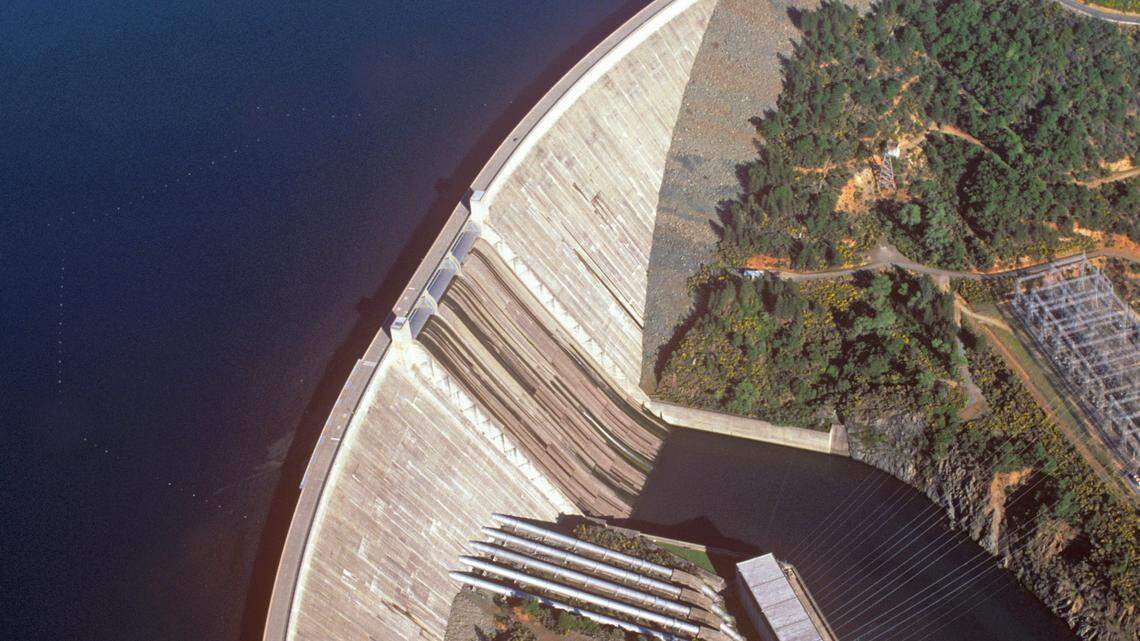

Shasta Dam across the Sacramento River was completed in 1945. The dam serves long-term water storage and flood control in its reservoir, Shasta Lake, and also generates hydroelectric power. At 602 feet tall, it is the ninth-tallest dam in the United States and forms the largest reservoir in the state.
Gerald French
Getty Images/Corbis
The U.S. Department of the Interior announced this week that it is allocating about $540 million to upgrade the Central Valley Project’s aging water infrastructure, a key federal water management system in California that supporters and critics alike have described as a broken system for very different reasons.
The announcement came during an unusually hot and dry start to March in California, as climate scientist Daniel Swain said the state’s snowpack is on an accelerating downward trajectory and could end up matching 2015’s record-low by April 1, when the state’s supposed to see its peak snowpack.
As climate change keeps pressuring California’s water supply, supporters of the project say the large federal investment for the project offers some level of long-awaited relief to modernize aging infrastructure and make the system functional and operational. For those who oppose the project, it feels like the federal government is pouring money into a system that is already outdated and crumbling and continues to drive species toward extinction.
“Individual sites may be above or below record, but the point is, we’re going to be right around this territory where we’ve never seen snow pack this bad, this early,” Sawin said during a webinar on Friday.
A system under climate strain
The idea for the Central Valley Project was first pursued in California, but it was ultimately handed to the federal government as the state struggled to meet the funding requirement during the Great Depression. Today, under the Bureau of Reclamation, the Central Valley Project stretches from Shasta Dam in the north to the southern San Joaquin Valley, and it typically delivers about 7 million acre-feet of water annually for irrigation, municipal and industrial uses.
According to the Interior Department’s Tuesday announcement, out of the $540 million total funding, $235 million would be allocated to the Delta-Mendota Canal, $200 million to the Friant-Kern Canal, $50 million to the San Luis Canal, and $15 million to the Tehama-Colusa Canal Authority pumping plant to upgrade outdated water infrastructure. Another $40 million would go toward steps to raise Shasta Dam by 18.5 feet, the department added, echoing the administration’s intent to advance the controversial reservoir expansion despite strong pushback from environmental groups.
While the Central Valley Project aims to deliver the water promised in its contracts, those contracts also include shortage provisions tied to hydrologic conditions in specific watersheds, and those provisions have been applied aggressively in recent drought years, including in 2021, when some agricultural contractors north and south of the Delta received no water at all.
“We see declining water supplies over the past few decades to the point where we have really volatile and unreliable water supplies for Westland and the South of Delta Central Valley Project,” Allison Febbo, general manager at Westlands Water District said.
“Our Central Valley Project is a broken system, and we haven’t made investments for several decades, and these investments are highly important to start making our system functional and operational.”
The environmental cost
But from environmentalists’ perspective, investing in the Central Valley Project means getting further away from addressing the underlying problems driving canal damage with groundwater overdraft and subsidence — or when you pump out too much groundwater too fast and cause the land to sink and affect the canals.
Ron Stork, a senior policy advocate with Friends of the River, said the Interior Department’s funding represents a messy reality that it benefits powerful agricultural districts that caused the problem in the first place.
“The irony (is) that often the same folks who benefited from the canals are the ones who are over-pumping the groundwater that’s wrecking the canal,” Stork said. The reason the canals are damaged, he explained, is because industrial agriculture in the Central Valley pumped so much groundwater that it caused the ground along the route to sink.
National Marine Fisheries Service released findings in 2009 that said the long-term operations of the Central Valley Project and State Water Project were “likely to jeopardize” several fish species, including Sacramento River winter-run Chinook salmon, Central Valley spring-run Chinook salmon, and California Central Valley steelhead.
Environmental groups estimate that thousands of fish are killed each year by the federal and state projects that pump water from the Delta, with the Central Valley Project specifically killing fish by cutting flows into San Francisco Bay-Delta and blocking salmon migration.
“We’re continuing to invest in an infrastructure system that’s designed around damming rivers in Northern California, funneling all of that water to Central Valley industrial farmers, to the detriment of tribes and salmon and other species in Northern California,” Harrison Beck, an attorney with the Center for Biological Diversity said. He argued that rather than addressing the Central Valley’s unsustainable water demand and rethinking different ways for agricultural water use, the federal government is pouring hundreds of millions of dollars to meet “insatiable demand.”
“We don’t think that salmon should go extinct or locally extinct, so that industrialized agriculture corporations can grow tree nuts in the Central Valley at this scale,” Beck continued.
Related Stories from Sacramento Bee

The Sacramento Bee
Chaewon Chung covers climate and environmental issues for The Sacramento Bee. Before joining The Bee, she worked as a climate and environment reporter for the Winston-Salem Journal in North Carolina.