
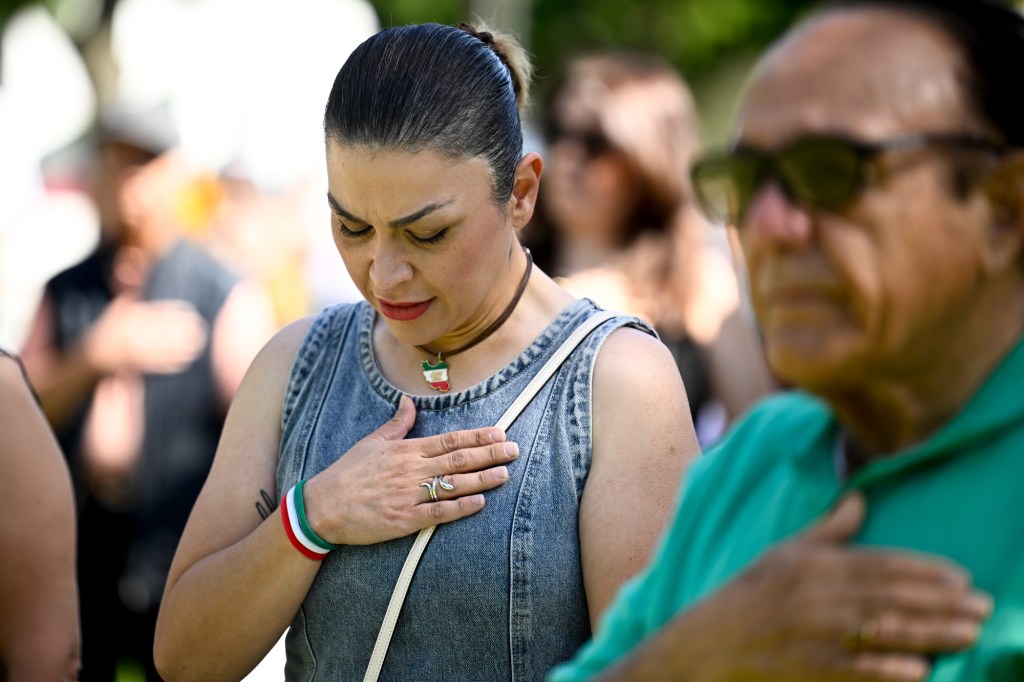
Soheil Bigdeli didn’t want his in-laws to fly to Iran.
Last summer, his own parents had gotten stuck there for months after the Twelve-Day War began, and he feared his wife’s parents could also be stranded.
Still, his in-laws — who live in Sorrento Valley — traveled to Iran to visit an elderly relative outside the western city of Hamedan.
Now Bigdeli’s fears are reality. The U.S. war with Iran has prevented the couple, and a family friend from Encinitas, from coming home. He and his wife, Saharnaz, can talk to them only sparingly, due to an internet blackout Iranian authorities imposed amid protests months ago.
Days after the U.S. began bombing Iran, the State Department told Americans there and in 13 other countries to leave the region. By then many couldn’t, with airports shut and travel risky.
The State Department said Wednesday that more than 70,000 Americans had returned to the U.S. and late last week said it had completed more than two dozen charter flights to get people home.
But that help is more accessible in some countries than others. The U.S. has no diplomatic relations with Iran. There is no U.S. embassy there. And commercial flights are not leaving Iran.
“I don’t understand what they mean by getting out,” Bigdeli said. “It’s not that easy.”
Bigdeli, 48, the secretary of the San Diego Persian Cultural Center, was born in California but spent time in Iran as a child, before his family moved back to the United States.
He hopes the war leads to a regime change — he wants to see basic civil liberties restored under a new government voted in by the people — but the uncertainty over his family’s current safety in Iran is difficult to handle.
“This lack of connection with the family is just so painful to many of us, and we question whether it’s worth it,” Bigdeli said. “We have mixed feelings. Hopefully it will end the way we want it to end.”
Now, Iranian Americans in San Diego who were already heartbroken over Iran’s bloody crackdown on protests are increasingly anxious about what the future holds for their loved ones, and for the country many once called home.
In recent months, Iranian authorities killed thousands of people involved in nationwide anti-government protests and arrested tens of thousands more.
Then, the U.S. and Israel launched surprise bombings across Iran on Feb. 28, sparking a broad regional war that has killed top Iranian leaders and sent shock waves through the global economy.
The recent events have fallen just before Nowruz, the Persian new year celebration that began Friday, a holiday typically marked by dancing and large feasts.
But this year, some say it doesn’t feel right to celebrate.
“It’s going to be unlike any other celebration that Iranians have conducted,” said Tinoosh Feyzbakhsh, 55, who lives in Carmel Mountain Ranch. “How can you justify celebrating?”
On Sunday, the local nonprofit Iranian-American Movement for Human Rights hosted a Nowruz event in Balboa Park that was more somber than in previous years. Along with the traditional sofreyé haft seen, a spread of items set out to welcome the new year, this year’s event encouraged people to honor the lives of protesters killed by placing flowers on a map of Iran.
“We are still mourning,” said Siamak Rahmani, the organization’s president. “However, we’ve got to honor the heritage.”
Other local Iranian American groups are making similar efforts to square the spirit of the holiday with the upheaval and violence their families now face.
The San Diego Persian Cultural Center canceled its programming for the Nowruz celebration to offer support services for the community instead, including reflection sessions and help for people trying to reach family in Iran.
In January, it hosted a candlelight vigil to honor the lives lost in the recent protests; close to 400 people attended. It has since hosted reflection sessions and will host a community event for Nowruz next Friday.
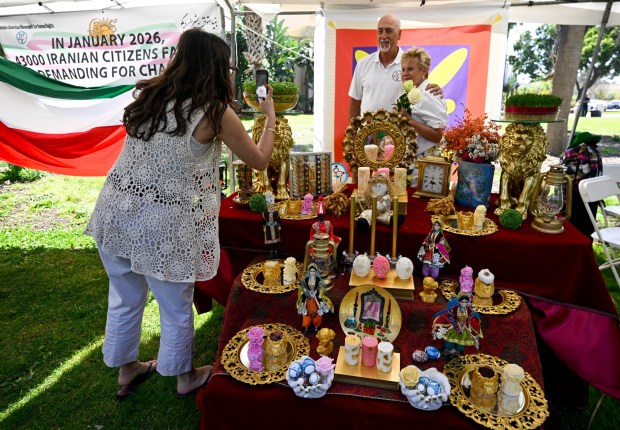 Iranians pose with a haft seen at a celebration of Nowruz, the Persian New Year, on March 15, 2026, at Balboa Park in San Diego. (Denis Poroy / For The San Diego Union-Tribune)
Other members of the community are marking the occasion with more intimate family gatherings.
Habib Hariri, 62, who lives in Scripps Ranch, was sharing a meal with his family Friday, the first day of the 13-day Nowruz celebration.
Some of his loved ones, including friends from San Diego, are stuck in Iran and many family members fled Tehran for the coast of the Caspian Sea. It’s been an anxious and depressing time, he says, but the holiday is still an important one.
“This is a tradition that goes back 3,000 years, and nothing is going to keep us from recognizing the Persian New Year,” he said. “That’s not going to go away. We’re not going to compromise or give in and not recognize our Nowruz.”
It’s a sentiment others in his community share.
Feyzbakhsh is among them.
He and his parents first left Iran in 1979, when he was 8 years old. His parents had worked for the ousted shah’s U.S.-backed government, and they were granted political asylum in the U.S.
He still has family in Iran. His aunt and cousin fled Tehran after the war began. Another cousin was shot dead protesting recently — his second such relative to be killed in uprisings there.
“They stood for what they believed,” Feyzbakhsh said.
He worries for his family’s safety, but he supports the U.S.-Israeli attacks, seeing them as a necessary step toward toppling the current clerical government.
“A war is never, ever a choice,” Feyzbakhsh said. “But how are you going to deal with a fanatic regime? They need to be eradicated.”
A fresh start with a new government is what 22-year-old Elika Kiani wants, too.
Nearly all of the UC San Diego pharmaceutical student’s family lives in Iran. Only she and her parents live in the U.S.
To Kiani, in some ways the war feels like Iranians’ “only chance” at freedom after years of feeling hopeless — especially if it weakens the current regime.
But it’s not clear what the Trump administration’s goals are. President Donald Trump and his top officials have given conflicting statements about what they want the war to achieve.
“Sometimes he’ll say something, and he’ll do something different,” said Kiani, who used to lead her school’s Persian American Student Association. “We’re still hopeful that regime change will happen. I think we’re all sort of uncertain.”
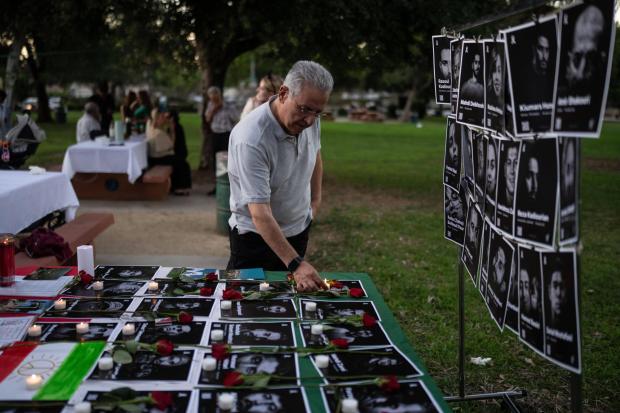 Geev Lameh places a candle by photos described as Iranian protesters killed in January, during a community gathering ahead of the Nowruz holiday in the Encino neighborhood of Los Angeles, March 17, 2026. (AP Photo/Jae C. Hong)
Hariri expresses a similar uncertainty. His own support of the war with Iran depends on whether U.S. and Israeli attacks are focused on government targets.
”But when we start bombing civilian infrastructure, I think that becomes more and more difficult to support,” he said.
Other Iranian Americans in San Diego are less supportive but are loath to speak about their perspectives, said Tazheen Nizam, the executive director of the local chapter of the Council on American-Islamic Relations.
People who left Iran long before the Iranian Revolution and never lived under Iran’s clerical regime may not support the war, and they fear repercussions if they speak out against it.
“Within their own community, they will face backlash,” Nizam said.
Meanwhile, for those with family still in Iran, waiting for news requires patience and hope.
Friends Naser Niknan and Farideh Najafi attended the Nowruz event in Balboa Park on Sunday with their families.
Niknan’s uncle lives in Isfahan, south of Tehran. They hadn’t spoken in three weeks.
Najafi, 72, left Iran more than 30 years ago but has four brothers who still live there, in Shiraz and Isfahan, as well as nieces, nephews and cousins. Tears filled her eyes as she spoke of them — she hadn’t heard from them for nearly a month.
The next day, her cousin called with reassuring news: All of them were safe.
Only a few words passed between them. The phone call lasted about one minute before it was disconnected.