
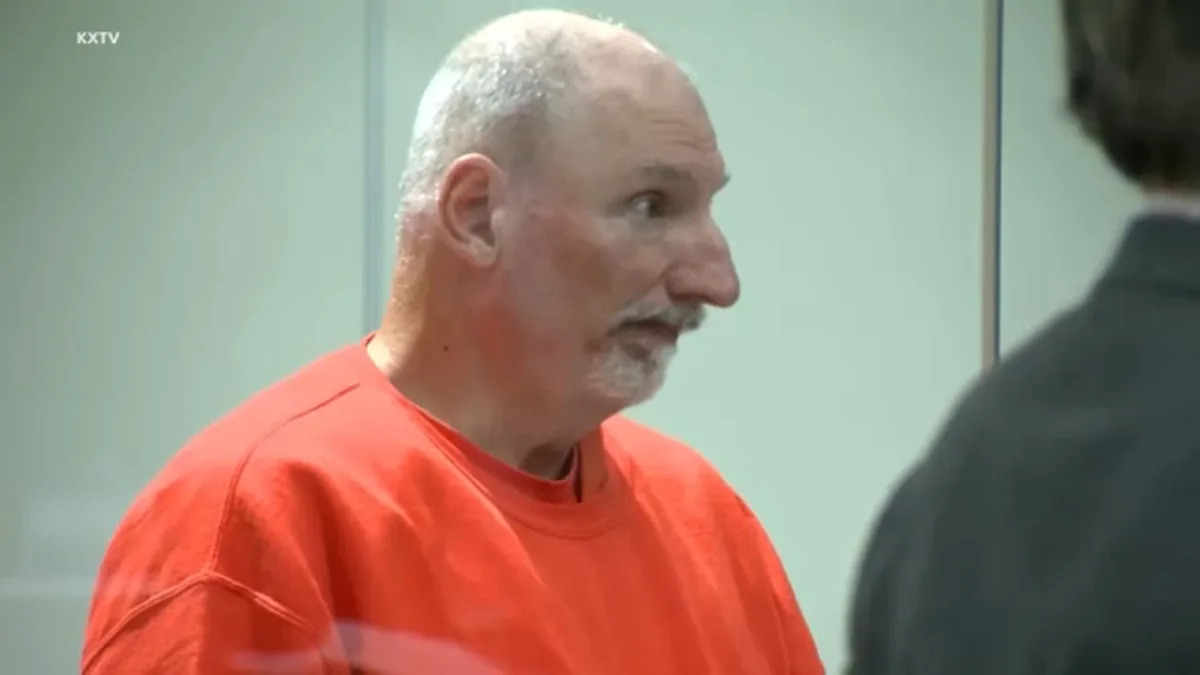
The public is getting a new look at how close a serial child molester is to walking the streets of Fresno.
David Funston used candy and toys to lure children in Sacramento County back in the 1990s. His youngest victim was three years old.
“It was the worst serial child predator case I’ve ever seen in my history,” former Sacramento County District Attorney Anne Marie Schubert told Action News.
She prosecuted the case in 1999, securing a conviction and three life sentences.
“A prosecutor had a belief that when you got life, it meant life,” Schubert said. “We made promises to these families, to these children. ‘Don’t ever worry, he’s never going to get out.'”
But under new laws, the 64-year-old Funston received parole in February. He is considered “elderly” under a state program that allows the possibility of parole for any inmate who is 50 years of age or older and has served a minimum of 20 consecutive years.
The decision to release the convicted child molester from prison came even after stunning comments.
Documents obtained by Action News reveal Funston told the parole board last September that he still has sexual fantasies.
He describes a thought from four years ago involving his daughter’s 8-year-old playmate.
“This parole board felt that he was still safe to release, which is really quite shocking,” Schubert said.
Asked where he wanted to go, Funston said the Centers for Living in Fresno.
Funston was set to walk free and would likely be in Fresno. However, on his release date in February, Placer County authorities arrested him on prior charges by reopening a case they dropped 30 years ago after the three life sentences.
“They were dropped ‘in the interest of justice’ because the belief was David Funston would never get out,” Schubert said. “And so now those interests of justice have been flipped on their head.”
His imprisonment now hinges on the new case and the potential trial to come.
Schubert now recalls what the judge said about Funston in her case.
“He essentially described him as every parent’s worst nightmare, and that no amount of time would ever be enough for the crimes that he committed,” Schubert said.
The California Department of Corrections and Rehabilitation sent the following statement after this story’s publication:
Commissioners for the Board of Parole Hearings take many factors into consideration when determining a candidate’s release suitability. This includes the Comprehensive Risk Assessment, the candidate’s central file, parole plans and impact statements. The law requires that a hearing panel must grant parole at a parole hearing, unless it determines the incarcerated person currently poses an unreasonable risk of danger to society if released from prison. Commissioners may not deny parole based solely on the facts of the crime.
On background:
On Sept. 24, 2025, the Board of Parole Hearings granted parole to David Funston. On Jan. 9, 2026, Governor Newsom referred the case back to the Board, pursuant to Penal Code section 3041.1 and California Code of Regulations, Title 15, section 2044, subdivision (b), to request en banc review of a parole decision by a majority of appointed commissioners. At the executive board meeting on Feb. 18, 2026, the Board’s en banc panel affirmed the Sept. 24, 2025, decision to grant parole to Funston.
Please refer to the Parole Suitability Hearing Transcript for factors that led to the decision in this case.
Under California law, the narrow question commissioners must answer at a parole hearing is whether the person currently poses an unreasonable risk of danger to public safety. The Board’s standard is stringent, involves numerous steps and use of validated risk assessment tools, including evaluation by forensic psychologists.
Parole commissioners receive extensive training on evaluating the current risk of incarcerated people, including the use of validated evidence-based risk assessment tools. Hearing officers use these tools to analyze the person’s risk factors and determine whether the person can safely return to their communities and if their proposed parole plans and conditions of parole are sufficient to manage their individual risk factors.
The Board does not determine who is entitled to a parole hearing – eligibility is set by the sentences courts impose and the laws enacted by the legislature, including Youth Offender, Elderly Offender, and Non-Violent Offender laws. Eligibility for a parole hearing does not necessarily mean release on parole.
The Board of Parole Hearings is an independent Board that conducts suitability hearings at which they determine if an individual currently poses an unreasonable risk of danger to public safety. Those found to pose an unreasonable risk are not released on parole. BPH works closely with the Office of Survivor and Victim Services to ensure crime victims receive timely notice and support through Board processes. Crime victims and survivors, and their next-of-kin are encouraged to register to request services from CDCR’s Office of Victim and Survivor Rights and Services.
It is also important to clarify the Governor’s authority. Under state law, the Governor may only reverse a parole grant in murder cases. In cases involving non-murder offenses, the Governor’s only options are to allow the person to be released on parole or refer the decision back to the Board of Parole Hearings for review by the commissioners sitting en banc.
The Board grants parole at fewer than 12 percent of scheduled parole hearings. The recidivism rate for people released after an Elderly Parole hearing is 1.8 percent for any conviction. None of those re-convictions involved sex offenses. The recidivism numbers are similarly low for people with a sex offense conviction released after an Elderly Parole hearing. Of the 15 sex offenders released after an Elderly Parole Hearing in 2022, one was convicted during the three-year follow-up period. The crime was misdemeanor driving without a license.
Overall, the Board’s record of protecting public safety by granting parole only to those who are not likely to recidivate is among the best in the United States. More than 97 percent of people released after a parole hearing successfully transitioned to the community without being convicted of another crime within three years. Less than 3 percent (2.5%) were convicted of any new misdemeanor or felony within three years. Less than 1 percent (0.5%) were convicted of a new felony offense against a person during that same period.
These outcomes are consistent with decades of research showing that recidivism declines sharply with age. Individuals over 60 have some of the lowest reoffending rates of any demographic group in the correctional system.
For news updates, follow Gabe Ferris on Facebook, Twitter and Instagram.