
PEORIA, Ariz. — If only anyone could fathom what it is like to be a 6.1 WAR player and be disappointed in yourself.
Fernando Tatis Jr. feels that deep inside. By his telling and the observations of others, he is practically obsessed by the notion.
“I know what I’m capable of doing,” he said. “I’m dealing with 1,000 things. Just having that curse — it’s also a blessing, but a curse — that you know that you’re just better than what you’re showing.”
To provide some context, six wins above replacement, which Tatis topped by one-tenth of a point in 2025, is a level achieved by an average of 10 major league players each season. In all, 34 different players have reached that level over the past five seasons. Tatis, who missed one of those seasons, is one of 10 players to have done it twice in that span.
Tatis hit 25 home runs and stole 32 bases last season. Among the 10 other players to have 25-25 seasons in ‘25, only Juan Soto had a higher on-base percentage than Tatis’ .368 mark. And none of the rest of them leaped above a wall four times to rob would-be home runs.
Tatis finished the 2025 season with a 131 wRC-plus, a metric used to measure a player’s offensive value relative to players in all eras. That means he was 31% better than the average major leaguer, and it placed him in the top 18% of qualifying hitters in Major League Baseball last season.
And that is just OK.
“For me, everybody knows that there’s more,” Tatis said. “There’s more in there.”
‘Job No.1’
Craig Stammen’s first conversation with his best player after taking the job as Padres manager was nostalgic, and it was purposeful.
Stammen told Tatis that he could still clearly recall when he was pitching in 2019 and a rookie shortstop was behind him doing things Stammen “had never seen in baseball.”
It was the truth, and Stammen told that truth to help bolster in Tatis’ mind who he is.
Stammen even before taking the job placed a priority on the task of figuring out how to help get the most out of his former teammate, who is now a right fielder and at 27 years old is square in the prime years of his career.
“That’s job No.1, figuring out what he’s about and what will make him reach his potential,” Stammen said in November. “… Even operating at what we would consider 75% he’s probably still a top-20 player in the game. It’s absolutely possible he could be sleeping on the couch right now, in November, and you could say, ‘You’ve got a game in an hour.’ And he would be the best player on the field, and he would show everybody.”
That’s the thing. Stammen and everyone in the organization knows it. Tatis wants to show everybody.
To him, it is a fact that he must.
Speaking to reporters at FanFest in January, Tatis said, “My best years are definitely ahead of me, and this year is going to be one of those. There’s no limit. Now it’s (up) to myself to show you guys.”
Asked this offseason what he anticipated of the three-time All-Star, Stammen said, “His expectations are going to be greater than mine. He wants to be the best player in baseball, and that’s what he’s been working toward.”
There are myriad reasons every season seems to be a big one, a prove-it year for Tatis.
For all he has accomplished, the arc of his career has so far been akin to a rocket that fell from orbit, stopped and resumed a flight around the exosphere.
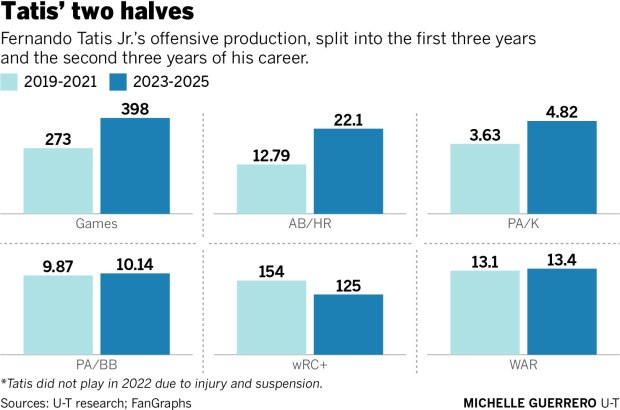 Fernando Tatis Jr.’s offensive production, split into the first three years.and the second three years of his career.
Some of the questioning from the outside has been self-inflicted, owing to Tatis’ 2022 suspension for a failed PED test after he had declined to get a necessary shoulder surgery the previous year and already had surgery to repair a wrist injured when he fell off the back of a motorcycle in the offseason. Some was brought on by the 14-year, $340 million contract he signed in 2021.
There has been no escaping that.
“A lot of growing pains, stuff that we learn from the past, stuff like turning into a man,” Tatis said. “Every mistake that I made, it was out there for the public, so that definitely sucked. But at the same time, it holds you accountable and to way bigger standards.”
People inside the Padres organization see signs he is ready to move past all that has happened.
“I think it’s different this year,” Manny Machado said. “In the offseason, he has been more focused on being who he is. It’s tough going through the things he’s had to deal with as a young player. It’s not easy. For him to kind of just put everything behind him, just focus on baseball will be huge.”
Some of the perception Tatis has not been all he could be — in his own mind and the minds of others — has its root in the expectations that grew out of his doing things in his first three seasons that no player had ever done before.
He is the first player to have hit 81 home runs and stolen 52 bases over his first 273 big-league games, which is how many he played from his debut on opening day 2019 through the end of the ‘21 season.
The list of players who have put up those numbers over any 273-game span in their careers is this long: Shohei Ohtani, Barry Bonds, Christian Yelich and Tatis.
Tatis’s 154 wRC-plus in those first three seasons was second in the major leagues behind Soto’s 159. Tatis’ .965 OPS over that span is the second-best mark over any active player’s first 273 games behind Aaron Judge’s .976.
Less quantifiable but just as familiar to those who watched Padres games in those years was the feeling Tatis was always about to do something big — because it seemed like he was.
There was in 2019 the time he tagged up and scored on a pop fly to second base and the time he scored from second base on a ground ball and the time he scored from third base on a ground ball to the pitcher and the time he scored after being called out twice in an inning.
The last of those saw two overturned calls — at first base after hitting a groundball to shortstop and at second base on a steal.
It reached a point where his improbably acrobatic slides had umpires for a time seeming to err on the side of calling him safe, because they had so many out calls overturned.
“It’s like poetry when he’s playing the game,” former Padres first baseman Eric Hosmer said during the 2019 season. “He’s so electric and moving all fast. You can tell it was just meant to be. … The stuff he’s doing, he’s treating it like he’s a high school guy who’s playing on JV when he should be on varsity. It’s unbelievable.”
That version of Tatis still lives so vividly in the minds of those who witnessed it on an almost daily basis that it seemed ironic when Tatis answered a question this spring about what it’s like to be so good and think you should be so much better.
“Yeah, the challenge is always there,” he replied. “There’s definitely players now in the game that are breaking the roof, and they’re bringing the game to a different level. I’m just looking forward to that challenge.”
‘You definitely get in your head’
One of the Padres’ top priorities this offseason was to do all they could to get the best version of their best player in 2026.
Tatis is seen as that paramount to the Padres’ success. Some in the organization argue his performance — and, inextricably, his energy — set the tone for the entire team.
And a joyous Tatis has most often been a transcendent Tatis.
“For me, it’s getting his personality to come out,” Stammen said. “That’s when he plays the best.”
Conversely, a struggling Tatis eventually becomes a dour Tatis. And while that version might be better than most, it is not what he is supposed to be based on the gifts he was given at birth and the “statue contract” he was given at 22.
Tatis does not deny that frustration can get the better of him.
“Yeah, a lot,” he said. “… You definitely get in your head, because you’re just searching for an answer. You’re searching for where’s that click, where’s the difference maker? You definitely get in your head.”
This is not just a matter of Tatis pouting. When things aren’t right, he has taken to tinkering.
“In talking with him, he knows he can do it, because he can get away with it, because he’s so special,” first-year Padres hitting coach Steven Souza Jr. said. “But I think over a long course of the season, to have these long stretches of consistent success, you have to develop a routine where you know where everything is, and then you kind of go unconscious and you’re just depending on your routine.”
Last year was dizzying. No leg kick, leg kick. No leg kick, leg kick. Hands lower, hands higher. Leg kick, no leg kick.
“I just couldn’t click it,” Tatis said. “I don’t want to say I didn’t have the right help, but I feel like we were not looking in the right spots. We didn’t have the right answers at the time.”
Now the Padres have a new hitting coach that Tatis has praised for being part of a coaching staff that has infused “more 21st-century baseball talk” into its instruction.
He also has a familiar voice in the batting cage.
“This year, I don’t think it’s going to be that way,” Padres hitting instructor Raul Padron said of Tatis’ tinkering. “I think we’ll keep him in a good spot. If we need to make a little adjustment, we’ll make it. But other than that, it’s more knowing that somebody is watching, somebody’s gonna hold you accountable, and it’s gonna make it, ‘Let’s go. We need to go. Let’s go.’ Any player needs that. It doesn’t matter who you are.”
The title of hitting instructor is a new one for the Padres. Padron joins Souza and returning assistant hitting coaches Mike McCoy and Pat O’Sullivan in working with Padres hitters. Padron is also one of Tatis’ mentors, having first come alongside him when Tatis was in Double-A, the No.1 prospect in all of baseball and having a little trouble with the accompanying expectations.
The two men formed a bond. Tatis has mentioned Padron often over the years as someone he trusts with his swing.
“I wish I could have a little bit more power (in the organization),” Tatis said of having previously lobbied to have Padron join him in San Diego. “But, you know, I speak it into existence. I definitely brought that to (president of baseball operations) A.J. (Preller) way more. And I feel like it was the right time. … The way he approaches hitting, the way he talks the game and the way he sees details, the way he knows me as a hitter. He really emphasizes a lot of good stuff when you’re hitting. All credit to him for winning my confidence.”
After a decade coaching in the Padres minor-league system, Padron was added to the staff this season. He is well-regarded by many players. His ascension to the big leagues was not entirely for him to work with Tatis. But it certainly was part of the emphasis on the Padres supporting Tatis.
“I think he knows that everything is gonna be served for him to keep him in a good spot mentally,” Padron said. “… I’m not afraid to say (what needs to be said). I’ve known him for such a long time, and now it’s like he knows that I know.”
‘Great offseason’
Padron is among those who have touted the work Tatis did over the winter.
“He had a great offseason,” Padron said. “Best I have ever seen so far.”
If that is so, there was a fairly simple reason.
Tatis was fully healthy, unfettered by any lingering issues, unlike most offseasons since he became a major leaguer.
Tatis played through a torn labrum in his left shoulder in 2021, making his first All-Star game and leading the National League in home runs with 42 that season. He declined to have surgery that winter and then fractured his wrist.
MLB players were locked out, and the Padres were not aware of the severity of the wrist injury until spring training began. Tatis underwent surgery and was nearing a return when he was suspended 80 games in August 2022 for a failed PED test.
Chastened by the suspension, he agreed to shoulder surgery that September, and in October, he underwent a revision of his wrist procedure.
His suspension lasted 20 games into the 2023 season, during which he batted .257 with a .770 OPS and 25 home runs in 141 games.
Tatis was healthy going into the next offseason and played winter ball before having his best season since the missed year — hitting .276 with an .833 OPS in 2024. . But he played in just 102 games, hurting in virtually all of them due to a stress reaction in his right femur (thigh bone). He sat from mid-June to the end of August and came back to hit seven home runs in his final 16 regular-season games and go 11-for-26 with four home runs in the postseason.
But he wasn’t right.
“I still had the stress fracture at the end of the season,” he said. “They were thinking about having surgery, redoing my entire body. … I was in New York and they were thinking about drilling my right leg because of the stress fracture. I ended up not doing that surgery. I found different ways to get healthy.”
That involved some extra rest.
This year, he got back to work a little more than a month after the Padres were eliminated from the postseason.
“I ended up being healthy and in a good spot with my body,” he said. “So I started to kick it up a little bit earlier. … I feel better. Physically and mentally. But I feel like my body is way better spot.”
‘Don’t have to be a superhero’
Padres officials watched the World Baseball Classic with a sense that it might mean something for them in 2026.
It clearly meant a lot to Tatis, who starred for the Dominican Republic in his first WBC, going 8-for-20 with two home runs, six walks and 11 RBIs in six games.
And doing it with a huge smile, lots of dancing and outsized stutter steps as he rounded third base.
An all-time stutter step around third base from Fernando Tatis Jr.
Electric. pic.twitter.com/19k8OvXYPz
— Sammy Levitt (@SammyLev) March 12, 2026
“He deserves it,” Stammen said near the end of the tournament. “He deserves to be enjoying who he is and his ability to perform the way he’s performing.”
It is not that the Padres are asking for that from Tatis in the regular season. Playing for the Dominican Republic for two weeks is entirely different than the 162 games in 186 days working at his day job.
“You can’t sustain that for 162, that type of emotion,” Stammen said. “But we’ve got to find a balance of, like, that framework of emotion through 162. And that will be a balance.”
Tatis took reinforcement from the tournament that his offseason work was paying off. He also noted the impossibility of maintaining for an entire season the emotional energy he exhibited while playing for his country over a short period of time.
That doesn’t mean it is not possible to replicate in small but effective doses. The reality is that sort of emotion is raw. It has to be organic. It is seeded in success, and it grows in an environment that nurtures it.
“It was just a bounce back from what the fans were giving me — how loud, how people were just so happy to see me on the baseball field and how they were cheering,” Tatis said. “It was just what they gave me, I gave them back. … And it was not just myself. It was the entire team being loud, bringing that energy, running the bases, doing bat flips. It’s contagious.”
A part of the Padres’ attempt to cultivate the right environment to help lift Tatis to his previous heights is convincing him he must not take on so much burden.
“I told him, ‘You don’t have to be a superhero. Just be who you are. They’re gonna pick you up. Don’t worry,’” Padron said. “Because he worries so much about that.”
One thing the Padres won’t be able to provide for Tatis is a lineup with Vladimir Guerrero Jr., Julio Rodriguez, Soto and various other All-Stars and Silver Sluggers.
It was easy to feel he was just a puzzle piece playing for the stacked Dominican team, for which Tatis led off.
Tatis hit first for the Padres last season and was routinely up to bat after the bottom of the order had made two outs and nobody was on base.
“If I’m hitting leadoff, just, let’s put a real lineup down there so we can create situations,” he said this spring. “Because I feel like I create more chaos when I have situations in front and behind me. With people on base, I can hit a ball over a wall. Me getting on base, I can steal two bags. That’s having my abilities play in a 100% manner.”
He paused, perhaps recalling that there is a different way to view the situation.
“I feel like this year we’re gonna have a way better lineup — a way, way better lineup,” he said. “At the same time, we have created a culture in there of team bonding and great group of guys that we’re just gonna help each other. That’s what a good team, what a good chemistry, good clubhouse does.”
Told of Tatis’ evaluation of the offense and the team around him, Stammen smiled.
“In baseball, sometimes you feel pressure that you don’t need to put on yourself,” Stammen said. “And he’s got a whole other realm of pressure that I don’t even understand. I have never had to live that life. But I just know that when you feel pressure, you can’t feel like you’re on an island. And I felt like at times in his career, he’s felt like he’s on an island. As his teammate, that’s probably my fault too. This year for me, my thought process is, how can we share that burden with him a little bit and be there for him and not just let him have to feel like the weight of the world is on his shoulders.”