
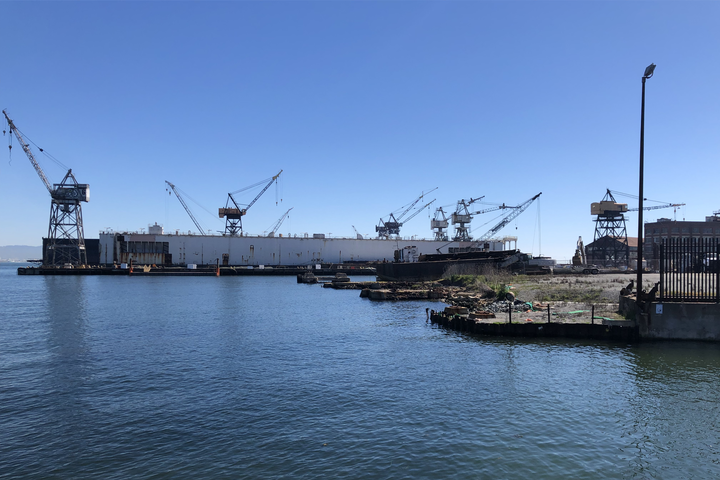
Dry dock No. 2 languishes in the bay at Pier 70 in San Francisco. The pier’s two rusting dry docks, abandoned since the shipyard closed nine years ago, will be removed as the city revitalizes the waterfront.
Carl Nolte/S.F. Chronicle
Heavy steel plates remain on the floor of the 800-foot dry dock No. 2, as seen in 2017. After an early-season storm last fall, the dry dock started to leak and began to list like a sinking ship before the city repaired it.
Paul Chinn/S.F. Chronicle
The 580-foot Eureka dry dock, as seen in 2017. The last operator walked away from a plan to operate the port’s two dry docks.
Paul Chinn/S.F. Chronicle
Not so long ago, San Francisco’s waterfront was lined with heavy industry: shipyards, floating dry docks to keep ships seaworthy, machine shops and jobs for thousands of blue-collar workers. They built and repaired easily a thousand ships.
It was not the pretty part of the waterfront, south of the Ferry Building, miles from Fisherman’s Wharf, south of South of Market. It ran around the clock: the sound of machinery by day, a kind of roar, the flash of welding torches at night. The shipyard at Pier 70 just off Third Street had been in operation for 150 years.
You could hear the whistles for the shift change even downtown when the wind was right: the beginning of the shift, lunchtime, quitting time.
Article continues below this ad
The last whistle blew at 8 p.m on Friday, May 26, 2017, just nine years ago, when the yard closed for good.
Modern glass towers stand tall behind the Eureka dry dock at the old Pier 70 shipyard, shown in 2017.
Paul Chinn/S.F. Chronicle
Eric Lee, a San Franciscan, had been a maritime worker all his life and was there at the end. “We’re human beings. We’re workers,” he told Chronicle reporter J.K. Dineen on the final day. He had been counting on working there until retirement age.
San Francisco Chronicle Logo
Make us a Preferred Source to get more of our news when you search.
Add Preferred Source
Dineen asked another worker whether he had a Plan B. “Plan B?” he said. “There is no Plan B for me.”
Article continues below this ad
But the Port of San Francisco and the maritime industry had a Plan B, and it was not what they hoped. The port, which owned the shipyards, and the two big dry docks tried to find a buyer for the business. The price was right: The last operator, Puglia Engineering, bought the operation from BAE industries for $1. But the facilities needed repair and there was a $38 million pension obligation. Puglia walked away. There were lawsuits. There were bigger and newer facilities up the coast in Oregon. No other operator could be found. The yard never reopened.
So the port’s two dry docks lay idle. Nine years is an eternity in the life of a city. More for two empty pieces of maritime hardware. Rust and the salt water environment did their work. Last fall, an early-season storm roared in. Dry dock No. 2 started to leak and began to list like a sinking ship. It looked like the floating dry dock was going to sink in the bay. The dock is 900 feet long, as long as a skyscraper is tall. If it sank, rusty and full of years of oil, grease and toxic material, it would have been an environmental shipwreck.
Pier 70’s abandoned dry docks, which provided critical support for ships for decades, offer a backdrop for visitors to the beach at Crane Cove Park.
Carl Nolte/S.F. Chronicle
The Mission Local website reported what happened next: The port declared an emergency, patched up the leaking dry dock, and decided the only solution was to scrap and remove dry dock No. 2 and its smaller companion, the Eureka dry dock. The port budgeted $61 million for the job.
The money comes from port funds, not the city’s general fund. But it’s the end of an era. “These are the last big pieces of maritime infrastructure here,’’ said Eric Young, the port’s spokesperson.
Article continues below this ad
By next year, this part of San Francisco’s blue-collar past will be gone. You can still see the abandoned dry docks from Crane Cove Park, or on the little beach there, or from the deck of the Ramp restaurant. There they are, big and gray, surrounded by cranes, sitting in the bay like stranded whales.
If you are like me, on a summer afternoon not long ago, you might sometimes have looked out from the shore and seen those ships — sometimes even a big white cruise ship sitting up and out of the water in the dry dock — and wonder how they did it.
In my checkered career, I got involved with the historic ship Jeremiah O’Brien and became a volunteer, first as a deckhand and then in the administration of the nonprofit organization that owns the ship. The O’Brien is a seagoing ship and needs to be maintained.
In 2012, we took the ship to the Pier 70 dry dock for repairs. So I got a closer look.
The 580-foot Eureka dry dock, shown when the shipyard at Pier 70 closed in 2017, remains vacant nine years later. The Port of San Francisco has budgeted $61 million to remove its two dry docks.
Paul Chinn/S.F. Chronicle
A floating dry dock is essentially a box, two sides surrounding an open space big enough to hold a ship. The dock can be raised and lowered by pumping water in and out of the sides of it. The process begins when the structure is afloat just below sea level. The ship is moved in, slowly and carefully; tugs help, and so does the shipyard crew. The ship has to be positioned exactly over concrete blocks; they will support the weight of the ship when the gate at the back end is closed. The water is pumped out, and the ship, thousands of tons of steel, is out of the water, balanced on the blocks. It has to be exact. A mistake can break the ship’s back.
Article continues below this ad
“A complex affair, requiring coordination and planning,” wrote the late Jim Hafft, who self-published a book on it.
I had some responsibility for the project, but Dave Winter, the ship’s port engineer, was the mastermind of the operation, watching, negotiating with the shipyard, planning the work. We replaced some of the steel hull plates, removed the propeller so the main drive shaft could be pulled for inspection, took the paint down to bare metal, pulled the anchor chains and laid them on the dock to inspect every link, and did a thousand other things.
What impressed me most was to walk under the ship out of the water, see the rivets and the seams, and look straight up the bow. We had trusted that old ship at sea and in the bay and loved it a little. And there she was, getting a new lease on life. The new lease cost a lot more than $1 million, all privately raised.
That was then. For a while after the shipyard closed, Pier 70 looked virtually abandoned, a ruin, decay and broken windows. Now the city’s Plan B is to revitalize the shipyard area, renew and replace the beautiful old buildings that surrounded the old industrial yard.
Stone lions guard the entrance to RH San Francisco, a historic building adjacent to Pier 70 featuring five floors of high-end furnishings and the Palm Court restaurant.
Carl Nolte/S.F. Chronicle
The centerpiece, you might say, is the old shipyard main headquarters, transformed into RH San Francisco, five floors of high-end furnishings, the Palm Court restaurant, offering “timeless classics,” the website says, “recalling the glamour of San Francisco’s Gilded Age.” It’s on 20th Street, and two stone lions guard the entrance.
Article continues below this ad
For ordinary people, there’s a pretty little beach a block or two away with a view of San Francisco’s industrial age.
As for the port, spokesperson Young is quick to point out: “We have an active working waterfront, good shipping activity around Pier 80, a robust cruise ship industry and growing ferry travel. But it’s different. It has evolved.”