
Heyday
Review by David Starkey
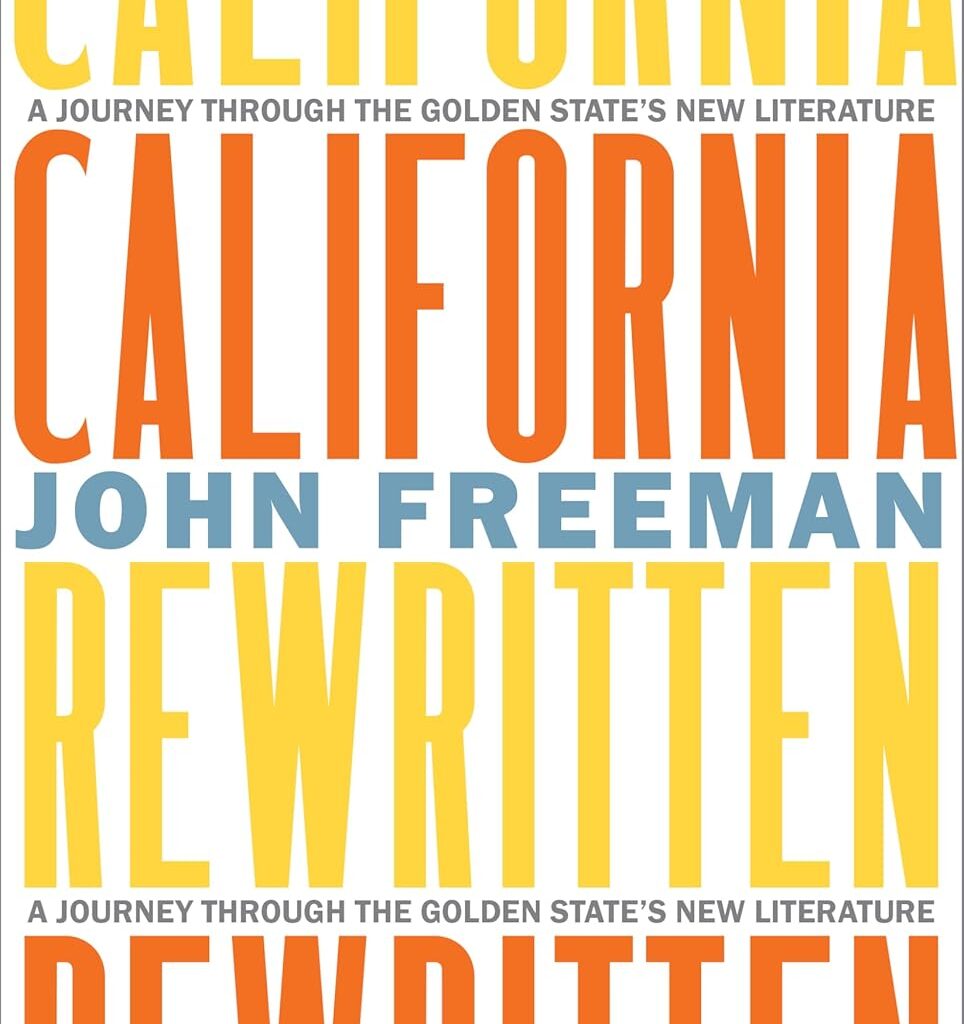
When we at the California Review of Books heard there was a new collection of book reviews about California writers, we were interested in learning more, and I’m happy to report that John Freeman’s California Rewritten: A Journey through the Golden State’s New Literature is definitely worth our, and your, time.
A former president of the National Book Critics Circle, Freeman was decrying the shrinking space for book reviews nearly twenty years ago, and of course that has only become worse, with even the Washington Post sending the great Ron Charles out into the wilds of Substack. Fortunately, Freeman is doing his part to keep book reviewing alive. Many of the pieces, he tells us in the introduction to California Rewritten, were composed during the pandemic, when, “prompted by editors at Alta magazine, several friends and I got together to read books by and about Californians.” The ultimate result was the California Book Club, which “now involves a month-long exploration of each book,” and typically features a Zoom interview with the author.
Although Freeman refers to the chapters in California Rewritten as “essays,” nearly all of the entries are extended reviews of a single book, and they are extraordinarily well-written. Often, the reviews begin with a big statement that becomes the theme of the review. Introducing Manuel Muñoz’s stories about Central California farmworkers, The Consequences, for instance, Freeman writes: “The word consequence does not appear in the King James Bible. Oh, there are punishments reaped and fates which are sowed—but consequences, that very behavioral term, are not to be found.” As a lead-in to a discussion of the multiple points of view in Tommy Orange’s There There, Freeman opines, “Perhaps in the future what we will say about film is that it rescued the novel, not that it destroyed the form.” And these aren’t just catchy ledes: Freeman follows through on his main idea throughout the piece.
Reviews are so important for a book’s success because a good reviewer is able to convey their enthusiasm for what they have read, and Freeman excels in this role. Who wouldn’t want to get hold of Claire Vaye Watkins’s Gold Fame Citrus, “the best cli-fi novel to have emerged from a burning, troubled America since the astonishingly prognostic Parable of the Sower by Octavia E. Butler” (a nice plug for Butler there as well). Danzy Senna’s Colored Television sounds equally compelling: “The ways that envy, longing, and fury feed off one another…is so sophisticated, so raw, and so like a current that the novel makes the overwhelming case that only fiction gets us inside the experience of experience.”
Freeman’s California is admirably multicultural, like the state itself. Indeed, books by writers of color are very much in the majority, and rightly so. What would a survey of California’s new literature be without discussions of The Woman Warrior by Maxine Hong Kingston, Under the Feet of Jesus by Helena María Viramontes, The Sellout by Paul Beatty, The Sympathizer by Viet Than Nguyen, Interior, Chinatown by Charles Yu, and on, and on? I like, too, that Freeman doesn’t always write about an author’s most famous book. Instead of The Joy Luck Club, for instance, the chapter on Amy Tan is about her very recent The Backyard Bird Chronicles.
Granted, some readers might quibble with Freeman’s definition of what it means to be a Californian. Claudia Rankine’s Citizen is no doubt one of the most important books of the twenty-first century, but her connection to California seems to be that she taught at Pomona College for a little over a decade. Freeman himself, though he spent important growing up years in Sacramento, was born in Cleveland, went to college in Pennsylvania, and lives in New York, where he is now an executive editor at Knopf.
Frankly, though, John Freeman is such a strong advocate for California literature that it doesn’t really matter where he’s from or where he lives. His heart is clearly in the Golden State, and anyone willing and able to promote Rachel Khong’s Goodbye, Vitamin, Rebecca Solnit’s A Paradise Built in Hell, and the poetry of Kay Ryan and Ada Limón is all right with me.