
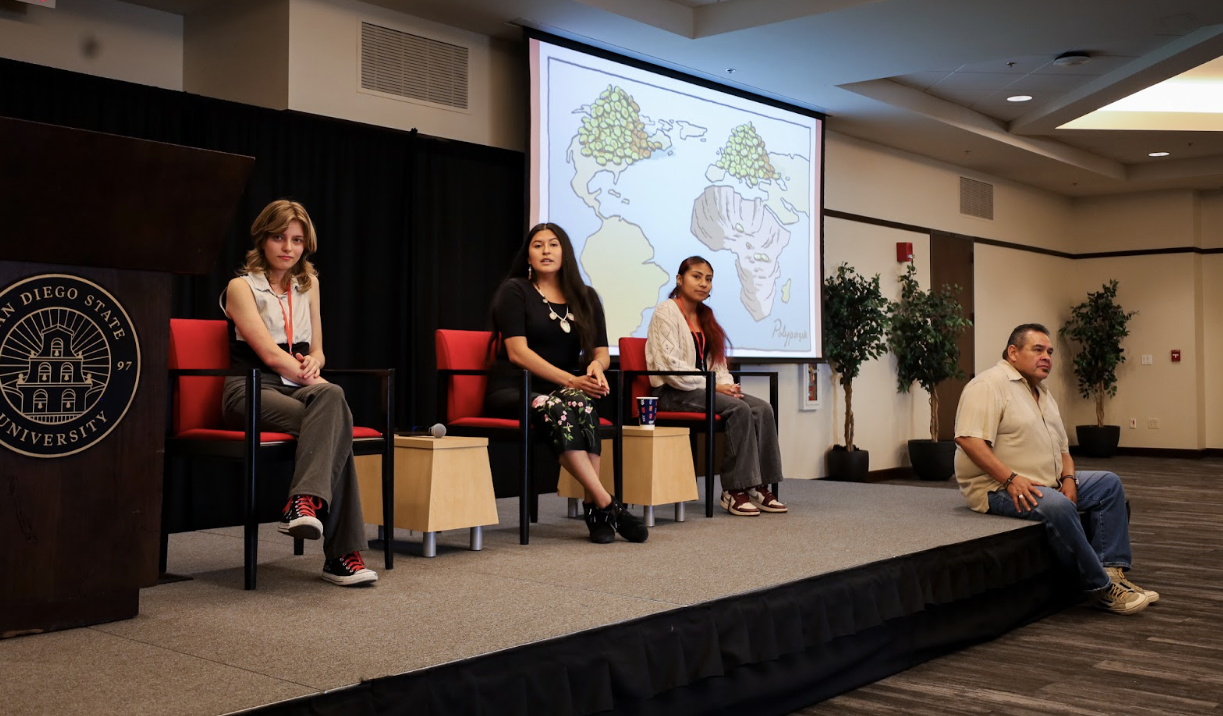
The Native Resource Center hosted its sixth annual Native and Indigenous Research and Arts Symposium on March 12 and 13, where students were given a space to share stories and transfer knowledge. Presenters were given an opportunity to share oral presentations, art, research films and dances.
While primarily providing a space for Indigenous SDSU students to present research and arts, the NRC also makes the symposium inclusive by allowing non-SDSU students to present.
Taté Garcia, a San Diego City College student with Lakota and Tongva heritage, presented research last year on how wildfire smoke impacts public health.
“It was awesome, it was the first time I did any kind of presentation like that in the institution setting,” Garcia said. “Luckily, the general native community of San Diego is very strong, and it’s with events like these you can really be and exist in it and come back with a good heart.”
For many students, NIRAS is more than just a symposium — it’s an opportunity to connect with others who value Indigenous culture, which is something the NRC actively facilitates.
“The center values allyship as well as inclusivity,” said Chris Medellin, Native Resource Center director, in an email. “If any student has a proposal that supports the success and sustainability of Native American and Indigenous communities, we consider them for the symposium.”
The event started with a dance performance by the Pacific Island Student Association. Students then presented research on health and wellness in the indigenous community.
Mark Freeland, SDSU graduate student and member of the 24th Navajo Nation Council, presented research showing COVID-19’s particularly hard impact on the Navajo Nation because of their underdeveloped infrastructure.
In addition to student presentations, the symposium hosted a panel with the Collaborative of Native Nations for Climate Transformation that furthered discussions of Indigenous allyship with the wider community.
Panel members presented yet-to-be-completed documentaries, including the Sacred Places Institute’s “Our Water Ways,” for feedback.
The film focuses on the collaborative management of California’s waterways by Indigenous communities. Condor Visual Media also presented a trailer for its documentary, “MAATHAAW: The Fire Within Us,” which explores the reestablishment of Indigenous land stewardship and burning practices.
Through the panels and student presenters, the NRC aims to show the wider SDSU community that Indigenous culture is thriving and that its knowledge is meant to be shared.
“In Lakota, we have a saying, ‘Mitakuye Oyasin,’ which means we are all related,” Garcia said.
“There is so much we learn just by taking our time and going to a potluck or a talk,” they continued. “Even if you don’t engage with anyone, you now have those questions you can take back to your own life, and your own people.”