
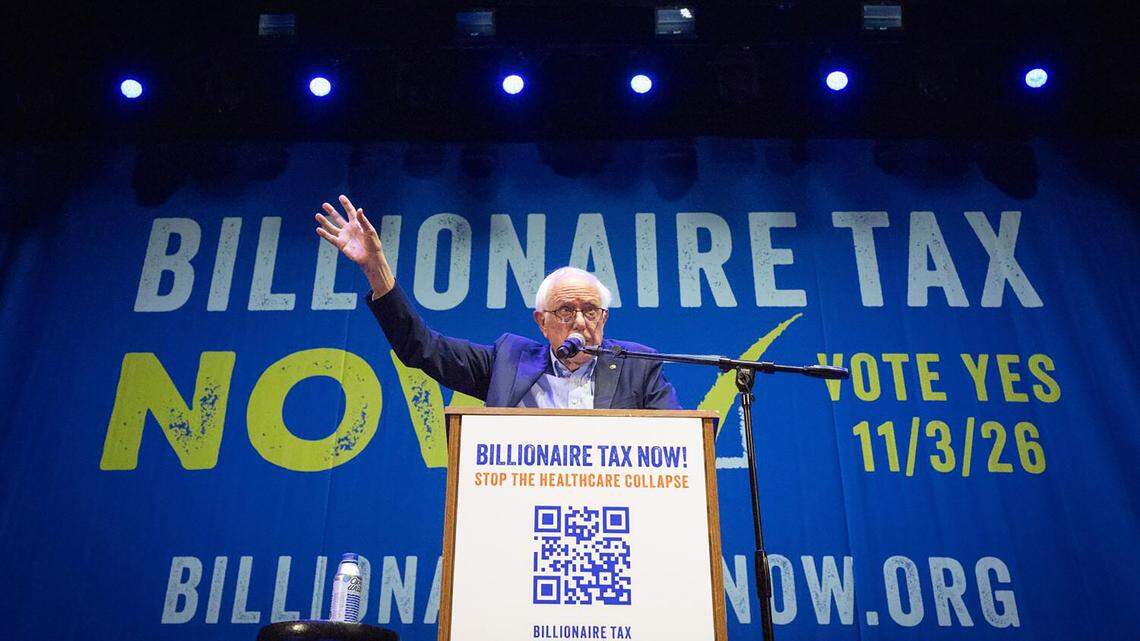
Sen. Bernie Sanders, I-Vermont, speaks at a Los Angeles rally in support of SEIU-UHW West’s proposed wealth tax ballot meaasure. Wealthy critics of the initiative are gathering signatures for their own proposals designed to undermine the tax.
Jason Armond
Los Angeles Times
Every two years, California voters are confronted with a wall of ballot measures ranging from nitty-gritty legal tweaks to sweeping changes to the state Constitution.
This year is no different. Californians could decide to institute a new wealth tax on billionaires, cap health care executive salaries, curtail unions’ political activities and require voter identification at the polls.
Ballot measures are no longer a grassroots undertaking. It costs millions of dollars just to collect enough signatures to qualify a measure. Firms hiring petition gatherers are advertising payouts between $3 and $10 per signature, and measures need up to 874,641 registered voters to qualify. Many of the 31 measures that have been cleared for circulation won’t make the cut, and others exist to try to force concessions from political opponents or the Legislature.
California voters have historically rejected around 65% of measures, according to data analyzed by University of California, San Diego, political science professor Thad Kousser. So, given the costs, why bother?
“It’s because the stakes are in the billions” of dollars, Kousser said. “A victory in California reverberates across the nation and leads to people emulating that in blue states across the country.”
Here are several major ballot measures to watch:
Taxes
Arguably no measure has inspired more political maneuvering than the 2026 Billionaire Tax Act backed by SEIU United Healthcare Workers West. The proposed constitutional amendment would impose a one-time tax on California residents with a net worth over $1 billion. Individuals with a net worth over $1.1 billion would pay a 5% tax, with a sliding scale for those between $1 billion and $1.1 billion.
Most of the revenue — 90% — would fund health care programs, including Medi-Cal, while 10% would support education and food assistance programs.
The unions supporting the measure say it’s needed to address the Republican megabill signed by President Trump last year, which included provisions that state legislative analysts say could force millions of people off of insurance. Backers warn that without the billionaire tax, dozens of hospitals and emergency departments could also be forced to close.
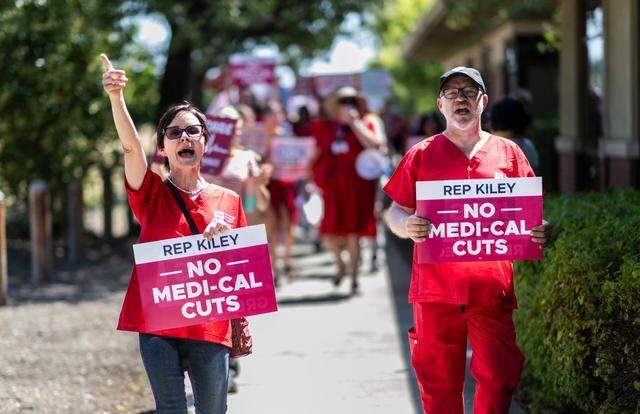 Rocklin nurses rally against the Republican megabill outside Rep. Kevin Kiley’s district office last year. Proponents of the wealth tax say it’s needed to avoid deep cuts to health care in California. HECTOR AMEZCUA hamezcua@sacbee.com
The billionaires are pushing back. Google co-founder Sergey Brin has dumped $45 million into a campaign committee that’s sponsoring a handful of other ballot measures, including three currently collecting signatures, that seek to counteract the tax in various ways. One would require any new tax to abide by rules that steer a portion of state funding to schools rather than another targeted area—in this case, healthcare. Another would require extensive audits of any programs slated to receive funding from a “special tax initiative.” A third would ban most taxes that apply retroactively, including ones that appear on the same ballot–e.g., the billionaire tax.
Brin’s committee, “Building a Better California,” has also received multimillion dollar contributions from the CEOs of Doordash, Stripe and Ripple as well as venture capitalists Michael Moritz and L. John Doerr.
Other critics of the measure include Gov. Gavin Newsom, who has started his own committee on the issue, and most of the frontrunners in the race to replace him (Democrat Tom Steyer, whose net worth Forbes estimates at $2.4 billion, has said he’d prefer other mechanisms to tax the rich but would back it if it was the only option). Critics warn the one-time tax could drive wealthy people out of the state, imperilling its long-term finances.
Other major tax and regulation-related ballot measures include:
• An initiative that would cement a 2012 voter-approved tax on high-income Californians ($360,000 in income for single filers, $721,000 for joint filers) that’s currently set to expire in 2031. The funding would continue to go to K-12 schools and community colleges.
• A proposal to exempt a principal residence from property taxes if a homeowner is over the age of 60 and has used the house as a principal residence for five consecutive years.
Unions and businesses
Brin’s committee is also supporting a proposal from the California Chamber of Commerce to overhaul of the California Environmental Quality Act, a significant law that requires environmental review and public input on new development and infrastructure projects. CEQA critics say it’s often used to delay new housing and other developments, contributing to the state’s housing crisis and high cost of living.
The ballot measure would impose new deadlines on reviews of a broad range of “special projects” including housing, hospitals, water treatment facilities and transit infrastructure.
The measure would give government officials one year to approve or deny applications. It would limit the timeline for court reviews and reduce public agencies’ current obligations to consider alternative projects. Its backers include the California Building Industry Association, Edison International and Brin’s committee, which has so far contributed $5 million.
 A construction worker installs electrical conduit at The Cannery housing development in Davis in 2015. CEQA’s critics say it’s used to delay and add costs to new housing and infrastructure, while its backers argue it helps protect California’s environment and community health. Manny Crisostomo Sacramento Bee file
The ballot measure expands major CEQA exemptions Newsom signed into law last year focused more narrowly on housing projects. Those changes were widely opposed by environmental groups, who are lining up against the latest CEQA overhaul.
Elizabeth Reid-Wainscoat, a policy specialist at the Center for Biodiversity, said the measure would “erode” CEQA and damage California’s environment, calling it a “handout to tech billionaires who want to profit at the expense of Californians.”
In other cases, unions and business interests are battling with dueling signature campaigns.
The California Association of Hospitals and Health Systems is financing a measure that would limit health care unions from funding ballot measures, arguing in its filing that the unions often use the ballot process for what it calls “corrupt purposes” like leverage in negotiations with health care providers.
The measure would require the health care unions to get sign-off from a majority of their members before contributing more than $1 million to a statewide ballot campaign.
The SEIU-UHW West — the group backing the billionaire tax — is sponsoring another proposal that would cap hospitals and medical entities from paying executives more than $450,000 in total annual compensation, with annual adjustments tied to inflation. In its filing, the union argues current executive pay is “excessive, unnecessary, and inconsistent with the corporations’ charitable purposes.”
Uber and trial attorneys
Uber is driving a controversial ballot measure that aims to cut into the pocketbooks of trial attorneys who represent people hurt in car accidents involving the ride-share company’s drivers
The measure would cap the contingency fees those attorneys can charge their clients, as well as the amount of medical expenses someone can ask for in a lawsuit.
The ride-share company says it’s pushing back against predatory “billboard attorneys” who lure accident victims in through prolific advertising and then put them through medical procedures they don’t need and take the better part of any legal settlements. The company has put $32.5 million so far into a campaign committee to make its case to voters.
Trial attorneys also have deep pockets, setting up an expensive political brawl. So far, committees backed by the attorneys have put together more than $50 million to oppose Uber’s measure and advance their own countermeasures.
The Uber-backed campaign is playing to recent high profile instances of corruption among trial attorneys, such as allegations that a Los Angeles firm paid people to file fabricated sexual assault claims and the embezzlement case against famed trial attorney Thomas Girardi.
But trial attorney advocacy organizations, and academic legal experts who don’t have a dog in the fight, say those attacks obscure the high stakes for consumers writ large. Capping the attorney fees, even slightly, will upset the incentive for attorneys to take cases on a contingency basis — where the person hurt by an Uber driver isn’t required to pay expensive hourly fees just to bring a case, experts say. The measure could “decimate people’s ability to retain legal representation,” one Stanford professor told The Sacramento Bee in December.
Elections
California voters would need to produce government-issued ID when they go to vote under a ballot measure spearheaded by Assemblymember Carl DeMaio, R-Valley Center. Voters sending in a mail-in ballot would need to provide the last four digits of a government-issued ID number, like a driver’s license. The measure would also require election officials to use government data to verify the citizenship of people on their voter rolls and publish annual reports listing the percentage of people who’ve been confirmed that way.
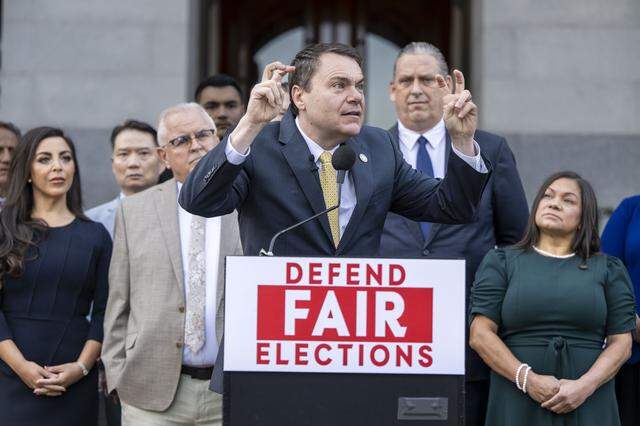 Assemblymember Carl DeMaio, pictured at a rally last year, is behind efforts to require voter ID at the polls and another measure that seeks to punish lawmakers who voted for mid-decade redistricting. HECTOR AMEZCUA hamezcua@sacbee.com
DeMaio says his group has already collected more than enough signatures to appear on the ballot and is bullish on the odds of it passing, citing polling showing a majority of voters support the concept.
There are a number of other election measures that are so far unfunded and therefore unlikely to gather enough signatures.
DeMaio is also the author of a measure that would prevent any legislator who voted in favor of last year’s mid-decade redistricting ballot measure, Proposition 50, from holding office for the next decade.
Another proposal, from a Democratic congressional hopeful, would require the California attorney general to sue any U.S. president who attempts to serve a third term, and, if a federal court finds the president ineligible to serve, attempt to arrest and detain them under existing state law.
Then there’s a proposal that lays the groundwork for a 2028 vote on a weighty question: Should California leave the United States and become a free and independent country?”
A “yes” vote would constitute an “expression of the will of the people of California.” Not much would immediately change aside from the removal of U.S. flags from state-managed property. It would, however, create a very California institution: a commission to further study the issue.
This story was originally published March 21, 2026 at 5:00 AM.
Related Stories from Sacramento Bee

The Sacramento Bee
Ben Paviour is the California political power reporter for The Sacramento Bee’s Capitol Bureau. He previously covered Virginia state politics for public radio and was a local investigations fellow at The New York Times. He got his start in journalism at the Cambodia Daily in Phnom Penh. Before becoming a reporter, he worked in local government and tech in the Bay Area.