
Intro
Maziar Behrooz: 0:00 – 0:26
The United States has its own interest. The Israelis have their own interests. And to think that foreign powers are coming in to help the Iranian people, to get rid of a regime, to bring in democracy, is utterly nonsense. And I just don’t think this is something that will happen. We’ll see about it, but I don’t think it will happen.
Interview
Jovanni Alvarado: 0:31 – 0:56
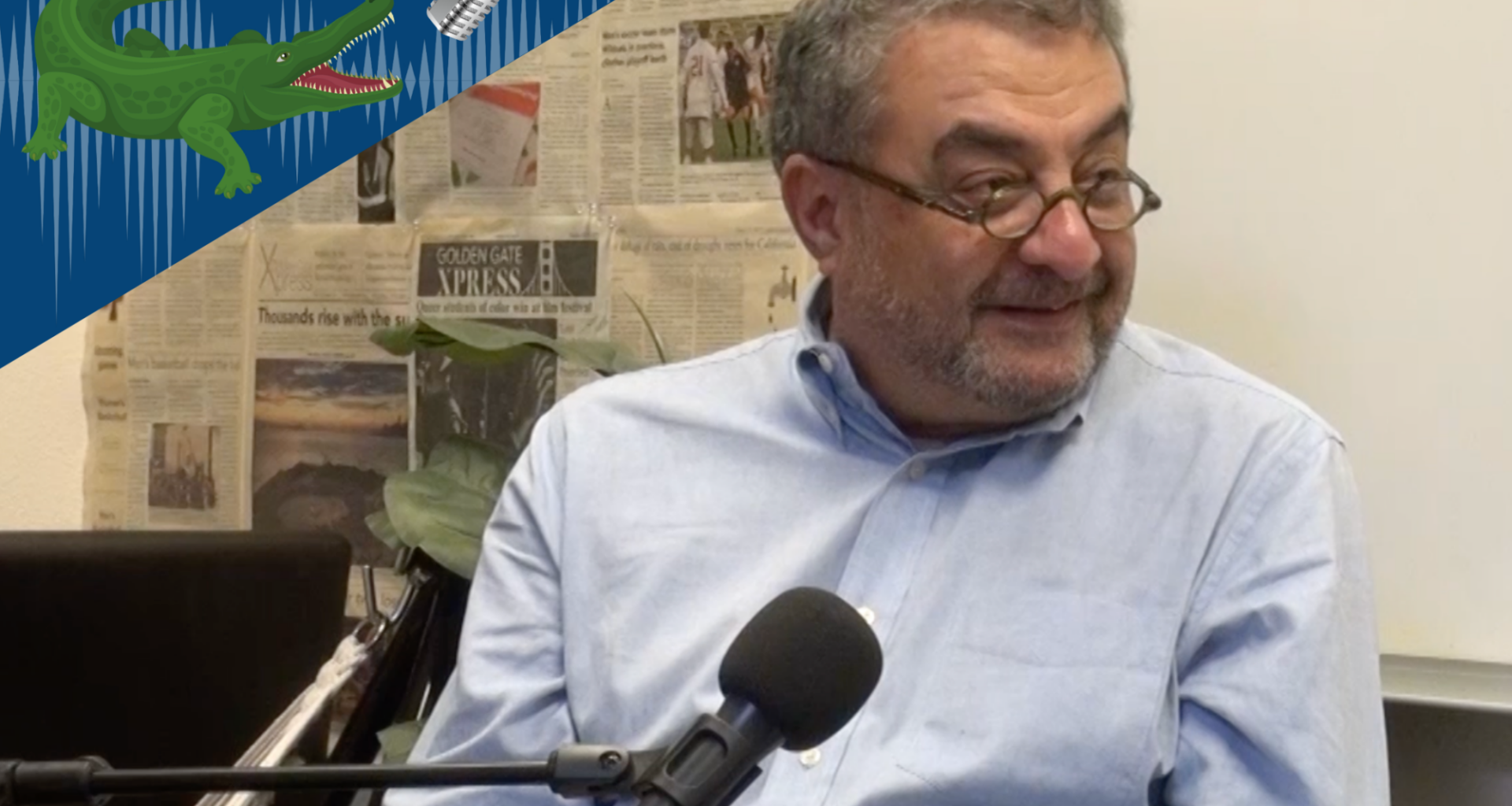
Welcome back, Gators. My name is Jovanni Alvarado, staff reporter at Golden Gate Xpress. And today, we’re here with Dr. [Maziar] Behrooz, a professor on campus with a doctorate from UCLA. He’s taught at colleges such as [University of California,] Berkeley, Stanford and, of course, here. And today, we’ll be talking about the foreign conflict that’s going on in Iran right now. So, just for our listeners and viewers, could you explain what’s going on in Iran right now, please?
Behrooz: 0:57 – 1:08
Well, Iran is under heavy bombardment and everything is being targeted, it seems, from schools to hospitals to infrastructures to military targets.
Alvarado: 1:09 – 1:13
And what is America’s reasoning for this intervention in Iran?
Behrooz: 1:14 – 1:53
I don’t see any reason for the U.S. to attack Iran. I think this is basically the U.S. doing the agenda of Israel. And Israel wants, it seems to me, to weaken Iran, if possible, to dismember Iran. And that has some relation to the issue of Palestine and Palestinians, and which has remained unsolved since 1949. I think these two are connected, and the U.S. is basically doing the bidding of Israel by this point.
Alvarado: 1:54 – 2:12
I believe Donald Trump has said that Iran was two weeks away from developing a nuclear weapon. From my understanding, there was a nuclear deal that was settled under the Obama administration with Iran. Why did Donald Trump back out of that agreement that was co-signed by…
Behrooz: 2:13 – 2:48
It has to do a lot with Israel’s agenda. If the policy was to put Iran’s nuclear program under severe scrutiny of international organizations such as IAEA [International Atomic Energy Agency], then the Obama era agreement did just that, and Iran agreed to produce enrichment uranium, something around 3.1% for non-military use of its reactor and the future reactors it would be building.
2:49 – 3:14
So that was the ideal deal, but Israel opposed it all the way while Obama was in power, and when the new administration came, it tore it apart and that was Israel’s policy. But the suggestion that Iran was few weeks away is pure nonsense and propaganda.
3:15 – 3:43
The president himself said back in the summer of 2025 that they have obliterated Iran’s nuclear program and everything is under rubble. How could Iran possibly make a nuclear bomb in two weeks when everything is under rubble, and the president had said that they have completely destroyed that program? So it is propaganda, it’s nothing less than that.
Alvarado: 3:44 – 3:59
The Obama deal that we were talking about, it was signed in order for some mode of relief in sanctions from the United States in Iran. Are these sanctions something that affect Iranian politics today?
Behrooz: 4:00 – 4:18
The sanctions are back and they’re more severe, but yes, the spirit of the agreement was about Iran putting its program under international observation.
4:19 – 4:43
They even signed very intrusive protocols that other countries don’t have to sign, but Iran did it anyway to make sure that the rest of the world, especially Western powers, are assured that Iran’s program is not going toward a military phase. And in return, of course, Iran wanted some of the sanctions to be removed.
4:44 – 5:19
Now, the sanctions imposed on Iran are three types. Some of them are United Nations sanctions that, with the agreement, they basically suspended it. The other one are United States sanctions. And these sanctions are of two kinds, some of them by executive order, some of them by the [U.S.] Congress. The one that are by by the Congress, the President cannot just revoke, the ones that are by executive order, then the President can do something about
Alvarado: 5:20 – 5:21
You’re from Iran, actually, right?
Behrooz: 5:22 – 5:23
I was born there.
Alvarado: 5:24 – 5:29
Could you talk more about your upbringing in that in Iran? Do you have family still there?
Behrooz: 5:30 – 6:04
I have family there. I haven’t been able to contact them since the attack on Iran started. Yes, I was raised there, and then, for continuing my education, I basically went abroad, but I’ve never lost my contact. I visit there almost every year. The conflicts, notwithstanding, I wasn’t able to go, but my contact to the country and to the city I was born in, Tehran, is still very strong.
Alvarado: 6:05 – 6:16
When you were born in 1959, this was under the last Shah’s reign, correct? And you also experienced, or at least have – do you have stories of the previous Shah’s rule?
Behrooz: 6:17 – 6:18
Yes.
Alvarado: 6:19 – 6:22
And how was it when the Islamic Revolution came into fruition in Iran?
Behrooz: 6:23 – 7:03
Well, the previous regime was a dictatorship that tried to promote programs of development from top-down by subverting Iran’s constitution, by subverting Iran’s legal system, arrangement, which went all the way back to the Constitutional Revolution of 1906. But, when it came to personal freedoms, in terms of cultural freedoms, liberty for women, women’s rights, your privacy and private life, as long as you didn’t get involved in politics…
7:04 – 7:20
the government wasn’t intrusive. The revolution was for many different reasons, for different groups, they participated in the revolution for different reasons, but as a result of the revolution, then they lost.
7:21 – 7:46
Not only they didn’t gain those political freedoms that [were] supposed to be gained, but they lost the personal freedoms that they had with the new Islamic religious theocracy that demanded moral uniformity and expected obedience by women by taking away many of their rights.
Alvarado: 7:47 – 8:06
And I think that brings us to today, right? Many are celebrating the U.S. intervention in Iran, saying they want freedom. They want this regime to end. Is this a nuanced – how much nuance is there to this conflict, as there are in many wars?
Behrooz: 8:07 – 8:35
First of all, I don’t think everybody is doing this. Some groups are doing it, I understand. And people [that] are doing it are naive to think that bombing Iran will bring democracy and the fall of the regime, but I understand many people are very angry with this regime. Just in [the] month of December, the regime opened fire, killed many people in the streets of Tehran and other cities.
8:36 – 9:08
So there is a sense of frustration there, and part of this reaction that you just mentioned is probably due to that, and part of it is to – because of naivete – to think that a foreign power, by bombing Iran’s infrastructures, hospitals and schools as well as military targets, can bring the regime down is not very realistic. I don’t think it will happen.
9:09 – 9:35
And then, even more naive is okay, let’s say it did bring the regime down. What’s going to happen after that? And how are you going to keep the country together when there are real powers outside that want to dismember the country by promoting ethnic tensions? So that’s where we stand today.
Alvarado: 9:36 – 10:06
From my personal experience with diaspora members, Iranian diaspora members, they – of course not, the group isn’t a monolith, as you mentioned earlier, not everyone is celebrating – but it seems especially their online presence is in the majority. How do you better convince these people that, like you said, the bombing won’t stop the regime? If the regime does get toppled, who will fill the power vacuum?
10:07 – 10:13
How do you talk to those people that aren’t experiencing the violence, but very much have a vested… investment in Iran?
Behrooz: 10:14 – 10:39
I tell them, look at the clips that are coming out of Iran. Look at the 150 schoolgirls who were killed in southern Iran, and the bombs that are falling all over Tehran and the infrastructure that is being destroyed. This is the future of Iran, if Iran is to pass this phase, but if all of its infrastructure is destroyed, what is the point? How is it going to do it?
10:40 – 11:13
I would direct their attention to that. I understand many people feel that they are between a rock and a hard place. They are dealing with a government that does not listen, does not reform, is corrupt and it is incapable of providing efficient governance for the country. I understand that. On the other hand, I understand that they feel that they do not have the power to do anything about this.
11:14 – 11:44
So the alternative is – and here is the naivete part – that maybe a foreign power can come in and do it for them. Now, the foreign powers have their own interests. The United States has its own interest. The Israelis have their own interests. And to think that foreign powers are coming in to help the Iranian people, to get rid of a regime, to bring in democracy, is utterly nonsense.
11:45 – 11:52
And I just don’t think this is something that will happen. We’ll see about it, but I don’t think it will happen.
Alvarado: 11:53 – 12:09
Could you speak more or educate on the political factions inside Iran right now? Are there any oppositionary forces to the regime? Are any of them in contact with American or Israeli governments?
Behrooz: 12:10 – 12:32
Inside Iran, I don’t think so. Inside Iran, there are those who criticize the regime, maybe mostly among the educated, intellectual class, journalists, college professors, things like that. All the political parties have been crushed since 1979, since post-’79 when the revolution was victorious, all have been crushed.
12:33 – 13:11
Civil society such as independent NGOs, they all have been crushed. The regime doesn’t tolerate it. This is a theoretical dictatorial regime, and it doesn’t tolerate any of them. There is an Iranian diaspora, and there are some groups that are armed, and they are camping in Iraqi Kurdistan. And they are from Iranian Kurdistan, and they are camping in, headquartered in Iraqi Kurdistan.
13:12 – 13:37
So there are some armed groups, six of them actually there. But other than that, there is no military organization except one on the eastern part of Iran, the Pakistani border, where they do bombing and things like that, the Baluchi people. Then there is the diaspora, in the diaspora, you have different groups.
13:38 – 14:03
I think the most visible ones are the supporters of monarchy, the former monarchy, and the former Crown Prince Reza Pahlavi, but they want to claim to be hegemonic, that they are the only voice. It is not true. There are other voices. The big problem with them is that they are very violent.
14:04 – 14:50
They viciously attack other groups, both on cyberspace and actually physically. And by cursing them, by sending them violent emails, harassment, and that is not a good sign for a leadership that claims that it wants to bring democracy in Iran. Added to that, Reza Pahlavi, the former crown prince, has issued a pamphlet for emergency period of passing through this transition, emergency period of transition, that gives himself a dictatorial power from one to four years.
14:51 – 15:13
So people have to trust him, that between the next five to four years after the fall of the current regime, he will arrange for democracy to return, which I don’t think is something that many people would be interested in. Then there are other groups, smaller groups.
15:14 – 15:51
We are talking about Republican, those groups that support Republican alternatives for Iran, and other smaller groups, women’s groups and other groups, but these are people outside Iran. Many of them have been away for a long time, and they are very disjointed. They don’t work with each other. There is no cooperation among them, and that is one reason they are not very able to influence the events inside Iran, because of this lack of unity among them.
15:52 – 16:12
So, what the Islamic Republic is faced with, therefore, is an opposition. I think maybe 10-15% of the population supports the regime, the government today. I think about 80-85% does not support the government.
16:13 – 16:42
But the Islamic Republic is faced with this reality where a large number of people do not want it, but they do not have any leadership or organization, and that the regime is losing its ships and airplanes and artillery pieces, but those are not needed to maintain power. What is needed to maintain power is organization, police force, guns, which the ordinary people in the street don’t have any.
16:43 – 16:52
So you can bomb Iran all you want, the hospitals, the schools and the military targets. But that doesn’t mean the regime will fall.
Alvarado: 16:53 – 16:55
Do you foresee possible boots on the ground?
Behrooz: 16:56 – 16:57
Possible?
Alvarado: 16:58 – 17:01
Possible boots on the ground invasion by either America or Israeli forces into Iran?
Behrooz: 17:02 – 17:39
I don’t know. Maybe. If they’re foolish enough, they’ll do it. I have a quotation here from the former American President Jimmy Carter in April 2019, few years ago, and he said, he’s quoted as saying, “In its 242 years of history, the United States has enjoyed 16 years of peace, making this country the most warlike nation in the history of the world.”
17:39 – 18:13
So will the United States land troops there? Maybe, if they need it. Will those troops be faced with resistance on the ground? Yes, they will. So we will see. The Islamic Republic has a system, it has structures, it has the military, it has some support among the population, and it will fight back. So what would be the result of that? Of course, I cannot predict.
Alvarado: 18:14 – 18:26
Talking to Iranian diaspora, they believe that this invasion, not invasion, this intervention, would be different from past interventions by America in the Middle East. Is there a reason for them to believe this?
Behrooz: 18:27 – 19:09
I don’t understand that at all. Millions of people died, if not hundreds of thousands, hundreds of thousands of people died in Iraq, in Libya, in Syria, and there are no central governments in any of these. The countries are in chaos. In Afghanistan, they went in and after 20 years they left, Americans left. They got tired. And to think that a country of 90 million can be occupied and then something good will come out of that occupation by sending in ground troops, I doubt it.
19:10 – 19:43
We’ll see. I’m sure there’s people in the White House and among president’s advisors that are telling him not to do it. That is going to be too costly. It’s already very costly. Much of the money that was spent in this war, billions of dollars, have been spent in this war in terms of damage done to U.S. infrastructure around Iran, and the munition that was used to attack, [that] could be used for providing medical insurance for the population like yourself, the only industrial country without one.
Alvarado: 19:45 – 19:59
How do you personally – how do you foresee this ending? Will it be just another brief stint like we saw over the summer. Last summer was a 12-day war between Israel and Iran. Or do you see a possible…
Behrooz: 20:00 – 20:35
I don’t know how it will be. I’m a historian. I deal with the past, but I can tell you this: I think Iran’s strategy is to prolong the war and stretch it beyond 10, 15, 21, months, no, days, 30 days. By stretching it, it would deny the current president and his advisors the short, quick war that they expected. Indeed, I read somewhere that the president is surprised that Iran hasn’t capitulated yet.
20:36 – 21:08
Why haven’t they? And so that is their strategy, to hit back as much as they can and to prolong the war. Would the Iranian civilian population get hit as a result of this, and infrastructure get destroyed? Yes. Do they care? I don’t think so. So that is their strategy. The strategy of the United States, it seems to be, or at least it was, to attack, have a quick victory and capitulation.
21:09 – 21:31
That has not happened. Iran had already told the world that it would spread the war to other countries around the Persian Gulf, which it did, and, of course, Israel. And these are U.S. bases. There are U.S. bases in Bahrain, Qatar, Kuwait in UAE, in Saudi Arabia. So of course they get attacked. Of course they get hit when Iran gets hit.
21:32 – 21:52
You cannot blame a country for defending itself. It’s ironic. So I cannot predict anything. It’s not my job to predict. But this is what the situation looks like.
Alvarado: 21:53 -22:20
Earlier, you spoke about – we touched on the nuance of the subject. You mentioned how many people are displeased with the regime, but some people may not want U.S. intervention, but simultaneously they cannot bear arms and hold a revolution against themselves. What do you think – we already touched on the possible outcome – but how do you muddy these waters?
22:21 – 22:28
How do you step through these paths where Iranian people do get what they want, but without the aid of a foreign nation?
Behrooz: 22:29 – 23:04
I don’t know. I think the situation is very muddy and very difficult to even suggest a path. I think Iran is at a deadlock in many ways. You have a government that is refusing to listen and is unable to reform itself to be more pleasant and functional, which is a very dysfunctional government state.
23:05 – 23:32
So if you have that, and you have a people who at least the majority, if not a huge majority, are very much dissatisfied with the government and the state for the past 47 years, but they are not united. They know what they don’t want, but they are not sure what they want and they do not have the instruments of bringing about change.
23:33 – 24:00
I mean, in the month of December, they came into the streets and they incurred heavy casualty. The numbers are 7000, maybe a few 100 more than that, in terms of verified casualties. You know, people add zeros to this, which I’m not going to go over that, but that’s a very large number, 7000 people getting killed in a few days by the security forces.
24:01 – 24:19
So that shows the degree of anger there. So you have a deadlock, and I’m not sure how you get out of this deadlock, except that I’m sure that bombing Iran is not the way out.
Alvarado: 24:20 – 24:40
I’m gonna go back to you and your upbringing there for a second. Are there any personal conversations that you’ve had with family that’s either in Iran, friends, family that are there, or people that have immigrated to United States where they have opposing views to what you believe. How do you traverse those conversations with them?
Behrooz: 24:41 – 24:42
In what ways?
Alvarado: 24:43 – 24:56
For example, if someone in your immediate family is like “I would like for America to intervene in Iran,” help liberate the people of Iran. How do you navigate that conversation?
Behrooz: 24:57 – 25:41
It’s what I just told you, that to think that this type of intervention will provide produce positive results for the situation in Iran is doubtful, and that one needs to be sober about this, that foreign powers, an imperialist power like the United States originally hegemonic power like Israel, who has a lot of influence in the United States, they’re after their own interest, and that interest does not necessarily correspond to freedom for Iranians, democracy for Iranians.
Alvarado: 25:42 – 26:04
I want to bring it back. I want to bring it to domestic politics here in America for a second, you just touched on the control that Israel, through lobbying efforts such as AIPAC, has on politicians themselves. But I believe in this past couple of weeks, since the Feb. 28 attack on Iran, there have been multiple attempts in both Congress, the House and the Senate, to block Donald Trump’s powers.
Alvarado: 26:05 – 26:24
But it seems to be sort of a uniparty decision – unilateral decision across both parties – to continue this war. How do those efforts – how can Americans try and stop this if that’s the will of the people as Americans in America?
Behrooz: 26:25 – 26:55
I guess the next election would be a step toward that direction, but that is in November. That’s a long time for us, and the pressure that people in Congress, especially the progressive wing of the Democratic Party, are trying to exert, can convince some Democrats to do something about this.
26:56 – 27:33
This emphasis on the War Powers Act, that you need the name the permission of the Congress to wage war, is a kind of an interesting policy to follow regarding this conflict, especially if it gets prolonged. If Iran can prolong the conflict, then there will be gradually more opposition to this. It is costly, and it is without consent of the Congress, which is a constitutional issue, the War Powers Act.
27:34 – 28:18
These are the things I can see that can be done. Iran is not on the most favorite list of other countries in the world. Many countries are against the regime in Iran, and for obvious reasons, and therefore, sympathy for the regime is zero, or minus zero. But sympathy for Iranian people, civilians getting killed, maybe also a level of pressure on the American government to do something about it, to step back.
28:19 – 28:56
It’s like the hospital – I’m sorry, like the schoolgirl attack, which the President tried to lie about, actually saying that Iran had Tomahawk missiles, which it doesn’t. Tomahawk missiles can be only purchased from the United States. And that Iran did it itself. Iran hit the school itself, which is proven to be false. And those types of scenarios can perhaps help the case of trying to put pressure to bring the war to an end, maybe.
Alvarado: 28:57 – 29:25
Is there a certain, specific moment in history that this kind of reflects on that you think, “Oh, this is more similar to Afghanistan or Iraq. Maybe Syria.” Is there something that, like that when you heard about this news, you’re like, it’s kind of like this.
Behrooz: 29:26 – 29:53
Well, you can see that these other countries, governments in all these other countries, all of them are authoritarian regimes. Let’s put it this way, from Syria to Iraq to Libya, the guns, the ones that fell as a result of either direct U.S. intervention or indirect pressure by U.S. and allies.
29:54 – 30:41
They were all authoritarian regimes in Afghanistan too, and the United States’ interest in the region is so closely tied to Israel’s interest that the consequence of the falling apart of these regimes becomes secondary. For example, how many refugees would be going toward Europe if Iran, a country of 9 million, falls into chaos? Are they taking that into consideration? Are they trying to weaken Iran, but not to break it apart, or are they trying to break it apart?
30:42 – 31:12
And so these are all questions that are not certain. I’m not certain the United States knows why they attacked, or what is the end game of this. And they keep changing their reasoning behind why they attack. You said nuclear, then they said ballistic missiles and they can enlarge the list anytime they want.
31:13 – 31:47
So this is really the breakdown of international law, the very international legal system that the U.S. helped to set up after Second World War, so that issues, problems like genocide doesn’t happen again, which it did happen. And after the fall of the Soviet Union, we see stronger governments, stronger powers, are attacking weaker ones with impunity.
31:48 – 32:16
It’s just like the 19th century, where stronger powers can do anything they want without any repercussions. And this whole legal system set up after the Second World War, the United Nations, the legality of international law, is all collapsing right before our eyes, and the U.S., one of the architects of that system, is actually helping it, actually doing its best to have it collapse.
32:17 – 32:44
And this is the result, Russia invades Ukraine, nothing can be done. The U.S. attacks Iran, nothing can be done. Tomorrow, China and Taiwan. The day after that, another government, another state, another stronger power attacking a weaker one, with no repercussions. We will see the chaos – that the result will be chaos.
Outro
Alvarado: 32:45 – 32:48
All right. I think that’s all the time we have for today.
Alvarado: 32:49 – 33:01
Okay, well, thank you so much Dr. Behrooz for coming on and talking. That’s been this episode, thank you so much for listening. Thank you to Dr. Behrooz for coming in, educating and talking about the situation.
Behrooz: 33:02 – 33:03
You’re welcome.
Alvarado: 33:04 – 33:05
See you next time, Gators.