
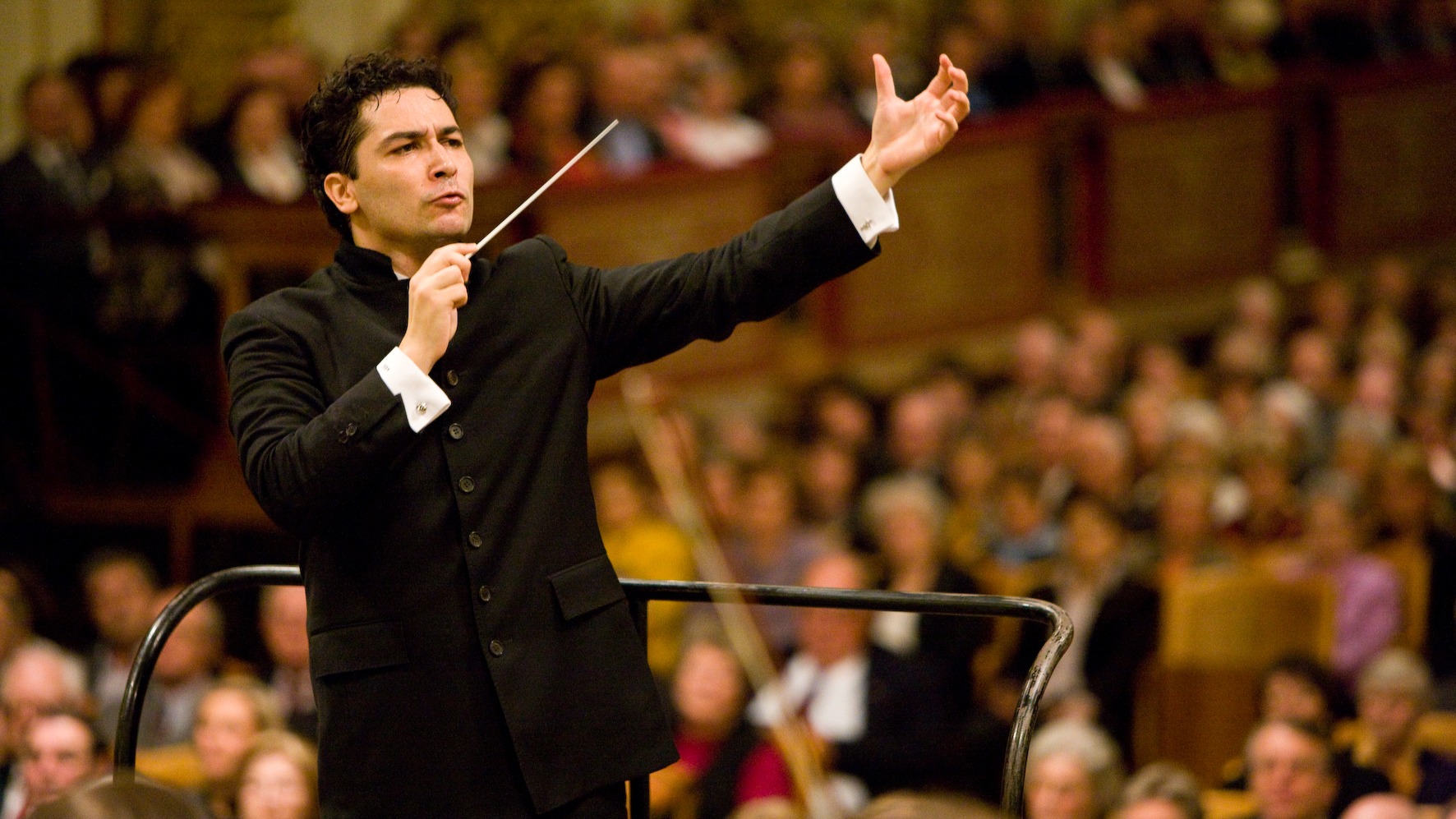
Colombian-born conductor Andrés Orozco-Estrada
Werner Kmetitsch
In the wake of Esa-Pekka Salonen’s departure last summer, the San Francisco Symphony has seen a parade of potential successors take the Davies Symphony Hall podium.
Many of them won’t be serious contenders, for one reason or another, but timing can be everything. Hit the sweet spot, and suddenly there’s a new music director in town.
Andrés Orozco-Estrada Conducts Dvořák 7: San Francisco Symphony. 7:30 p.m. Saturday, March 21; 2 p.m. Sunday, March 22. $55-$175. Davies Symphony Hall, 201 Van Ness Ave., S.F. 415-864-6000. www.sfsymphony.org
The latest visit came from the Colombian-born dynamo Andrés Orozco-Estrada, who led the orchestra on Friday, March 20, in the first of three weekend performances.
Article continues below this ad
The conductor, 48, made a strong impression. But with being recently appointed music director of the Swedish Radio Symphony, general music director of the city of Cologne and being principal conductor of the Orchestra Sinfonica Nationale della RAI in Turin, Italy, sOrozco-Estrada is an unlikely candidate for a music directorship here.
Still, it was an instructive and invigorating case of conductor-and-orchestra chemistry.
San Francisco Chronicle Logo
Make us a Preferred Source to get more of our news when you search.
Add Preferred Source
Before the first downbeat, he slowly swept his view across the orchestra, as if he were taking in every player and gathering his forces. Then, with a nod and the first of his full-bodied cues, he led the charge into Carl Maria von Weber’s Overture to the now mostly forgotten opera “Euryanthe.”
Orozco-Estrada made a strong case for the eventful piece, drawing a deep unified sound from the orchestra, which proved to be a virtue sustained through the concert. The strings held their own with the exclamatory brasses, while the woodwinds joined in with their own assertive voices.
Article continues below this ad
There’s a lot of musical material in this 10-minute overture, and Orozco-Estrada mined it all, from singing melodies to a brief fugue-like passage that migrated through the strings to a thundering climax. If the cutoffs weren’t always precise and some of the phrasing in the softer sections was a little wooly, that hardly dimmed the pleasure. The overture had taken on a symphonic scale and dimension.
Orozco-Estrada conveyed a youthful vigor. He darted on and off the podium, eager to begin, and went on clapping for the musicians as he left the stage. His conducting was full of big moves — punching the air, leaning in as if to scoop up what he’s after, raising both arms like an athlete who’d just scored the winning goal.
Returning to the stage for some entertaining remarks while the piano was wheeled onstage for a Mozart concerto, Orozco-Estrada joked that he hadn’t been invited back to Davies in nine years. “Maybe it didn’t go so well?” he added with a shrug.
He then riffed on the difference between Mozart and Antonin Dvořák, filling time like an old-school Broadway actor covering a scene change in front of the curtain.
Jan Lisiecki was the soloist in Mozart’s Piano Concerto No. 9. His performance was a marvel, with exquisite phrasing and crystalline passagework. Trills and ornaments got a velvety touch. In the work’s multiple cadenzas and solo passages, the pianist displayed an uncanny ability to separate his hands when it felt right.
Article continues below this ad
Unfortunately, the ensemble didn’t seem to hear the soloist well, so its responses didn’t measure up. The performance improved in the slow movement and a fleet Rondo. Lisiecki gentled his way through Chopin’s Nocturne, Op. 9, No. 2, for an encore.
As he did with the Weber, Orozco-Estrada summoned a solid, deeply based sound in Dvořák’s brooding and combustive Symphony No, 7. In a first movement passage that other conductors might treat more bucolically, he kept the music consistently under pressure, driving it forward.
That’s not to say the performance was heavy handed. The Adagio had a tragic cast, with the woodwinds expressing it keenly. The Scherzo married sweetness and pungency. Once again there were some fuzzy details and occasional balance issues, but when the horns, trumpets and trombones spoke in one urgent voice in the Finale, the audience heard it clearly. The ovation went on and on.
With his vitality and charm, Orozco-Estrada was the man in charge for the moment.
Article continues below this ad
Steven Winn is a freelance writer. This review is provided in partnership with San Francisco Classical Voice.