
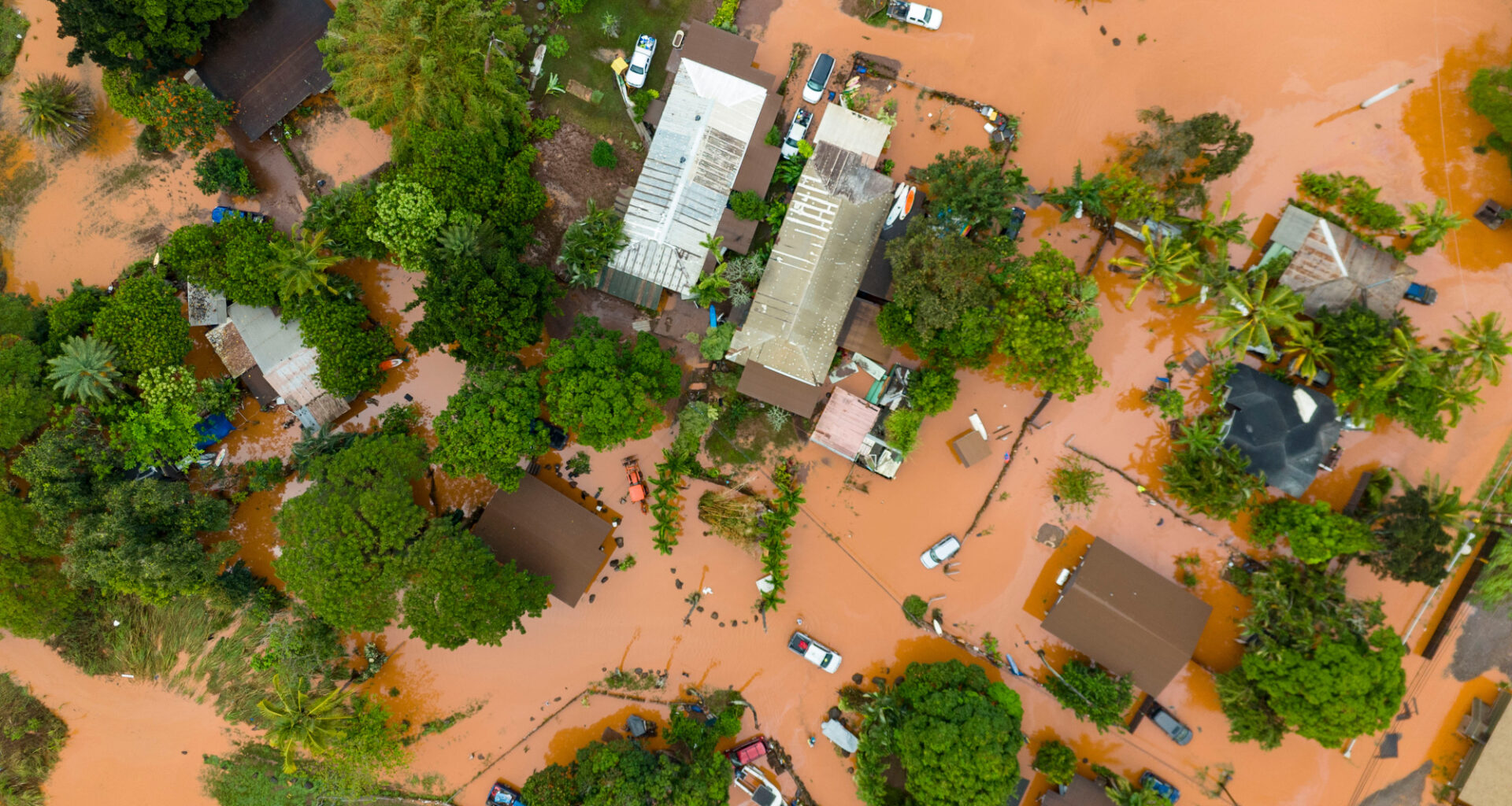
Floodwater surrounds homes Waialua, Hawaii, on Friday, after days of rain pounded Oahu, forcing evacuations and cutting power.
Mengshin Lin/Associated Press
The torrential downpour on the Hawaiian island of Oahu eased into on-and-off showers Saturday afternoon as the worst of the storm shifted east.
As much as 22 inches of rain fell on parts of Oahu between Thursday night and Saturday morning, with an additional 2 to 4 inches expected across the island by Sunday morning, according to the National Weather Service. The heavy rainfall fed flooding that shut down parts of highways, swept homes off their foundations and caused evacuation orders for about 10,000 residents. The majority of residents were evacuated as of Friday night, according to Stephen Logan, adjutant general of Hawaii’s Department of Defense.
Near the town of Waialua, an ambulance responding to another call for aid stumbled on a family with four children who were trapped in their collapsed home, said Honolulu Director of Emergency Services Jim Ireland at a Saturday evening press conference.
Article continues below this ad
“They weren’t going to that house, but happened on it almost by a miracle,” Ireland said, describing how the responders waded through waist-deep water to rescue the family as their ambulance was swamped by flooding. “The water was still rising. Our high-water rescue vehicle… was on its way up there already and helped extricate them out of that scene, to the hospital.”
San Francisco Chronicle Logo
Make us a Preferred Source to get more of our news when you search.
Add Preferred Source
It’s the state’s largest flood in 20 years, Gov. Josh Green told reporters Friday.
But by late Saturday morning, the National Weather Service’s flash flood warning for Oahu had expired. The rain occasionally paused for cloudy, but dry, skies, and crews were finally able to reach and clear out landslides that had shut down some roads across the island. At 2:41 p.m., officials lifted evacuation notices for the island’s North Shore.
Article continues below this ad
At Saturday’s press conference, authorities asked Oahu residents to stay out of the ocean for at least 72 hours. Debris, animal remains and sewage had turned local water brown and could potentially attract sharks, said Honolulu Chief of Ocean Safety Kurt Lager. Residents in the North Shore water system were also advised to boil their tap water before drinking it.
There were no reported fatalities due to the flooding as of Saturday evening, Honolulu Mayor Rick Blangiardi said.
“We dodged something that really could have brought with it a lot more danger and loss of life,” Blangiardi said. “We go from here, and hope the sun comes back out, and we get this behind us hour by hour.”
But concerns were rising for the eastern islands of Molokai, Lanai and Maui, where radar showed rain falling between a half-inch to 3 inches per hour in the afternoon, according to the weather service. The conditions prompted flash flood warnings for the three islands. Several communities were placed under evacuation warnings, including Lahaina, where a 2023 wildfire killed 102 people and destroyed more than 2,200 structures.
Debris from a storm-damaged house is trapped against a bridge along the Kaukonahua River in Waialua, Hawaii, on Friday.
Mengshin Lin/Associated Press
Two members of the rescued group were hospitalized, according to Blangiardi. In total, 10 people were hospitalized due to hypothermia after treading through the 60- to 70-degree water, Green said.
Article continues below this ad
As conditions eased on Saturday, far fewer residents needed rescue, according to Molly Pierce, spokesperson for the Honolulu Department of Emergency Management. Pierce said officials believe the worst of the weather has passed for Oahu, but noted there were still some lingering showers left in the forecast.
A particular area of concern had been the Wahiawa Dam on Oahu’s North Shore, which officials warned could collapse if the water surpassed its highest point — 90 feet, according to Green.
The water in Wahiawa Reservoir reached 85 feet early Friday, triggering evacuations. By 8:35 a.m. Hawaii time, it reached an all-time record of just under 85.3 feet, sensors run by the U.S. Geological Survey showed. In the time since, the water levels dropped, dipping below 82 feet overnight. The reservoir typically sits at about 68 feet this time of year, according to the USGS.
Residents are evacuated from Haleiwa, Hawaii, on a bulldozer Friday.
Craig Fujii/Associated Press
Just before 5 a.m. local time Saturday, the Honolulu Department of Emergency Management said the dam “continues to be monitored as water levels remain elevated and as the potential for heavy rain continues.”
Article continues below this ad
About 5,000 people, including the communities of Waialua and Haleiwa, would be at risk of flooding if the dam collapsed, Pierce told the Chronicle Friday.
Authorities shut down all access into Waialua late Friday, and it remained limited into Saturday. Around 2:15 a.m., the Department of Emergency Management warned all residents in Waialua who had not yet left to do so immediately, saying “the remaining access road out of Waialua is at high risk of failure if rainfall continues.” Several landslides were reported along Kamehameha Highway, according to the Hawaii Department of Transportation. Fears of the dam’s collapse also shut down parts of Farrington Highway, which heads west out of Waialua and hugs the island’s western shore. Authorities urged residents to “stay off the roads as much as possible.”
When the roads reopened Saturday afternoon, authorities warned residents to be cautious as they returned to their homes. The winds and fast-moving floodwaters knocked down trees and power lines, causing the local utility to turn off electricity in parts of the island to prevent endangering search and rescue officials traversing the muddy water. As of 1:30 p.m. Saturday, electricity was turned off for more than 6,500 customers on Oahu, according to Hawaiian Electric. In Maui, about 170 customers were without power, the utility said.
Floodwater engulfs homes along the streets of Haleiwa, Hawaii, on Friday after days of rain pounded Oahu, forcing evacuations and cutting power.
Mengshin Lin/Associated Press
These outages in Oahu made it difficult to pump water out of wells and reservoirs, according to the Honolulu Board of Water Supply, which urged residents to conserve water. In Ahuimanu, a community on the east side of the island, a water line broke, draining the local reservoir and leaving residents with little to no water pressure. The board said service was restored Saturday morning.
Article continues below this ad
Three of the island’s wastewater facilities overflowed Friday due to the influx of water. One, located in Kailua, released about 30,000 gallons of wastewater into a local pond area before being stopped, Honolulu’s Department of Environmental Service said. Two others — one in Ahuimanu, another in Waimanalo — were still ongoing as of Saturday morning and releasing wastewater into the Ahuimanu and Puha streams, according to the department. Officials cautioned residents to stay out of the affected streams, noting that water quality samples will be taken after the storm has passed.
Kawaihapai (Dillingham) Airfield on Oahu’s North Shore was shut down to all non-military or emergency flights until Tuesday, but all other major airports were operational on Saturday, according to the Hawaii Department of Transportation. The department noted the storm still posed issues with visibility and warned of potential delays or rerouting depending on the conditions. Sniffen, the department’s director, encouraged travelers taking inter-island flights to arrive at the airport 90 minutes before their flight and for those flying out of Hawaii to budget three hours.
Green said the storm had damaged airports, hospitals, infrastructure and homes, and estimated that it could cost more than a billion dollars. Both the White House and the Federal Emergency Management Agency have pledged support, he said.
The National Weather Service forecasted the worst of the storm could last through the weekend, with lingering effects continuing into the week.
Kurtis Alexander contributed reporting.