
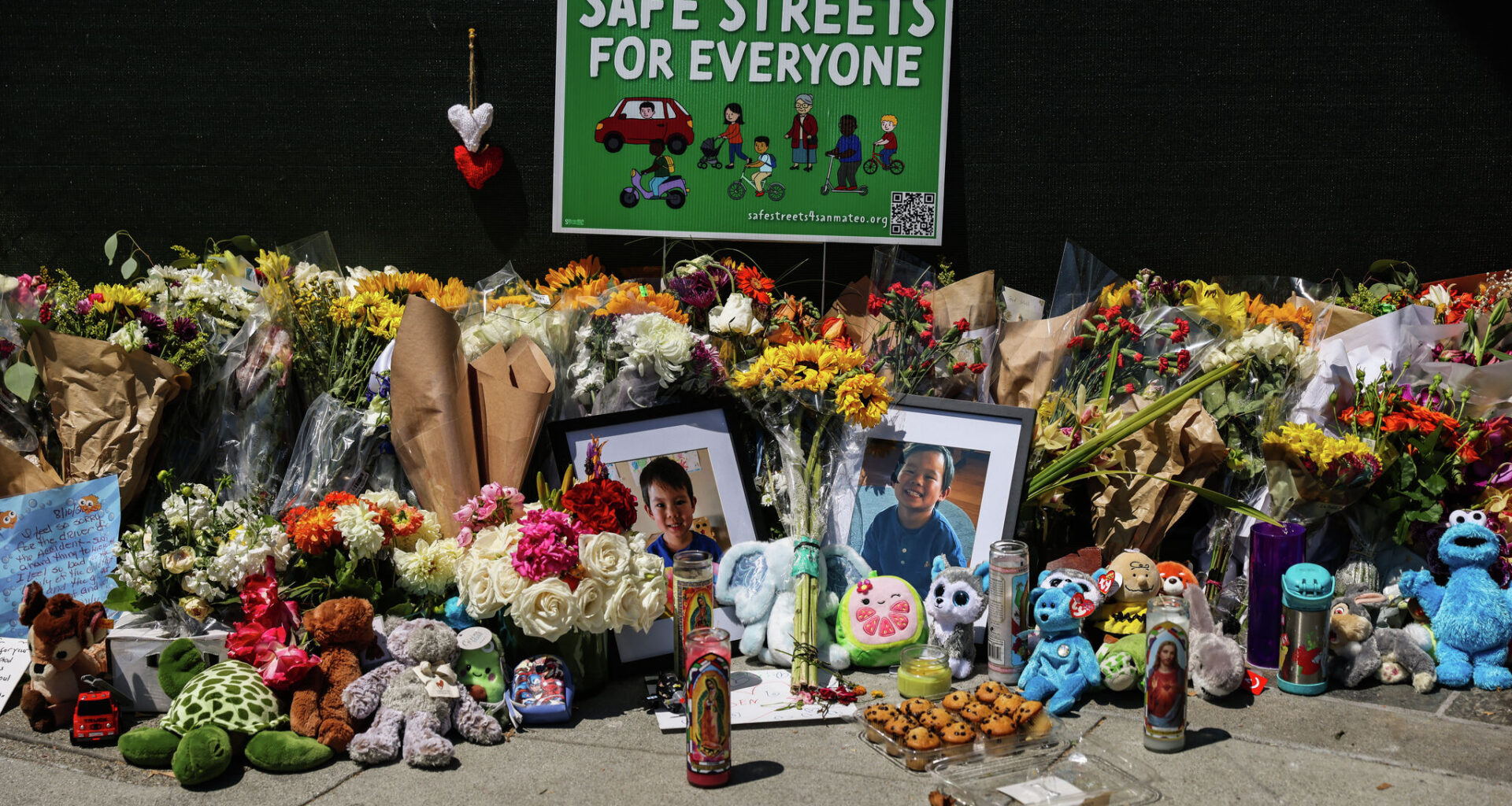
A memorial is seen outside a restaurant in Burlingame where a 4-year-old boy, Ayden Fang, was killed. Fang’s parents have sued the 19-year-old driver who struck Ayden, as well as an 11-year-old e-bike rider who allegedly triggered the chain reaction crash.
Gabrielle Lurie/S.F. Chronicle
A wrongful death lawsuit filed against an 11-year-old e-bike rider who allegedly triggered a fatal crash in Burlingame has drawn attention to a little-known feature of state law: Children can be sued in civil court, sometimes at surprisingly young ages.
The lawsuit alleges the crash last summer began when the 11-year-old, riding his e-bike with his 10-year-old sister on the back, collided with an SUV exiting a city parking lot. The 19-year-old driver then accelerated across the street and jumped the curb, killing 4-year-old Ayden Fang.
San Mateo County prosecutors declined to pursue charges. But last week, Fang’s parents filed a lawsuit against the 19-year-old driver, the 11-year-old e-bike rider, both sets of parents and the city.
Article continues below this ad
Legal experts said naming a young child as a defendant is rare but not unheard of. While the law does not set a universal minimum age for legal liability, courts have generally treated very young children as incapable of negligence — or acting without necessary care — and apply different standards when determining whether older children are legally responsible for harm they cause.
The Burlingame case comes as e-bikes have surged in popularity among children and teenagers across California, alongside a rise in young riders being treated in emergency rooms after crashes. Models can reach speeds of 20 miles per hour or more, and most don’t have a minimum age requirement, raising new questions for courts about how the law applies when minors operate fast-moving electric vehicles.
San Francisco Chronicle Logo
Make us a Preferred Source to get more of our news when you search.
Add Preferred Source
California courts have ruled that children under the age of 5 generally cannot be found negligent, though minors of any age may still be sued for intentional acts. Many courts follow a framework sometimes called the “Rule of Sevens.” Under that approach, children under 7 are presumed incapable of negligence, those between 7 and 14 are presumed incapable but that presumption can be rebutted, and those over 14 are generally presumed capable of negligence.
California courts have occasionally handled lawsuits involving young defendants. In a 1953 case, a woman sued a 4-year-old boy after he allegedly pushed her to the floor, breaking both of her arms. The court ruled that such a young child could be liable for battery, but he was too young to be negligent, because he could not foresee the consequences of his actions.
Article continues below this ad
There’s also a more practical reason why children aren’t usually sued.
“Kids are not sued very often because they don’t tend to have a lot of money,” said David Levine, a law professor at UC College of the Law in San Francisco who teaches courses on civil liability.
While plaintiffs can choose to sue only parents for a child’s actions, it can be a “strategic” choice to also name the child as a defendant, personal injury attorney Anh Phoong said. Parents’ direct liability can be narrower, and plaintiffs try to name everyone involved in the case. Phoong said she is not aware of any cases in which a child this young had been successfully sued, though such cases may be resolved quietly or without reaching higher courts.
Under California law, parents can be held responsible for up to $25,000 in damages caused by their child’s willful misconduct, or intentional wrongdoing, that a parent did not cause or allow through neglect.
“Typically you’d want to find some way to say the parents were negligent, and also responsible,” Levine said — for example, for failing to supervise or train their child on use of an e-bike, or, in firearms cases, for allowing the youth to have access to a gun.
Article continues below this ad
If the parents were found not at fault, Levine said, damages could be limited to the child’s assets. Those could include money held in a bank account the parents had set up for the child, and also future assets — judgments in civil suits can remain enforceable for as long as 20 years if the plaintiffs do the right paperwork, Levine said.
In California, punitive damages — amounts awarded beyond compensation for losses — are generally available only if the child was capable of understanding that the conduct was wrongful.
In practice, cases like these often turn on insurance coverage. Homeowners’ or renters’ insurance policies typically provide broad protections for household members, though the exact scope depends on the policy, and car crashes are generally handled separately.
“Most people in the United States who don’t have the kind of money to pay towards a claim have their coverage through a liability policy that comes from being homeowners or renters,” said Dorit Reiss, a law professor at UC Law San Francisco. “The child is the one in the hot seat, but it will be the insurance company’s lawyers or the parents’ lawyers representing them.”
In most cases, minors in California civil court aren’t required to attend most meetings. Instead, they must appear through another person, typically their parents or a court-appointed guardian, who acts on their behalf during the case.
Article continues below this ad
And unlike adults, children are judged under a different legal standard. Courts ask whether the child acted as a reasonably careful child of a similar age, intelligence and experience would have acted in the same situation.
However, there is a notable legal exception. When children engage in activities normally reserved for adults, such as driving, courts may hold them to the same standard as an adult.
“Children don’t get this latitude if they injure another person while engaging in an adult activity, like driving,” Stanford law professor Nora Freeman Engstrom said. “If a 12-year-old takes the family’s minivan out for a spin, the 12-year-old will be held to the standard of a reasonable driver, with no special accommodation given for her immaturity.”
Whether riding an e-bike qualifies as an “adult activity” remains unclear. In the Burlingame lawsuit, the plaintiffs argue that the 11-year-old was too young to operate the vehicle safely —a question that may ultimately determine how courts evaluate the child’s role in the crash.
Article continues below this ad
A case management conference is set for September. The defendants have not yet responded to the complaint or a request for comment.
Bob Egelko contributed to this report.