
Why this matters
School board members set budgets, approve policies and serve as districts’ connection to their communities for roughly 390,000 students across San Diego County.
A new state law has opened the door for school boards to give themselves large salary bumps.
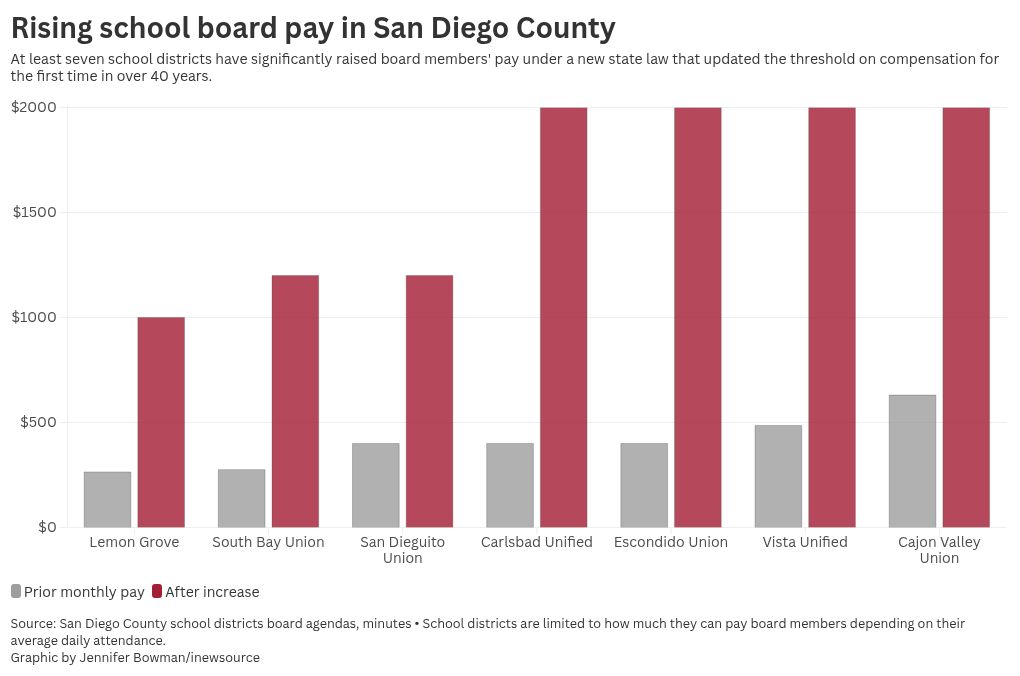
At least seven out of 43 public school boards in San Diego County have increased their pay after legislation that went into effect in January lifted the cap on how much districts can pay for the first time in more than four decades.
Some of them tripled their pay. More could soon vote to do the same.
These pay increases are happening as several districts lay off dozens of staff amid budget gaps and falling student enrollment.
How high can they go?: Previously, districts could pay board members no more than $60 to $1,500 a month, depending on their average daily student attendance. Now, small districts — those with 1,000 students or less — can pay each member up to $600, while the largest ones are capped at $4,500.
Who’s bumping up pay: School boards across the region have approved pay increases for themselves, including Vista Unified, Cajon Valley Union, Escondido Union, San Dieguito Union, Carlsbad Unified, South Bay Union and Lemon Grove.
In Vista, board members increased their monthly salary by more than 300% from about $490 to $2,000.
The board for San Diego Unified, the state’s second-largest school district, has yet to vote on a raise. Currently, the district provides trustees with about a $2,000 stipend each.
Zooming out: School board pay hasn’t kept pace with inflation and, even as members’ responsibilities have grown in recent years. That’s according to state Assemblymember José Luis Solache, D-Lynwoodwho authored the bill.
He has said that raising pay this way allows boards to be transparent about their decision, and that higher wages will also help ensure that these opportunities remain accessible to all.
An important job: Most school districts are governed by a board made up of three to seven members, each of whom are elected or appointed. They are essentially meant to be a bridge between the community and school system.
The board sets the direction for the district, establishes policies, determines how to allocate funds, approves vendor contracts and oversees the people who manage the day-to-day operations of the schools.
There’s no hourly work requirement set by school districts nor the state. But beyond public meetings, board members also often meet with constituents, participate in committee work, go to community events and continue their professional development.
Some locals say: Jose Lopez Eguino, a board member at South Bay Union, said it’s getting harder for many people — including himself — to make ends meet in San Diego, even with a good paying job. He said he’s been debating whether to run for reelection.
He argued that the decision could also allow a more diverse group of individuals to participate. More than half of school board members in California identified as white, according to a survey conducted by the state’s school board association.
Some experts say money is just one obstacle to serving on a school board, but by raising the compensation it will allow a wider range of people to run for that opportunity, KPBS reported.
Not everyone agrees: Some school boards have faced backlash for considering giving raises while essential school jobs are on the chopping block.
Vanessa Barrera, president of the teachers union at South Bay Union, said that a small bump is understandable, but the increase is significant.
The union recently reached a new agreement on pay with the district after nearly two years of negotiations. It was among many other teacher unions across the state fighting for contract changes, including higher pay and lower classroom sizes in special education.
“You guys made us fight, you didn’t give us anything out of the kindness of your heart, we had to work tirelessly,” Barrera said at a public meeting earlier this month.
Many districts are strapped for cash: From the largest to the smallest school districts, most in the county are facing financial challenges as student enrollment falls.
Experts expect enrollment numbers to worsen across the country in the coming years, which means fewer dollars for schools since funding for public education is tied to student attendance in California. Lower birth rates, high housing costs, changes in migration and an increased interest in alternative education are among the contributing factors.
Type of Content
News: Based on facts, either observed and verified directly by the reporter, or reported and verified from knowledgeable sources.