
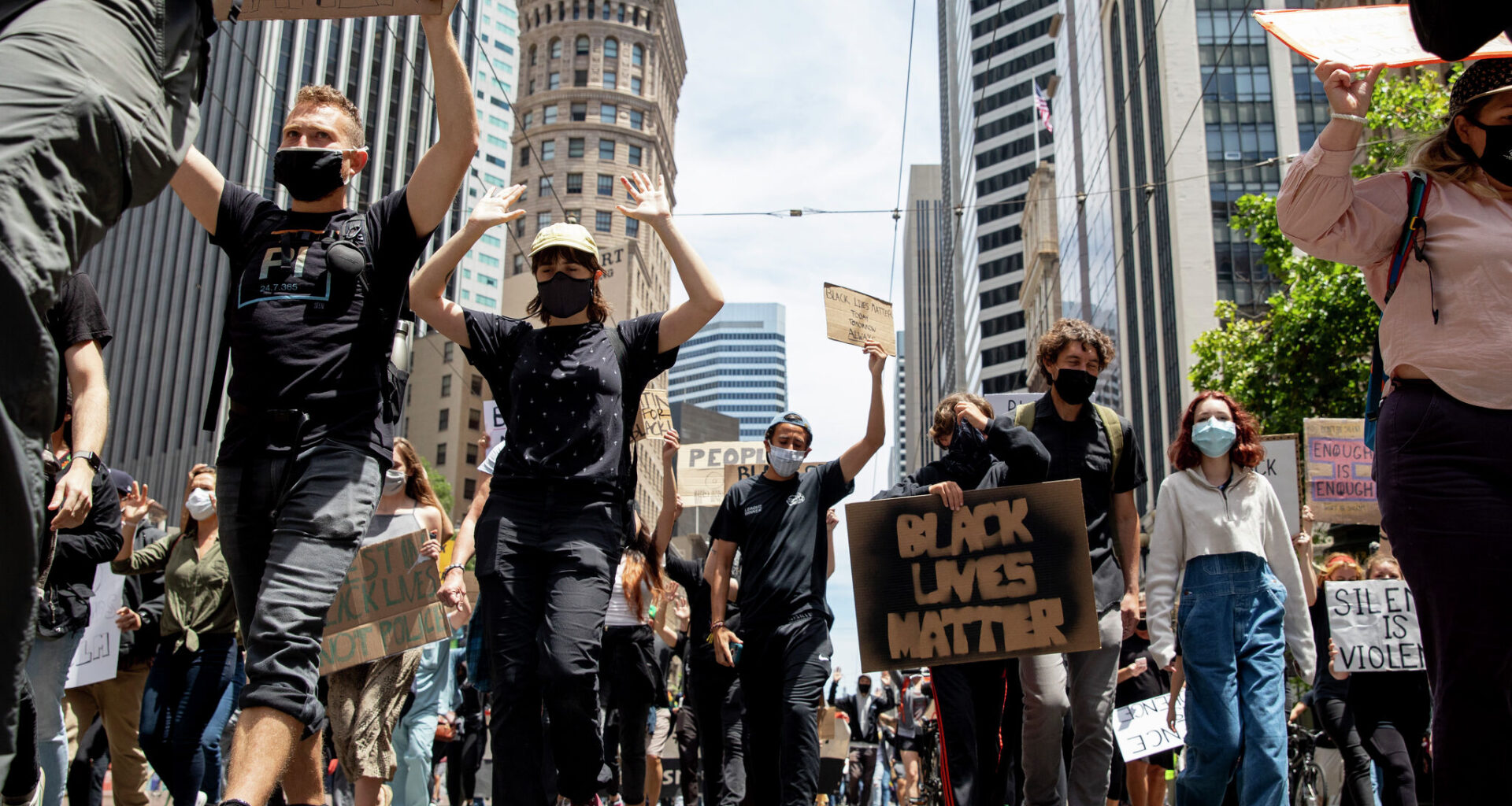
Hundreds of demonstrators march along San Francisco’s Market Street in June 2020 as part of Black Lives Matter, a decentralized movement driven by participants rather than a clear leader.
Jessica Christian/S.F. Chronicle
One of many gut punches in the recent investigation detailing sexual assault allegations Cesar Chavez came from the young accuser who told her mom after she said the civil rights icon assaulted her: “Cesar Chavez is just a man.”
The young activist understood that truth decades before the #MeToo movement revealed that countless lionized leaders in virtually every industry had used their power to sexually abuse women and compel them to remain silent.
“There are comparable or similar horrors in basically every American institution in our history: politics, religion, business, academia, entertainment, media,” said David Meyer, a professor of sociology at UC Irvine and author of “How Social Movements (Sometimes) Matter.” “So you wouldn’t expect interest groups and social movements to be all that different, even if they claim that they want to be.”
Article continues below this ad
But the era of iconic movement leaders has largely faded.
Meyer said he sometimes hears the frustrations of people who question why the pace of social progress is slow and “ascribe that to the absence of the charismatic leader. But (having an iconic leader) is a double-edged sword.”
San Francisco Chronicle Logo
Make us a Preferred Source to get more of our news when you search.
Add Preferred Source
While it can be easier for the public — and donors — to be drawn to a magnetic leader, being too reliant on one is a reason contemporary social movements often prefer to be leaderless or to decentralize power. The Sunrise environmental movement of young climate activists, Black Lives Matter and Indivisible are among those that empower local activist groups to carry their message instead of relying on a single figurehead.
Plus, this generation of female activists is much more willing to call out abusive men than the women who suffered silently — putting their movement’s health before their own — during the social movements of the 1960s.
Article continues below this ad
In a statement posted online, Dolores Huerta, who co-led the farmworkers movement with Chavez on a seemingly equal basis for decades, said she kept her secret for the past 60 years “because I believed that exposing the truth would hurt the farmworker movement I have spent my entire life fighting for.”
Contemporary activists, meanwhile, are concerned that “if the leader becomes discredited, the movement collapses,” said Rory McVeigh, director of the Center for the Study of Social Movements at Notre Dame University.
A crowd gathers at San Francisco’s Union Square last March for International Women’s Day — Unite and Resist, a leaderless event.
Yalonda M. James/S.F. Chronicle
That nearly happened with the Women’s March, which organized one of the largest national demonstrations in history the day after President Donald Trump was first inaugurated in 2017. In the days thereafter, a coordinated Russian bot campaign targeted Linda Sarsour, one of the four women who co-led the organization, with specious online attacks aimed at crippling the fledgling movement. A 2022 New York Times investigation found that “Russia’s troll factories and its military intelligence service put a sustained effort into discrediting the movement by circulating damning, often fabricated narratives around Ms. Sarsour, whose activism made her a lightning rod for Mr. Trump’s base and also for some of his most ardent opposition.”
The attacks splintered the Women’s March, and the ensuing controversy kneecapped its initial momentum.
Article continues below this ad
The Russians were following a playbook U.S. officials had established decades earlier. For several years in the mid-1960s, the FBI conducted extensive surveillance of the Rev. Martin Luther King Jr., hoping to gather compromising information that would hurt the civil rights movement. King wasn’t alone. The bureau’s Cointelpro program, which ended in 1971, conducted covert and illegal surveillance on many of that era’s leaders it considered subversive, including Malcolm X, the Black Panthers and Chavez’s United Farm Workers.
Aimee Allison, founder of She the People, an organization that elevates women of color in politics, said today’s young activists learned from the previous generation, which was “expected to make a Faustian bargain that if you want this (movement) to advance, you have to protect this leader.”
Allison said that because social movements often “attract a lot of true believers who hold so tightly to a shared vision,” many find themselves in that predicament. But that is changing.
“They’re saying, ‘You know what? We can hold on to a vision of a society that’s transformed in the way that we want, and we can demand accountability for people who abuse other people who commit these crimes. We can have both,’” Allison said.
Over time, movements began to de-emphasize having a sole representative. When the Occupy movement burst onto the scene more than a dozen years ago, calling attention to the broken political and economic systems that favor the 1% of richest Americans, its organizers made a point of saying the movement did not revolve around a single person. Instead, its motto emphasized: “We are the 99%.”
Article continues below this ad
Initially, it worked well. The Occupy protests were structured as a leaderless, highly democratized body, where decisions were made by consensus. While that was attractive to those repelled by traditional politics, the structure made it a challenge to collaborate with more traditional organizations, such as labor unions.
Protesters march through downtown Oakland in November 2011 as part of Occupy Oakland, a leaderless organization.
Michael Macor/S.F. Chronicle
The movement began to falter after splinter groups repeatedly hijacked its largely peaceful demonstrations by breaking windows of small businesses, lighting fires and clashing with police. An Occupy-led general strike in Oakland in 2011 drew national attention after splinter groups caused damage in the city’s downtown.
The clash highlighted a downside of leaderlessness movements: Nobody takes responsibility when a person or group causes damage in the name of the group — or confronts them by demanding that they stand down. The events in Oakland also showed that it is harder to control a group’s message when there is no leader. Ultimately, the repeated chaos repelled more people from joining the protests and broadening the movement’s appeal.
Article continues below this ad
Allison said the good news is that the young women of color she works with now tell her that they understand that older activists internalized a message that they should make a sacrifice on behalf of something larger, even if it meant enduring abuse or covering up a crime. Younger activists tell her that they interpreted that to mean, “You sacrifice your dignity, your safety or even your body. They say, ‘I’m not willing to do that.’”