
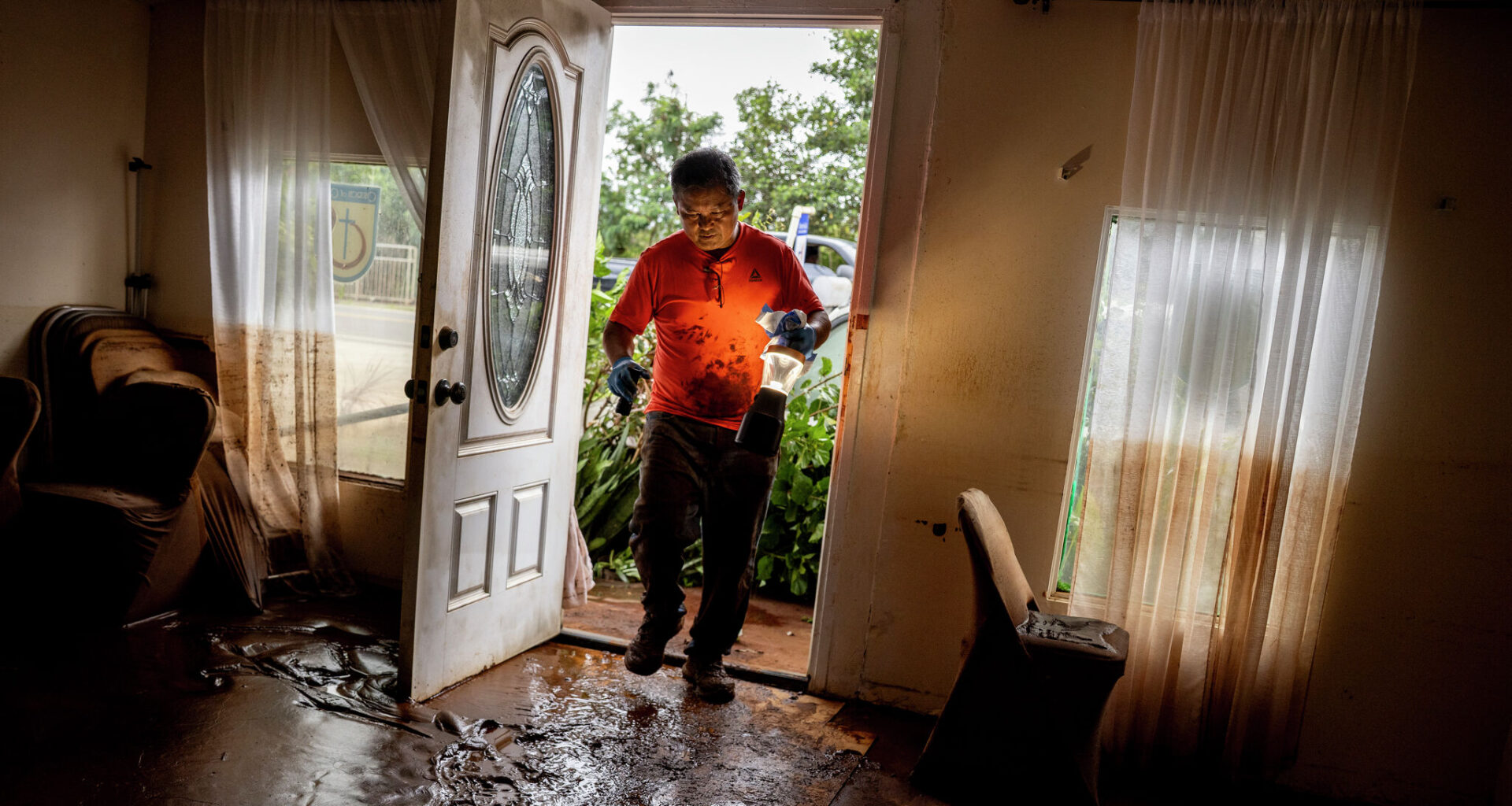
Glenn Duquez, associate pastor at the Church of God Jesus Is Alive Fellowship, carries a lamp into the mud-riddled church building to clean up Saturday after the fast-moving flood in Haleiwa, Hawaii, on the island of Oahu.
Stephen Lam/S.F. Chronicle
Vehicles washed away by the flood sit on a heavily damaged road Saturday in Haleiwa, Hawaii.
Stephen Lam/S.F. Chronicle
As Hawaii emerges from several days of punishing storms and surging floodwaters that shoved homes off their foundations, nearly toppled an 85-foot dam and forced 5,500 Oahu residents to flee, the state is eyeing more than $1 billion in needed disaster relief and questions about whether the Trump administration will provide it.
If California’s experience is a barometer, Hawaii may have a long and frustrating recovery road ahead.
As recently as January, Gov. Gavin Newsom was still clamoring for federal aid to rebuild homes, schools, roads and essential services that wildfires in Los Angeles County decimated more than a year ago.
Article continues below this ad
In December, he was in Washington, D.C., telling congressional leaders that thousands of wildfire survivors in Pacific Palisades, Altadena, Pasadena, Malibu and other parts of Los Angeles County were still waiting on the Trump administration’s formal issuance of a request for long-term recovery aid that Congress could then authorize.
Linda Griffith wades through a flooded yard in Haleiwa, Hawaii, on Saturday.
Stephen Lam/S.F. Chronicle
Newsom said federal officials refused to meet with him during the trip and that President Donald Trump’s “promise to ‘take care’ of survivors was clearly a lie.”
San Francisco Chronicle Logo
Make us a Preferred Source to get more of our news when you search.
Add Preferred Source
Newsom said the Federal Emergency Management Agency has delivered $5.7 billion to California for fires that killed 31 people and destroyed more than 31,000 homes.
Article continues below this ad
The UCLA Anderson Forecast last year estimated that the Palisades and Eaton fires caused between $95 billion and $164 billion in property and capital losses, and that employees and businesses in the affected areas could lose nearly $300 million in wages.
As of Sunday morning, Trump had not publicly commented on the storms in Hawaii, continuing a pattern of withholding statements of sympathy or support to Democrat-led states reeling from disaster.
His TruthSocial profile Sunday morning was flecked with posts disparaging Senate Minority Leader Chuck Schumer, Democratic Senate candidate James Talarico and former FBI Director Robert Mueller, who investigated Russia’s attempts to interfere in the 2016 election and whose death Friday Trump celebrated.
Scattered to widespread thunderstorms and downpours were forecast to continue across Maui, Molokai and Lanai on Sunday, raising flood risk in areas that had already received historic rainfall in recent weeks. Oahu, while not completely dry, appeared to be spared from the strongest storms, though any additional rain would “exacerbate the ongoing flooding,” the National Weather Service said.
Two teenagers surf Saturday next to a disabled vehicle in floodwater in Waialua, Hawaii.
Stephen Lam/S.F. Chronicle
Kahului Airport on Maui has received 20 inches of rain since March 1, already its wettest month on record and nearly 2 inches more than its annual average. This has been Honolulu’s wettest month in two decades.
Article continues below this ad
Flash flooding remained possible “across the rest of the island chain through Sunday,” the weather service said. “Rock and mudslides are also possible in areas of steep terrain.”
FEMA has acknowledged the situation in Hawaii, posting Saturday morning on X that the agency was “monitoring the severe flooding in Oahu” and coordinating with Hawaii Gov. Josh Green and statewide emergency officials. “Our teams on the island are embedded and ready to support if needed to help safeguard lives and communities,” the post read.
Sen. Markwayne Mullin, R-Okla., Trump’s nominee to take over the Department of Homeland Security from fired Secretary Kristi Noem, said at his confirmation hearing last week that he would speed up FEMA’s process for releasing disaster aid by overturning Noem’s policy requiring her personal approval for payouts.
Hawaii Gas workers remove a washed-away gas tank Saturday after the fast-moving flood in Haleiwa, Hawaii.
Stephen Lam/S.F. Chronicle
Still, Green will be seeking help for his state from FEMA’s new top official in charge of disaster recovery relief.
Article continues below this ad
Gregg Phillips, an election denier who disputed Trump’s 2020 loss and was appointed in December, is under scrutiny for claiming on multiple podcasts that he was once teleported against his will to a Waffle House, CNN reported Friday.
Last summer, California and 19 other states sued FEMA for abruptly canceling a pre-disaster mitigation program that Congress authorized to help communities prepare for natural disasters and reduce post-recovery costs.
In December, a federal court agreed that the program’s termination was unlawful, granting the states’ motion for summary judgment requiring the government to resume it. The judge followed that up with an order