
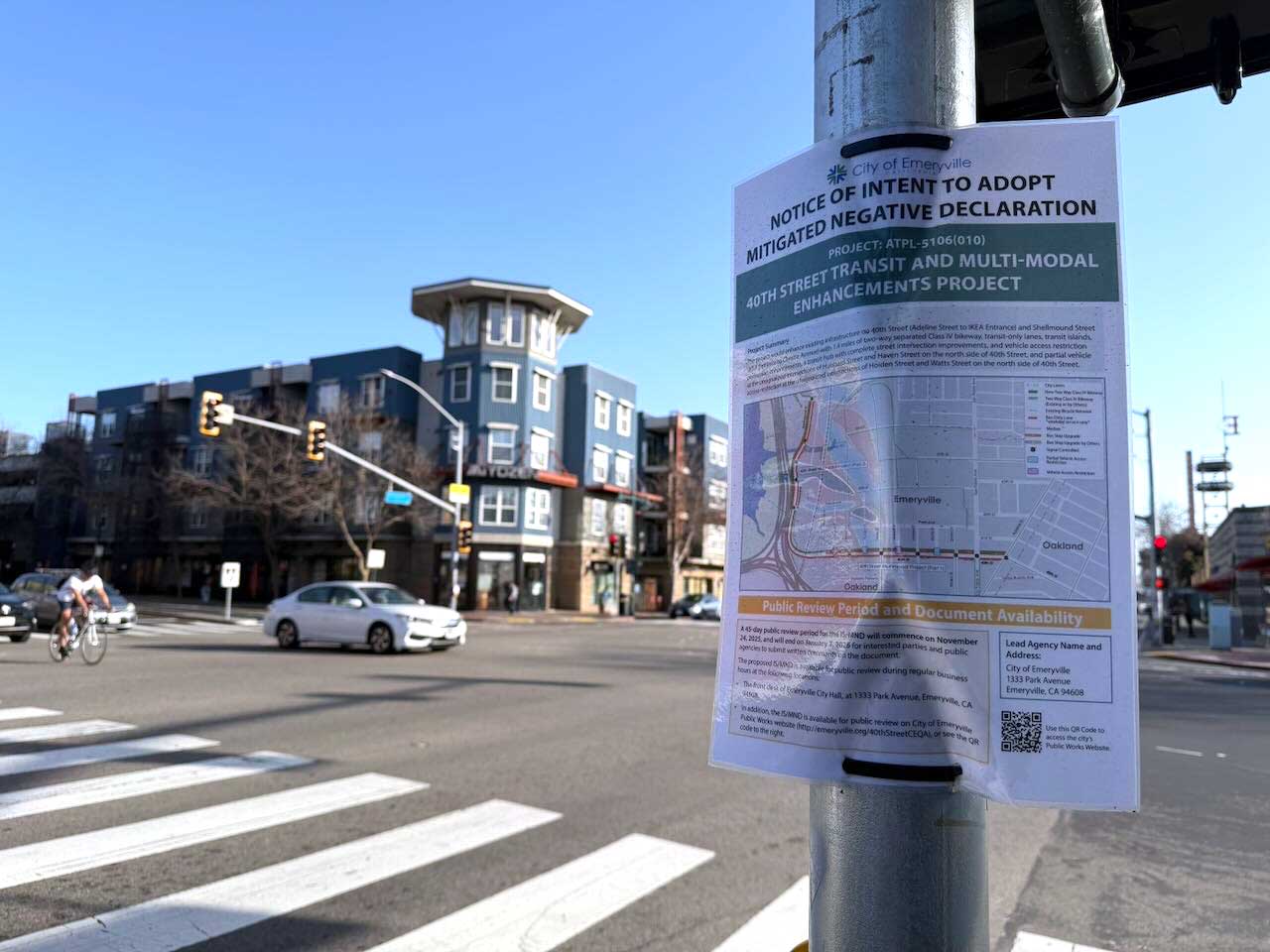
One of the more eventful and well attended city council meetings over the past year was held on Tuesday with two items of deep concern to the community. These included a Special Study Session for the long-delayed Emeryville Arts Center as well as a vote to approve the environmental report to advance the contentious 40th Street Multimodal project.
The meeting also had an active public comment period with commenters criticizing the city’s community grant program and “complaint driven” enforcement.
STUDY SESSION: Emeryville Arts Center [7:28]
The Emeryville Arts Center returned to Council for a study session following last year’s “feasibility” discussion, where staff was directed to pursue a comprehensive fundraising strategy.
The long-running project dates back to 2006, when the City acquired the former Albert Wright Screw Company building. In the two decades since, the effort has faced repeated setbacks and shifting visions. During that time, estimated costs have climbed dramatically—from roughly $14 million in 2009 to more than $50 million today—raising new questions about its viability.
To reassess the path forward, the City engaged strategic consulting firm CCS Fundraising to evaluate potential operating models and fundraising strategies.
Community Development Director Chad Smalley summarized the findings, cautioning that the $50 million target is not currently achievable—but that an incremental approach could still succeed.
“Build the organization first and then the facility”
The recommendation represents a significant shift from prior efforts, proposing the creation of a hybrid City–nonprofit entity to lead fundraising and programming before any permanent facility is built.
Establishing this entity would require an initial investment of approximately $350,000–$550,000 over two years, primarily to fund an executive director position and begin organizational development.
Councilmember David Mourra described the challenge as a familiar “chicken-or-the-egg” dilemma—needing a facility to attract donors, but needing donors to build the facility.
“This is a big opportunity for us.” Artist Community Weighs in
Members of the local arts community, including participants from the Arts Center Advisory Group, voiced strong support for the new direction.
Longtime resident and artist Vicki Jo Sowell framed the shift as essential to unlocking outside funding:
“This is a big opportunity for us… If we don’t have a nonprofit, we can’t go to Google… and ask for money.”
Speakers also encouraged the City to think pragmatically—suggesting the use of interim space for programming and meetings, and leveraging existing efforts like the Rotten City Cultural District and the Annual Celebration of the Arts to build momentum.
Cautious Buy-In from Council
Councilmembers generally embraced the “organization-first” approach, viewing it as a more realistic and strategic path forward.
Councilmember Kalimah Priforce noted that a city branding itself as the “City of Art and Innovation” should take a more innovative approach to solving the problem.
Mayor Sukhdeep Kaur emphasized the need for accountability, suggesting clear milestones to ensure any initial investment delivers measurable progress. She also emphasized that the Arts Center’s success depends on a broader, coordinated strategy—linking funding, transportation, and local business vitality—rather than treating it as a standalone project.
By the end of the discussion, Council expressed support for moving forward with the concept, including the formation of a temporary, non-fiduciary steering group to help guide development of the new entity.
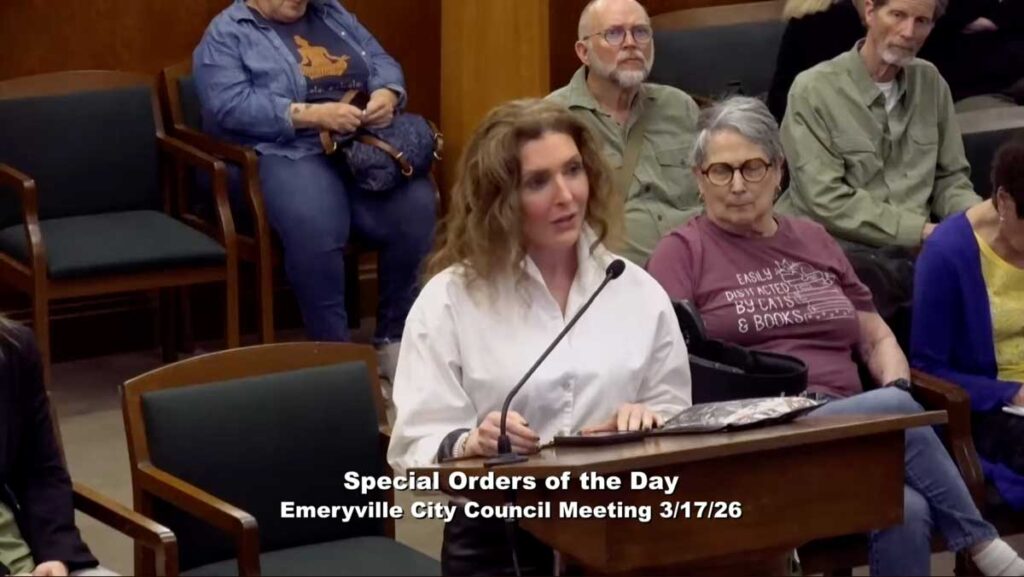 Public Art Committee Chair Taryn Walker presented the body’s annual report.
Special Orders of the Day: EDAC and PAC Committee Annual Reports [53:57]
The Economic Development Advisory Committee (EDAC) reported a strong 2025 focused on launching a BIPOC small business support pilot program, advancing a citywide marketing and branding initiative, and strengthening partnerships like the Emeryville Commerce Connection, which has grown membership and programming. For 2026, EDAC will continue refining the small business support program, launch a new website and marketing campaign to promote Emeryville as a hub for “art and innovation,” and focus on reducing commercial vacancies, improving business security, and supporting broader economic development efforts.
The Public Art Committee highlighted a 2025 centered on integrating art into everyday spaces, including the large-scale 40th Street streetscape project featuring community-informed installations, new murals and sculptural works, and ongoing programs like the bus shelter art series. The city also expanded its permanent collection and artist partnerships. In 2026, priorities include completing the 40th Street installations, continuing grant and residency programs, advancing restoration projects, and establishing a maintenance plan to preserve Emeryville’s growing public art collection.
The Women’s History Month proclamation recognized the historic and ongoing contributions of women across all sectors, with a 2026 theme centered on sustainability and leadership. Councilmembers celebrated local women leaders and entrepreneurs while also emphasizing inclusivity—acknowledging all working women—and reaffirmed the city’s commitment to equity, opportunity, and community recognition.
PUBLIC COMMENT [1:23:06]
Community Grant Panel Gender Makeup Criticized
Several members of the public addressed the dais during the open public comment period raising issues of concern to them.
The first speaker opened with criticism of Emeryville’s Community Promotions Grant program pointing to a lack of gender representation in decision-making. “The committee… was made up of only men… representation in these decisions really matter[s], especially when it comes to our public funds.”
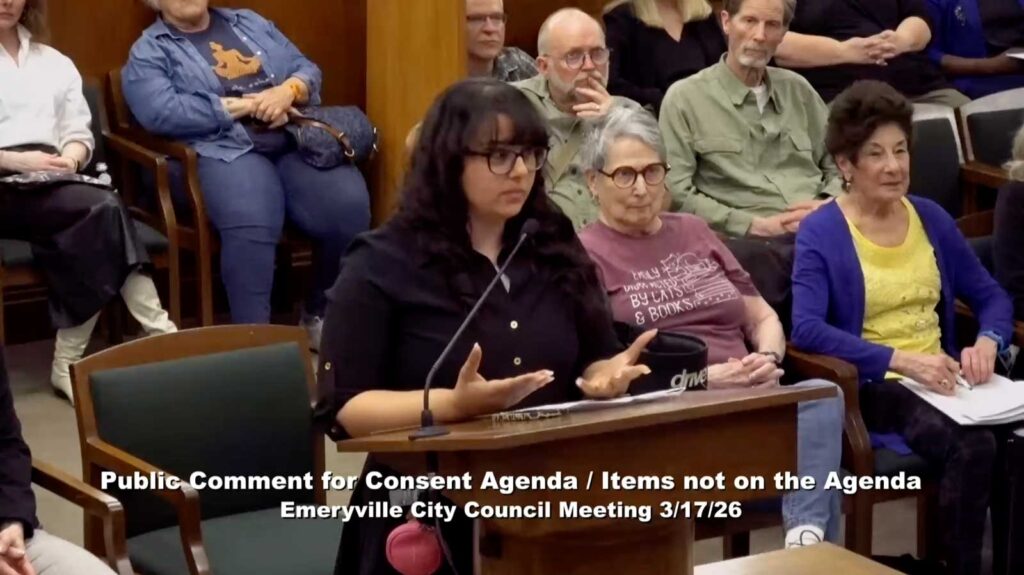 A public commenter criticized the makeup of the community grant subcommittee for being all men.
That critique framed the issue less as a single oversight and more as a values mismatch—particularly in a city where women make up a majority of the population.
Longtime resident and committee member Vickie Jo Sowell shifted the criticism toward scale and resourcing, arguing the program is simply too small to meet demand. “It’s still the same amount of money… about $78,000… and so many people [are] applying… we need to increase the money.”
Together, those comments painted a picture of a grant program that is both underfunded and insufficiently representative, limiting its ability to equitably support community initiatives.
“Intentions Must Align with Outcomes” — Small Business Owner Says City Is ‘Shutting Her Down’
Public comment took a pointed turn as a local small business owner described what she sees as a disconnect between Emeryville’s pro–small business messaging and how its rules are enforced in practice.
Choc’late Mama Cookies proprietor Empress Kehinde Koyejo, who began operating out of a live-work unit at The Emery development, said her business has effectively been shut down since December pending what she described as an ongoing “administrative review.”
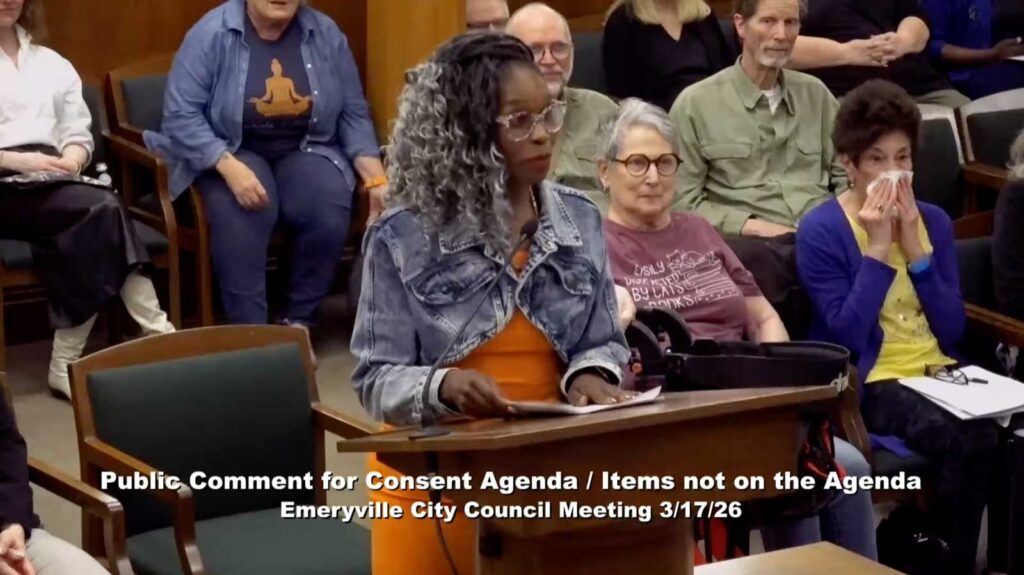 Choc’late Mamma Cookie Proprietor Empress Kehinde Koyejo spoke out during Public Comment.
Framing her situation as more than a one-off dispute, Koyejo argued it reflects a broader misalignment in the City’s system—where spaces are marketed for activation but constrained in practice:
“How can a space be… designed, approved and marketed for retail and food use and then treated as if those uses do not belong?”
She also pointed to complaint-driven enforcement shaping outcomes:
“The outcome is no longer based on what is permitted… [but] who applies the most pressure.”
Supporters described her operation as a low-impact, community-oriented use aligned with live-work zoning, but constrained by outdated definitions and inconsistent oversight:
“A small-scale low-impact community space… is being penalized by outdated definitions and repeated complaints.”
Speakers broadly argued that while Emeryville promotes small business and innovation, unclear rules and reactive enforcement can leave those same businesses at a disadvantage—raising questions about whether the system is functioning as intended.
ACTION ITEM: 40th Street Multimodal Project Environmental Clearance Approval [1:42:30]
The meeting ended with discussion and vote of approval of the “Initial Study/Mitigated Negative Declaration,” or IS/MND, a wonky term for identifying environmental concerns and prescribing remedies for them. The document is considered less comprehensive than an Environmental Impact Report (EIR) and does not address potential economic impacts of the project.
Within the 478 page document are 55 letters many expressing opposition or skepticism of the project. Among the higher profile voices to oppose the project include Nordstrom Rack, The owner of the Peet’s Coffee property and a former BPAC and EDAC member who called the project “overkill.”
The idea for the redesign of 40th goes back years with the Planning Commission weighing in on the design in 2018. At the time, many of the commissioners were against the idea of a two way cycle track. Commission Chair Steven Keller, an avid bike commuter, called cycletracks “dangerous” and warned that drivers didn’t understand them.
Despite opposition by some, The initial design concept was approved by council in 2019 when it was composed of John Bauters, Ally Medina, Dianne Martinez, Christian Patz and Scott Donahue (None who are on council today).
2017 – 2021 Collision Data Questions Notion 40th St. is “Dangerous”
Supporters of the project have typically portrayed 40th Street as “dangerous” with safety improvements needed. The available collision data appears limited, with no severe injuries recorded during that span.
None of the five collision “hotspots” identified in the city’s latest Active Transportation Plan are along 40th Street (hotspots are defined as locations where three or more Severe Injury bicycle or pedestrian-related collisions occurred).
The five hotspots identified by the city include:
62nd Street and Horton Street
Powell Street and Christie Avenue
Powell Street and Doyle Street
Stanford Avenue and Hollis Street
43rd Street and San Pablo Avenue
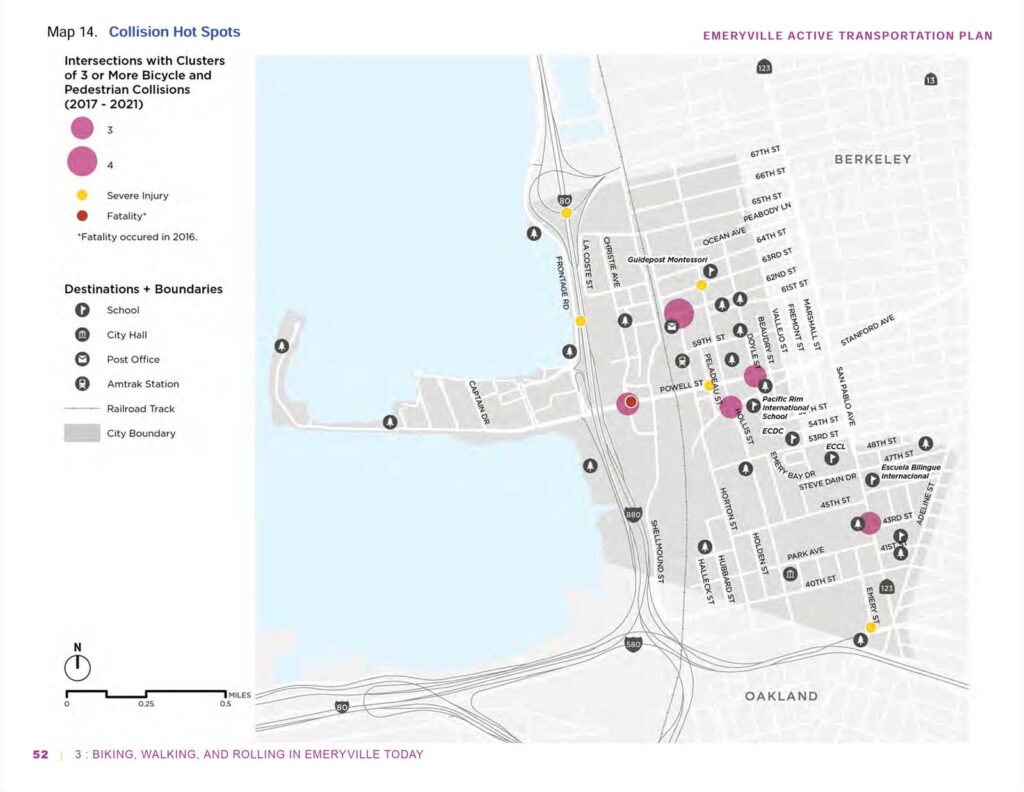
Bike collision data from 2017 -2021 shows a single collision that resulted in a minor injury near Hubbard St. Pedestrian data show two collisions (one near Emery St. and one near Adeline St.) that both resulted in minor injuries. There were zero “severe” injuries logged over this span.
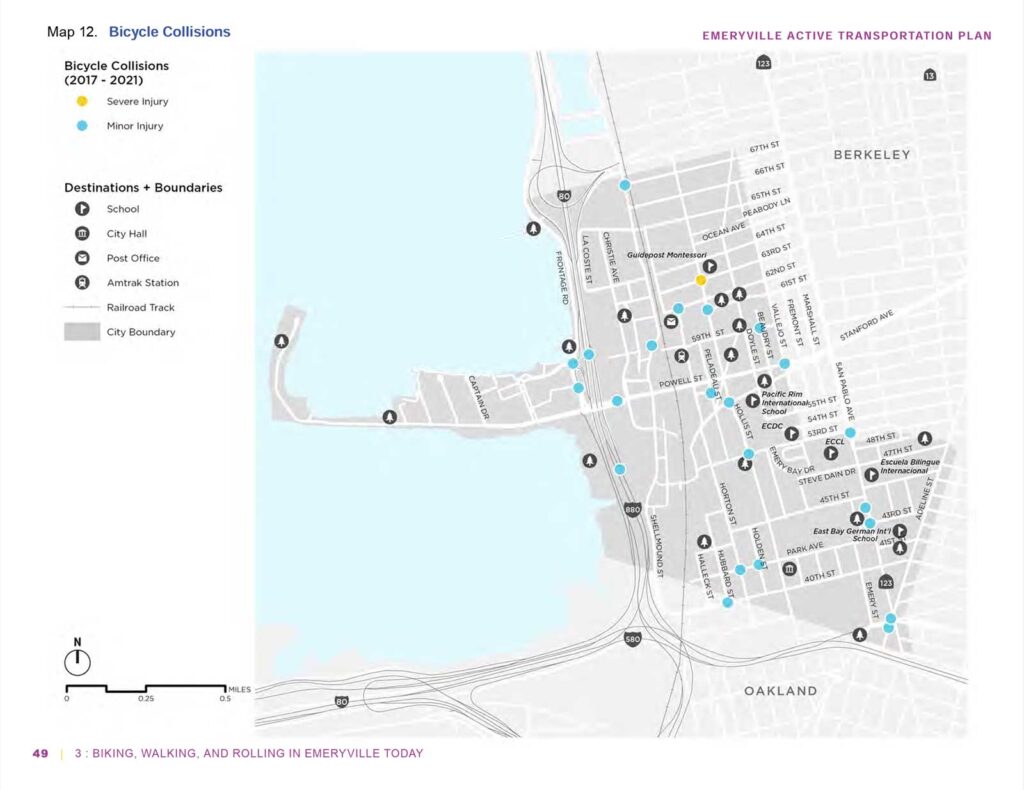 Bicycle Collision Data (2017-2021)
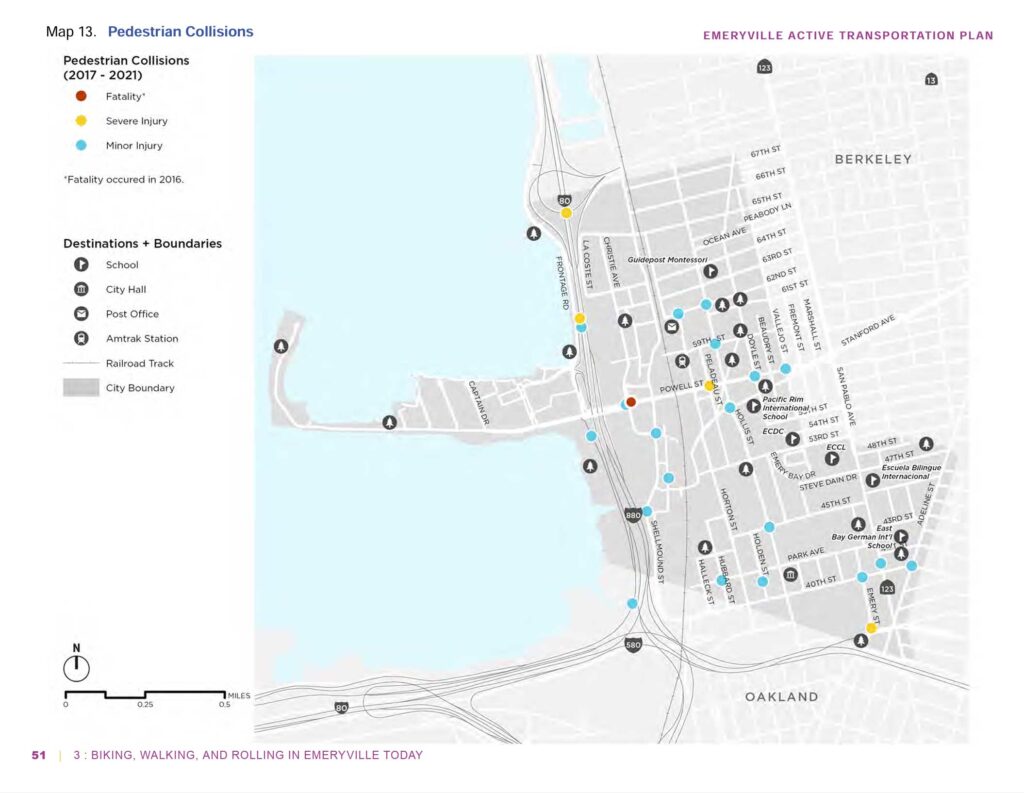 Pedestrian Collision Data (2017-2021)
Bike East Bay & Planning Commissioner Lead Charge for Project
One of the most consistent and vocal supporters of the project has been Planning Commissioner Sam Gould. Gould touted his involvement with the project while running in a failed bid for a city council seat in 2024.
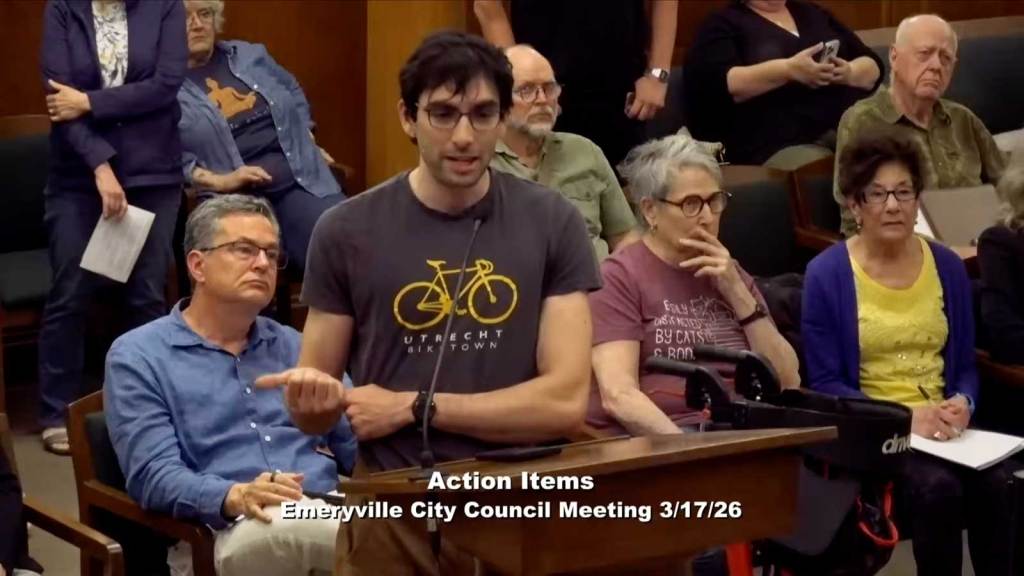 One of the project’s most vocal supporters has been former BPAC member and current Planning Commissioner Sam Gould.
Gould cited incidents where both he and his partner were injured along the corridor in separate incidents with Gould’s injury occurring at the Intersection of 40th & San Pablo Ave. In a follow up reddit post, Gould referred to 40th as “one of the city’s most dangerous corridors.”
Opposition: Former Council members, Business and Property Owners, Seniors
While speakers in favor heavily skewed younger and male, the coalition of opponents were a broad array of seniors, business owners and longstanding members of the artist community.
Former Councilmember and AC Transit Boardmember Greg Harper expresses strong skepticism regarding the feasibility of proposed bus lanes, arguing that AC Transit lacks both the passenger demand and the financial resources to justify the infrastructure. “If you pass this, you’re going to get three buses in each direction every half hour. That’s going to be embarrassing.”
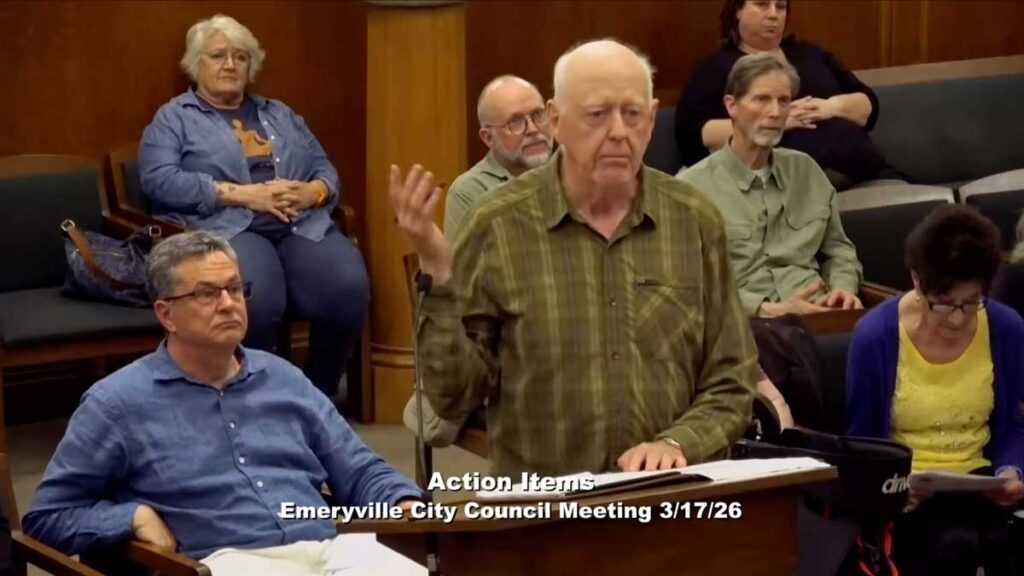 Former Emeryville councilmember and AC Transit Board Member Greg Harper expressed skepticism that passenger demand would warrant dedicated bus lanes along the corridor.
Scott Donahue, who served on council from 2014-2022 and remains an avid biker, expressed his preference for making the parallel Park Avenue the preferred bike route pointing to fewer lights, ample tree shade and dramatically less traffic. “If somehow you could retain all of that fabulous public money and put the biking onto Park Avenue. You would solve so many problems plus be able to improve 40th Street and actually increase traffic flow.”
Senior Civil Engineer Ryan O’Connell, tasked with presentation and addressing council’s questions, noted that 40th has been the direction staff has been directed to pursue and that changing this might impact grant funding already procured for the project.
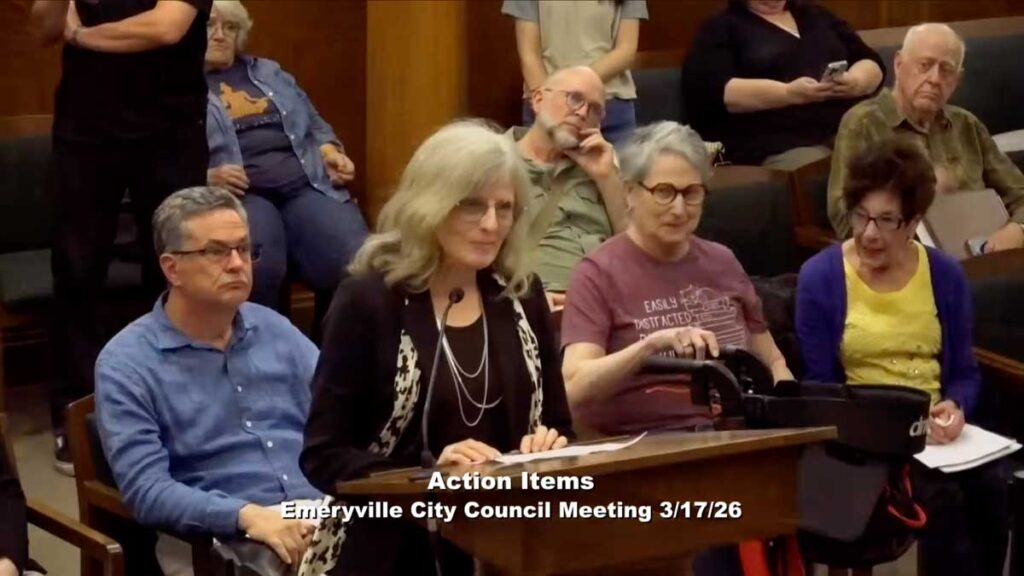 Representatives of larger businesses turned out to criticize the project.
Laura Vrostel, Senior Asset Manager for Federal Realty and manager of the East Bay Bridge Shopping Center, urged the City Council to balance transit goals with the economic health of the local business community. She reminded those behind the dais that businesses provide the sales, license, and property tax revenue that supports many of the City’s services and projects.
Vrostel cautioned that although the shopping center was doing well, it was not without its challenges. “Within the last year or two, we have lost an anchor tenant due to security problems, and we fear we may lose another anchor tenant because of this project.”
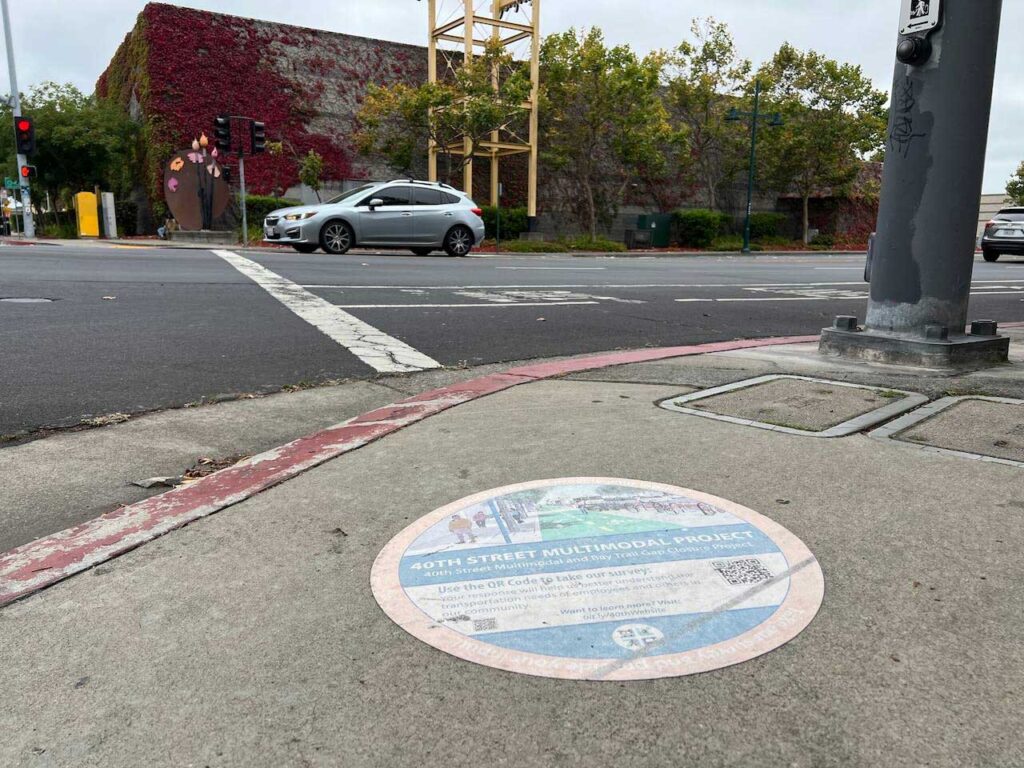 Outreach for the project included these sidewalk decals.
Tokyo Central, Sutter Health not accounted for in Traffic Counts
One of the biggest revelations of the evening was that the traffic study conducted for the project did not incorporate projected impacts from either Tokyo Central nor the Sutter Health campus. While the plans for Sutter Health are more recent and have not been formalized, the grocery space has been known since 2021.
”Your responsibility includes reassessing prior decisions when new information emerges. This is one of those moments,” summarized one commenter.
Mourra, Welch and Solomon Express Unified Support
Councilmember David Mourra led off council discussion by emphasizing outreach and the project’s core goal—moving people safely and efficiently—framing it as a long-term investment despite trade-offs:
“I’ve reviewed the project documents… and I’m convinced that this project succeeds in this goal… we’re actually setting ourselves up for success in the future.”
Councilmember Courtney Welch echoed that support, pointing to safety data and the need to design for all users: “This redesign… is based in data and best practices… I understand that change can be uncomfortable but this is such a necessary investment for safety for our community.”
Vice Mayor Matthew Solomon highlighted strong external funding and potential economic upside:
“This is first and foremost a safety project… sales tax actually goes up when you introduce those improvements… this is going to be a net positive for our community.”
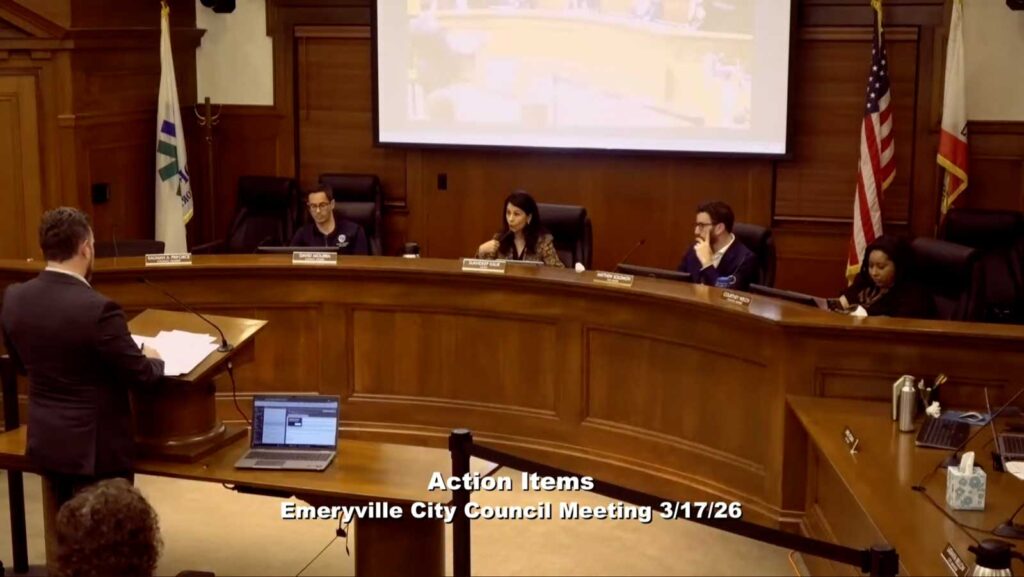 Mayor Kaur questioned the usefulness of the traffic study that did not account for a Grocery Store at Bay Street or the 200-bed Sutter Health Hospital.
Mayor Kaur: “I do not feel comfortable voting for this project as is.”
Mayor Sukhdeep Kaur remained unconvinced, citing analytical gaps and unresolved impacts including the recent opening of Tokyo Central and pending Sutter Health project and unknown impacts on them. “I think that it warrants at least some type of study.”
Kaur also validated the concerns of the many seniors that turned out to protest the project. “There have been a lot of people in this room who happen to live on 1440 who are disabled. And I think their safety is also of paramount importance.”
“Two former mayors, one of whom sat on this council when this project was being considered, are in this room today, and have discouraged the public or this council from moving forward with the project as is. I do not feel comfortable voting for this project as is.”
Resolution Passes in split vote
Despite Kaur’s opposition, the measure passed with a 3-1 vote (Priforce recusing himself because of potential conflict of interest).
The next step for the project is for the city engineer to advertise it for bids. Construction, barring further challenges, could start as early as this year with a completion timeline extending beyond two years.
Project cost estimates have been refined over the past year, moving from north of $30 million to a current projection of $34 million.
The complete agenda for the meeting can be viewed on Emeryville.org.
Related

Was this story informative to you?
Please consider making a recurring contribution at any level you feel comfortable with to help sustain local news for the Emeryville community.
You have Successfully Subscribed!